Stop Warranty Denials With These Coastal Metal Roofing Specs
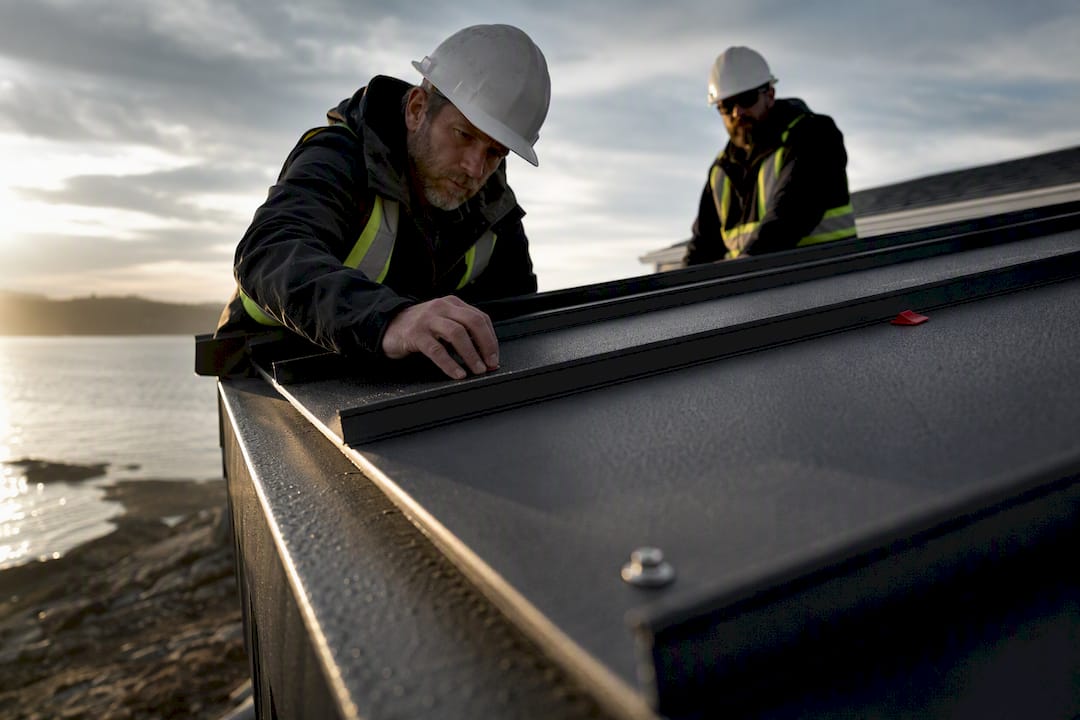
For contractors: a spec checklist showing when to use aluminum, 70% PVDF finishes, and 316 stainless fasteners within 1,500 feet of open water.
For true saltwater exposure, roughly within 1,500 feet of open water, specify aluminum standing seam panels with a PVDF finish and 316 stainless (or aluminum-compatible) fasteners. Get the coastal warranty language, fastener compatibility, and wind rating in writing before you order anything.
TL;DR:
- Use aluminum panels with PVDF coatings within approximately 1,500 feet of open saltwater for optimal corrosion resistance.
- Select stainless steel fasteners rated for marine environments, with 316 stainless recommended for direct oceanfront installations.
- Confirm tested wind uplift performance matches the specific assembly, clip spacing, and fastening pattern used in the actual project.
- Store panels properly protected from salt spray before installation, and ensure all edges are sealed to prevent corrosion initiation.
- Always specify fastener and clip finish details explicitly in contracts to avoid galvanic corrosion and warranty disputes.
Table of Contents
- Coastal Metal Roofing Materials and Panel Profiles That Actually Hold Up
- Which Coating System Survives Salt Air Best?
- Fastener and Flashing Compatibility: Where Coastal Roofs Actually Fail
- Wind Ratings, Tested Assemblies, and Coastal Warranty Fine Print
- Installation Practices That Prevent Coastal Roofing Failures
- Coastal Roofing Maintenance: What to Inspect and How Often
- What Contractor-Grade Coastal Roofing Experience Actually Looks Like
- An Editorial Take on Coastal Roof Specification
- Getting the Right Coastal Panels Without the Guesswork
- Sources
Coastal Metal Roofing Materials and Panel Profiles That Actually Hold Up
Distance from the water drives almost every material decision on a coastal metal roofing job. NOAA classifies coastal zones as environments where salt spray, wind, and UV load stack together, and that combination changes what “durable” even means compared to an inland roof of the same slope and pitch, per the NOAA Office for Coastal Management.
Aluminum is the default nearshore substrate. It forms a thin oxide layer that re-passivates almost immediately after a scratch or fastener puncture, which is exactly what you need when panels take a direct hit of wind-driven salt spray daily. Most coastal specifiers put the aluminum cutoff around 1,500 feet from open saltwater, per the Gulf Coast Metal Roof Guide.
Galvalume costs less and, when paired with a PVDF finish, holds up well past the highest-exposure band. It should not go bare or under a lesser coating within that first shoreline zone, though; the zinc-aluminum coating simply doesn’t re-passivate the way aluminum does when the paint film is compromised, per the same Gulf Coast guide.
Stainless steel and copper show up on high-end coastal builds, mostly for flashing, accent panels, or historic replication work, where the client is paying for a 50-plus-year service life and accepts the material premium. Copper carries its own galvanic baggage, covered in the fasteners section below.
Across all three substrates, standing seam with concealed clips beats exposed-fastener panels on salt-exposed roofs. Every screw head that penetrates the panel face is a future leak point and a corrosion starting line; concealed-clip systems keep water and salt off the fastener entirely.
- Aluminum standing seam: best choice within roughly 1,500 feet of the shoreline
- Galvalume with 70% PVDF: acceptable beyond the nearshore band, cost-effective for larger roof areas
- Stainless or copper: reserved for premium, high-durability, or architectural-accent applications
- Concealed-fastener standing seam: the default profile for any true coastal exposure
If you’re speccing panels for a shoreline project in Virginia or Maryland, standing seam panels with concealed clips solve most of this in one profile decision.
Which Coating System Survives Salt Air Best?
PVDF resin coatings, sold under names like Kynar 500 and Hylar 5000, are the coastal gold standard because the resin bond resists chalking and UV fade far longer than lower-grade paint systems. That’s not marketing language.
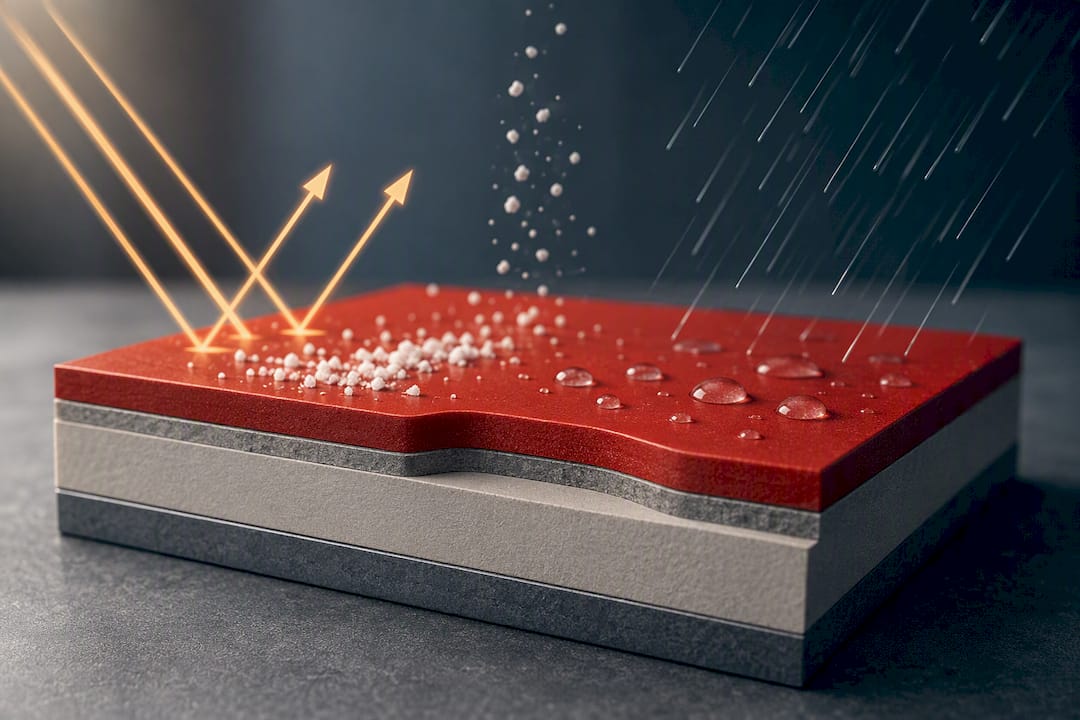
Pro Tip: Ask for the technical data sheet by resin percentage, not by trade name. Lower percentage PVDF blends marketed as “Kynar-based” do not deliver the same long-term color retention as a true 70% PVDF system, per the Gulf Coast Metal Roof Guide.
Here’s how the three common finish categories stack up in marine air:
- PVDF (70% resin): best chalk and fade resistance, holds gloss and color for decades in direct salt exposure
- SMP (silicone-modified polyester): mid-tier performance, shorter color life, acceptable for inland-adjacent or budget-sensitive coastal jobs
- Polyester: the weakest option for UV and salt air, generally unsuited for true coastal exposure regardless of substrate
Coating choice also decides whether painted Galvalume can substitute for bare aluminum. Without it, the substrate advantage aluminum offers becomes the deciding factor again.
Before you commit to a supplier’s finish claims, request three documents: the technical data sheet showing resin percentage, QUV or ASTM D2244 colorfastness test data, and the written coastal warranty clause. Manufacturers who won’t produce all three in writing generally have something to hide about how the panel performs in year eight.
Fastener and Flashing Compatibility: Where Coastal Roofs Actually Fail
Fastener choice, not panel substrate, is where most coastal roofs quietly fail. You can spec the correct aluminum panel and still lose the job to galvanic corrosion if the fastener metallurgy is wrong.
Galvanic corrosion happens when two dissimilar metals contact each other in the presence of an electrolyte, and salt-laden moisture is about as aggressive an electrolyte as exists in residential construction. Mixing plain steel or galvanized fasteners with aluminum panels sets up exactly that reaction, and the steel or the zinc coating loses fast.
- Match fastener metal to panel metal wherever possible; use aluminum or 410/430 stainless with aluminum panels.
- Step up to marine-grade 316 stainless for direct-oceanfront installations, where 304 stainless can still pit and fail under extreme chloride exposure, per SFS technical guidance.
- Reserve standard 304 stainless for intermediate zones set back from the immediate shoreline.
- Never let copper flashing contact aluminum or Galvalume panels directly; copper sits far enough apart on the galvanic scale to accelerate corrosion on both materials.
- Write fastener metallurgy, clip finish, and flashing compatibility into the contract scope line by line, not as a general “corrosion-resistant hardware” note.
Pro Tip: Specify clip finish and fastener grade in the same line item on your material takeoff. A contractor who orders the right panel but leaves fastener grade up to the supplier’s default stock is the most common way a coastal roof underperforms its warranty.
Wind Ratings, Tested Assemblies, and Coastal Warranty Fine Print
Wind uplift numbers only mean something when they’re tied to a tested assembly, not a generic panel rating pulled from a catalog. Coastal contractor guides consistently point to standing seam with concealed clips as the profile that carries the strongest tested wind performance in high-exposure zones, per the WeatherShield coastal roofing guide.
Before you submit for permit, confirm the wind rating you’re quoting matches the exact panel gauge, clip spacing, and fastening pattern in the manufacturer’s test report. A 24-gauge panel tested at one clip spacing doesn’t carry the same rating at a wider spacing, even if it’s the same panel profile.
- Pull the manufacturer’s tested assembly report, not just a published maximum wind rating
- Get an engineer letter matching the specific project’s exposure category and basic wind speed
- Confirm clip spacing and fastening schedule meet or exceed what the test report specifies
- Ask the supplier for coastal warranty language in writing; many standard warranties exclude “salt air” or “marine environments” outright, per 561 Roofers’ coastal material comparison
- Tighten clip spacing beyond the manufacturer minimum when local code demands a higher uplift rating than the standard test assembly provides
Coastal jurisdictions frequently require enhanced fastening schedules beyond a manufacturer’s baseline test assembly. Don’t assume your standard scope meets code until you’ve checked the actual wind speed map for the project address.
Installation Practices That Prevent Coastal Roofing Failures
How you handle panels before they even go on the roof determines whether that PVDF coating and 316 stainless spec actually pays off over 30 years.
- Store panels off the ground and covered. Salt spray reaches material sitting in a laydown yard just as easily as it reaches an installed roof. Stack panels on dunnage, keep them under cover, and minimize the time between delivery and install.
- Cut edges get treated, not left raw. Any field cut exposes bare substrate. Seal cut edges with a compatible sealant and finish with matching trim rather than leaving a raw edge exposed to salt air.
- Use concealed clips at manufacturer-specified spacing. Don’t stretch clip spacing to save material on a coastal job; that’s the spacing the wind rating and the warranty are both based on.
- Torque fasteners to spec, not by feel. Overdriven screws crack sealant washers and underdriven ones leak; both create long-term corrosion entry points in a salt environment.
- Photograph every stage before closing up. Clip spacing, fastener type, flashing laps, and sealant application should all be documented before the next course of panel goes on.
Pro Tip: Keep a signed copy of the material submittal on file with your project photos. If a coastal warranty claim comes up in year twelve, being able to prove you installed the exact panel, fastener, and clip spacing the manufacturer specified is the difference between a covered claim and a denied one.
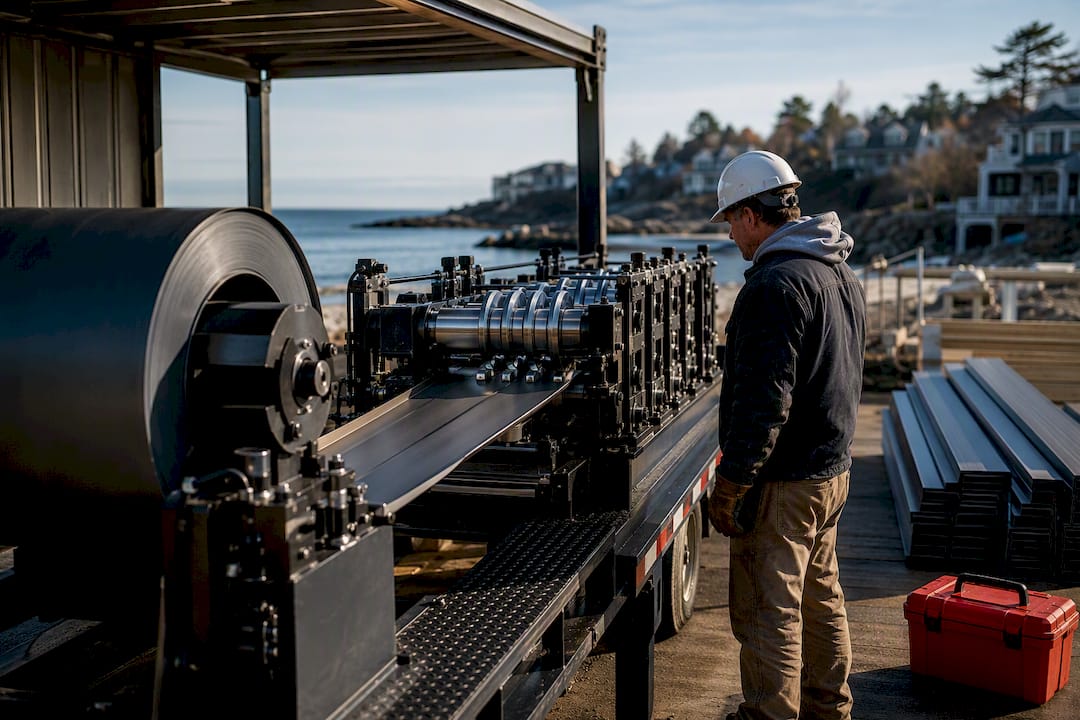
Custom-length panels cut to the exact run reduce how much field cutting and edge exposure happens on site in the first place, which is one reason on-site roll forming has become standard practice on longer coastal roof runs.
Coastal Roofing Maintenance: What to Inspect and How Often
Salt spray accelerates corrosion faster than humidity alone does, and that’s the single fact that should shape every coastal maintenance schedule, per JCROOF’s analysis. A roof three blocks from the beach needs a different rinse and inspection cadence than one thirty miles inland, even with identical materials.
- Rinse panels with fresh water every one to three months in direct nearshore exposure; twice yearly is often adequate further inland.
- Inspect fastener heads for rust bleed or pitting at every seasonal check; this is usually the first visible sign of galvanic trouble.
- Watch for chalking or color fade at panel edges and seams, which signals coating breakdown before it becomes a leak.
- Check flashing laps and sealant joints around penetrations, where wind-driven spray concentrates.
- Document every inspection with dated photos; most coastal warranty claims require proof of the maintenance schedule the manufacturer specified.
A localized fastener swap or sealant repair is usually enough if you catch corrosion early. Once panel substrate itself shows through-and-through pitting or the coating has failed across large sections, patch repair stops being cost-effective and full replacement becomes the only durable fix.
What Contractor-Grade Coastal Roofing Experience Actually Looks Like
Specifying correctly on paper and executing correctly on a coastal jobsite are two different skill sets, and the gap between them shows up in warranty claims more than in any inspection checklist.
MidAtlanticMetalPanels supplies cut-and-drop standing seam systems, including 1-inch mechanical lock and 1.5-inch snap lock panels in 24-gauge and 26-gauge Englert steel, to contractors across Virginia, Maryland, Washington DC, Pennsylvania, and West Virginia. That combination of panel profile and gauge options covers most of what the exposure-zone framework in this guide calls for.
- Custom-length panels delivered cut to the exact run, which cuts down on field cutting and the raw-edge exposure that accelerates coastal corrosion
- On-site roll forming available for projects where jobsite fabrication reduces handling damage during transport
- Trim and flashing packages matched to panel material, avoiding the galvanic mismatches covered earlier in this guide
- Direct delivery coordination that shortens the window panels sit exposed in a laydown yard before installation
Fewer touches between the shop and the roof means fewer chances for a coastal jobsite to introduce the kind of damage that voids a warranty before the roof is even finished.
An Editorial Take on Coastal Roof Specification
The industry’s biggest blind spot on coastal metal roofing isn’t substrate selection. It’s fastener discipline. Contractors will spend hours debating aluminum versus Galvalume and then let a supplier default them into whatever stainless grade happens to be in stock. The research is consistent on this point: fastener metallurgy is one of the highest-leverage decisions in the entire assembly, and it’s also the one most often treated as an afterthought.
Here’s where conventional advice falls short. Most coastal roofing guides frame the choice as substrate-first, then mention fasteners as a footnote. Flip that order. A correctly specified panel with the wrong fastener will fail years before a slightly less ideal panel with the right one. Galvanic corrosion doesn’t announce itself with a dramatic failure. It shows up as quiet pitting around fastener heads that a homeowner won’t notice until a leak appears, usually well outside any warranty inspection window.
If you take one thing from this guide into your next coastal takeoff, make it this: write fastener grade and clip finish into the contract as explicitly as you write panel gauge and profile. That single habit prevents more warranty disputes than any coating upgrade.
— Matt Catino
Getting the Right Coastal Panels Without the Guesswork
Everything in this guide, from aluminum versus Galvalume to fastener grade and PVDF resin percentage, comes down to one practical problem: getting the exact panel, gauge, and finish your scope calls for without waiting weeks or absorbing waste from stock lengths that don’t fit the run.
Custom-length standing seam panels can be cut to your exact project length and delivered directly to the jobsite, reducing field cutting, raw-edge exposure, and material sitting exposed to salt air before install. That means less field cutting, less raw-edge exposure, and less material sitting exposed to salt air before install, exactly the risks this guide walks through above.
Before you order from any supplier for a coastal job, request the technical data sheet, documented fastener compatibility, and coastal warranty language in writing. Then request a project takeoff or a sample panel from MidAtlanticMetalPanels to confirm gauge, profile, and finish match your specification. Start with the standing seam panel options for your region, or look into on-site roll forming if your project calls for jobsite fabrication instead of pre-cut delivery. For coastal builds where the exterior finish matters as much as the roof itself, this coastal design guide from One Day Doors & Closets is worth a look for the aesthetic side of the project.
Sources
- NOAA Office for Coastal Management
- Metal Roofing on Coastal Homes | Gulf Coast Metal Roof Guide
- 304 vs 316 stainless steel — SFS (technical guidance)
- Metal Roofing pros and cons: Coastal SC guide — WeatherShield
- Best roofing materials for coastal areas — JCROOF