Color Sample Approvals for Standing Seam Metal Roofing
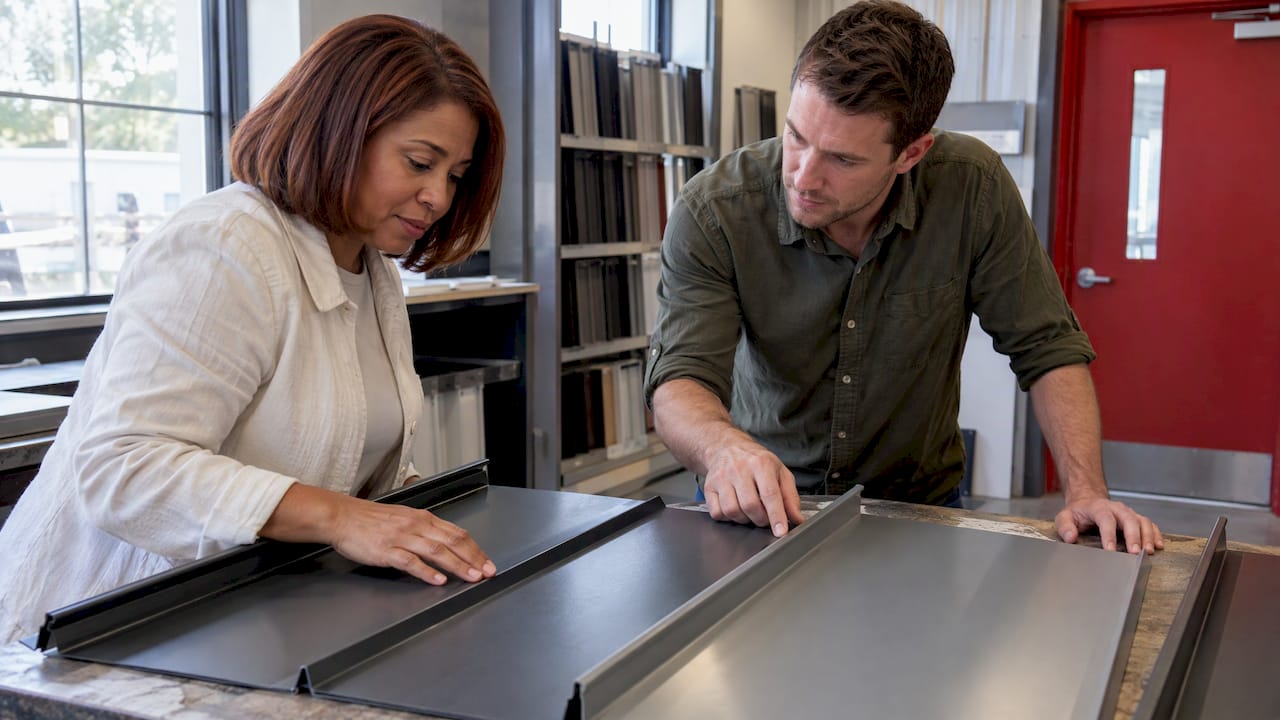
How contractors get metal roof color samples approved before panels are cut: what to submit, what to check in daylight, and what to lock in on trim and gauge.
A color sample approval is the signed step between “the owner likes this color” and “we cut and roll panels.” For standing seam, get it right by submitting a physical sample on the specified metal and gauge, at least 12 inches long. Have the architect or owner review it in daylight. Then record color, finish, gauge and trim in writing before any fabrication starts. Panels are cut to length, so a wrong color means the whole order is wrong, not one box of it.
This guide is for roofing contractors, builders and GCs who order custom-length panels. It walks through what a sample needs to show, how to run the approval, and what to document so panels, trim and flashing all arrive matching.
TL;DR
- Submit samples on the specified base metal and gauge, not a paper chip. Common spec language asks for a panel sample at least 12 inches long that shows the seam and finish.
- Judge color and gloss outdoors in daylight, and view the sample at the roof’s real angle, next to the siding, brick or stone it will sit beside.
- Approve in writing before fabrication: color name, finish, gauge, profile, and the same finish on trim and flashing.
- Trim normally matches the panel’s metal, gauge and finish. Heavier trim gauge is acceptable where the panel manufacturer details it.
- Send the approved color and gauge with your takeoff so panels, trim and accessories ship as one coordinated package.
Table of Contents
- What a color sample approval actually covers
- What the sample should look like
- How to run the approval step by step
- Checking color and gloss in daylight
- What to document before panels are fabricated
- Trim gauge and color: keep the package matched
- Perspective
- Order what you approved
- Common mistakes to avoid
- FAQ
- Sources
What a color sample approval actually covers
On a standing seam job the approval is more than a color choice. It is a submittal: a package the architect, engineer, owner or GC reviews and signs. Specifications for metal roof panels typically ask for several things at once: the color, the finish, the metal thickness and the seam profile.
The University of Texas at Arlington’s Division 07 guide specification for metal roof panels is a typical example. It has the contractor submit color samples on metal from the panel manufacturer’s standard color options for the architect’s selection. It also calls for two samples, 12 inches long and full panel width, showing the metal gauge, seam and finish.
Public-sector specs say the same thing in different words. A New York State DOT specification for standing seam roofs, for example, has the contractor provide a manufacturer’s color sample to the engineer for approval. Not every private job is this formal, but the habit transfers: the sample is a controlled document, not a courtesy.
Why paint chips and screens are not enough
A printed chip or a website swatch shows a color on paper or a monitor. It does not show:
- how the finish reads on 24-gauge or 26-gauge steel
- the sheen of the actual coating
- how the seam casts shadow lines across the pan
- how the color shifts between direct sun and overcast sky
Those are the things an owner reacts to once the roof is up. Putting them in front of the reviewer first is the cheapest insurance on the job.
What the sample should look like
The SynC Standards metal roof panel standard is specific. It requires color and finish samples on the specified base metal in the specified gauge, large enough to judge color and gloss in daylight. It also requires a panel sample at least 12 inches long showing the seam, the pan treatment and the finish.
A public bid specification from Cherokee County (Section 074113) goes further. It asks for verification samples of at least 12 inches square representing the actual roofing metal, thickness, profile, color and texture, with a typical panel joint and typical fastening detail.
Put together, a good submittal sample has these traits:
| Check | What to confirm |
|---|---|
| Base metal and gauge | Matches the spec (for our panels, 24-gauge or 26-gauge Englert steel) |
| Length and width | At least 12 inches long; full panel width where the spec asks for it |
| Profile | Shows the seam (1-inch mechanical lock or 1.5-inch snap lock) and the pan treatment |
| Color and finish | The exact color name and the sheen, on the real coating |
| Trim | A trim or flashing sample in the same finish when trim color is part of the approval |
| Fasteners | Exposed fastener color, if any, noted for matching |
Match the sample to the profile you are buying
If the job is a 1-inch mechanical lock or 1.5-inch snap lock standing seam system, say so on the submittal and make the sample reflect it. A snap lock seam reads differently from a mechanically seamed one. Reviewers who approve the color on one profile and receive another sometimes feel they were shown something different, even when the coating is identical.
How to run the approval step by step
- Pull the spec or owner selection. Find the color name, finish and gauge in the specification, the owner’s selection sheet or the contract. If the only description is “dark bronze,” stop and get the exact name.
- Request a sample on the real metal. Ask for the color on the specified gauge, at least 12 inches long and showing the seam. Request a trim sample too when the trim color is a decision.
- Review it in daylight. Take it outside, hold it at roof pitch, and look at it in sun and shade. More on this below.
- Compare it to adjacent materials. Set it against brick, siding, stone, windows and gutters that will share the facade.
- Get the sign-off in writing. An email reply that names the color, finish and gauge works on small jobs. On larger ones, use the formal submittal form.
- Release the order. Only after approval do panels get cut or rolled, so the approved color, gauge and profile go straight onto the order.
Steps 1 and 5 are where most disputes start. The approval record is what you point to when someone says the roof looks different from what they pictured.
Checking color and gloss in daylight
The SynC standard’s emphasis on a sample large enough to evaluate color and gloss in daylight is practical advice, not a formality. Showroom lighting and a truck cab flatter every finish.
When you run the review, work through this list:
- Direct sun, then shade. Metallic and pearl finishes can shift noticeably between the two.
- Roof angle. Tilt the sample to the pitch. Flat on a table is not how anyone will see the roof.
- Time of day. Morning and late afternoon light changes how a dark or warm color reads.
- Distance. View it from where the owner will actually see the roof, such as the driveway, not from arm’s length only.
- Gloss. Compare sheen to the reference. Matte, low-gloss and standard finishes read very differently in sun.
If you want a walkthrough of how professionals evaluate color under real light, a color consultation process from the painting trade covers the same habits of viewing samples in natural light on the actual surface.
Dark colors, reflective finishes and oil canning
Color choice can change how flat the roof looks. SMACNA’s guidance on oil canning, published through the PAC Association, says wide, shiny, dark-colored, light-gage panels show oil canning in proportion to width and in inverse proportion to thickness. It adds that darker colors accentuate it and reflective surfaces are less forgiving, while non-reflective or textured finishes help mask waviness.
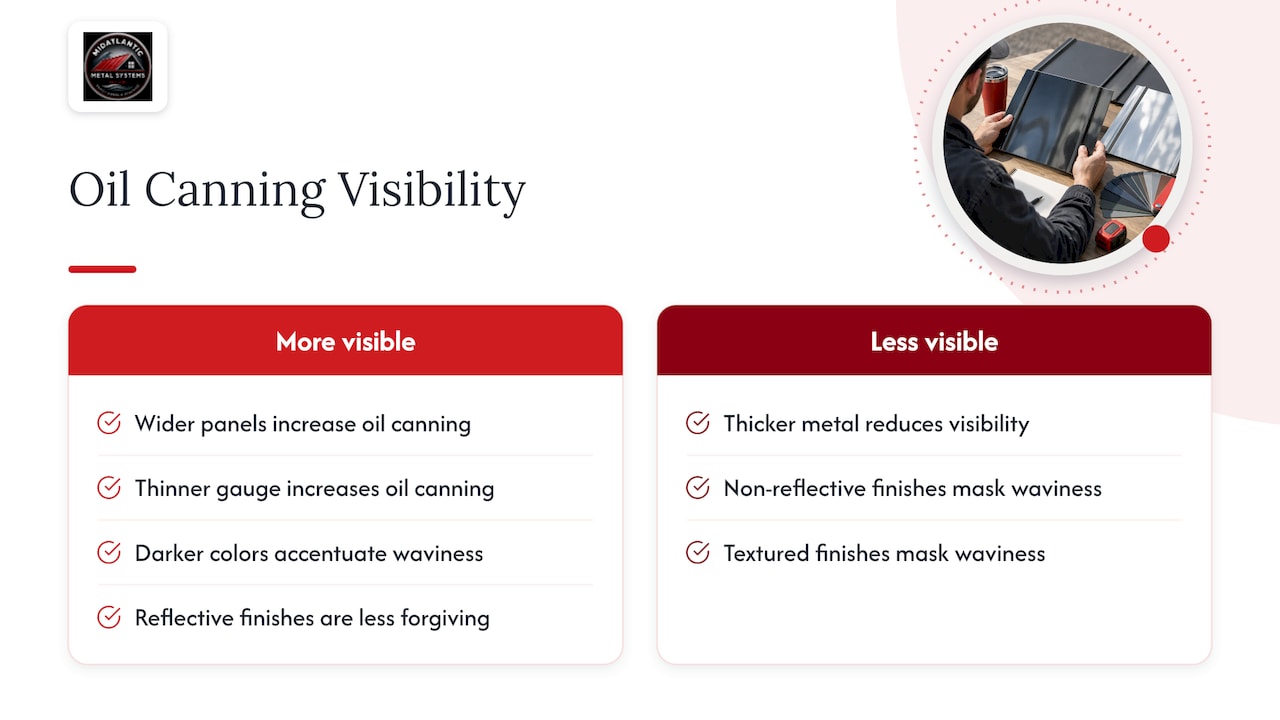
For your sample review, that means a dark, glossy color deserves extra attention. Talk through gauge and finish with the owner during approval, not after the panels are on the roof. Our 24-gauge matte black snap lock project in Sperryville, VA shows how a dark color reads on a finished roof. The 26-gauge forest green snap lock job in Virginia shows a mid-tone for comparison.

What to document before panels are fabricated
Cut-to-length panels are made once. Before fabrication, the approval record should contain:
- exact color name and finish system
- gauge or thickness and base metal
- profile and seam height
- panel lengths and counts from the takeoff
- trim and flashing color and gauge
- exposed fastener color, if used
- the name and date of the person who approved
The SynC standard asks for a single package before materials are ordered or field roll-forming begins. That package identifies the panel family, profile, seam height, coverage width, base metal and governing specification, gauge, metallic coating, finish system and interior-face coating. You do not need that level of paperwork on every residential roof, but it is a good checklist of what to settle.
On the flashing side, the Texas State University sheet metal flashings specification requires physical samples of fasteners used to anchor the metal work and a color sample of prefinished metal before mass fabrication. Fasteners are the detail people forget until a bright screw head shows against a dark roof.
Color consistency from the coil
Pre-painted steel is checked against the order. The Steelscape Green Book explains that color is verified by a visual check and by the Lab scale on a color computer, and that color and gloss are checked for consistency across the strip and against the order specification during production. The practical takeaway: order all the roof’s metal, including trim, against one approved color so it comes from matched production, and bring any later add-on orders in with the original color and gauge on the paperwork.
Trim gauge and color: keep the package matched
The keyword question “trim gauge standing seam” belongs in the approval, because trim is where mismatches show first.
The SynC standard states that eave, rake, ridge, hip and transition trim furnished with the panel system should be the same base metal, gauge or thickness, metallic coating and finish as the panels. The exception is that trim gauge may be heavier where the panel manufacturer details it. The same standard lists nominal thicknesses of about 0.024 inch for 24 gauge and 0.018 inch for 26 gauge, and describes 24 gauge as the common architectural and structural standing seam gauge. It also notes that heavier gauge increases span, uplift capacity and dent resistance and reduces oil canning, at the cost of more weight and price.
What to check when you specify trim:
- Same finish as the panels. The color on trim should come from the approved color, so it reads as one roof.
- Gauge as the panel manufacturer details it. Match the panel gauge by default. Go heavier only where the system details call for it.
- Large flat pieces. Wide flat trim shows waviness more than narrow pieces, so confirm the sample reflects the trim as it will be made.
- Uplift and structural needs. The gauge supplied should be the one tested for the uplift rating you rely on. Our article on standing seam wind uplift covers what to check.
Our trim and flashing packages are built so trim and panels are coordinated from one order, which makes this check simple.
Perspective
We see approvals go well when the sample is treated as part of the order, not a side errand. A contractor who sends us the exact color, the gauge and the profile on day one gets panels cut to length and trim matched to them. The same contractor does not have to chase a color question after the truck has left.
Because we work with 24-gauge and 26-gauge Englert steel in 1-inch mechanical lock and 1.5-inch snap lock profiles, we can talk about gauge, seam and finish as one decision. Cut-and-drop delivery to the job site rewards that discipline: panels arrive at the lengths you ordered, in the color you approved, with the trim to finish the roof.
Our advice is simple. Settle color, gauge and trim in one sign-off, view it in daylight, and put it in writing before anything is cut.
Matt Catino
Order what you approved
Once the sample is signed off, the next step is turning it into a takeoff. We supply custom-length standing seam panels, trim and flashing packages, and contractor takeoff support across Virginia, Maryland, Washington DC, Pennsylvania and West Virginia. Cut-and-drop delivery brings panels to the jobsite at the lengths you need, which cuts waste and keeps the approved color on schedule. For a hard-to-reach site, on-site roll forming is another option. Browse our standing seam metal roof colors to start the selection, or go to our contractor supply page to send your project details.
Bring the approved color name, gauge and profile with you when you contact us, and the order comes together faster.
Common mistakes to avoid
- Approving from a screen or chip. Always review the coating on the real metal and gauge.
- Approving the panel color but not the trim. State trim color and gauge on the same sign-off.
- Verbal approvals. Get the color name, finish and gauge in writing.
- Judging under shop lights. Take the sample outside and tilt it to roof pitch.
- Skipping the fasteners. If exposed fasteners are used, include their color in the record.
- Reordering by memory. Quote the original approved color and gauge on every add-on order, such as extra trim or replacement panels.
FAQ
How big should a metal roof color sample be?
Specifications commonly call for a panel sample at least 12 inches long showing the seam and finish, and some ask for two samples at full panel width. Check your project spec for the exact size, since public bid documents are specific about it.
Who approves the color sample?
On specified projects, it is the architect or engineer. On residential and design-build work, it is usually the owner, with the GC or builder collecting the sign-off. Whoever approves, record their name and the date alongside the color, finish and gauge.
Should trim be the same gauge as the panels?
By default, yes. The SynC standard calls for trim of the same base metal, gauge, coating and finish as the panels. It allows heavier trim where the panel manufacturer details it. Confirm this in the trim and flashing submittal.
Why view a sample in daylight?
Color and gloss change with light. A finish that looks right indoors can read lighter, darker or glossier outside, and dark colors tend to show waviness more. Daylight review at roof pitch shows what the owner will see.
When should the sample be approved in the project schedule?
Before panels are cut or rolled and before the order is released. Once panels are fabricated to length, a color change usually means a new order, so schedule the approval ahead of your takeoff deadline.
Sources
- UTA Guide Specifications, Division 07 41 13 Metal Roof Panels
- New York State DOT, Item 09634.01 M Standing Seam Metal Roof
- SynC Standards, Metal Roof Panels Construction Standard
- Cherokee County, Section 074113 Metal Roof Panels
- SMACNA on Oil Canning, via PAC Association
- Texas State University, 07 60 00 Sheet Metal Flashings
- Steelscape Green Book
- Color consultation process