Color Variation in Metal Roof Panels: Causes and Fixes

Why metal roof panels show color variation, what is normal, and how contractors can prevent mismatch on standing seam jobs with batch control and installation habits.
Color variation in metal panels comes from four places: paint batches, panel direction and light, the finish chemistry itself, and weathering over time. Most of it is predictable, and on a standing seam job you can control nearly all of it before the first panel goes up. This guide is written for roofing contractors, builders and GCs who have to answer for the finished roof, not just deliver the material.
TL;DR
- Small shade differences between paint batches are normal in coil coating. The mismatch you see on the roof usually comes from mixing batches on one visible plane.
- Order every panel for one roof plane from a single production run, and check the date of manufacture on the panel underside.
- Install all panels in the same orientation. Rotating a panel can make a metallic or dark finish look like a different color.
- Judge color after a reasonable area is installed and viewed from a distance, never from a single panel in your hands.
- Field touch-up paint will rarely match a factory finish, so use it sparingly and match the chemistry.
Table of Contents
- What counts as normal color variation
- The five causes you will actually meet on a job
- Quick diagnosis: what are you looking at?
- How to judge color the right way
- Ordering to prevent the problem
- Touch-up paint: use it sparingly
- Our perspective: color is a supply-chain decision
- Choosing color with variation in mind
- Order standing seam panels for your next job
- A short jobsite checklist
- FAQ
- Sources
What counts as normal color variation
Painted metal panels are coated on a continuous coil line. Pigment lots, line speed, oven temperature and film thickness all move a little from one run to the next. No two runs are identical, and that is true of every manufacturer.
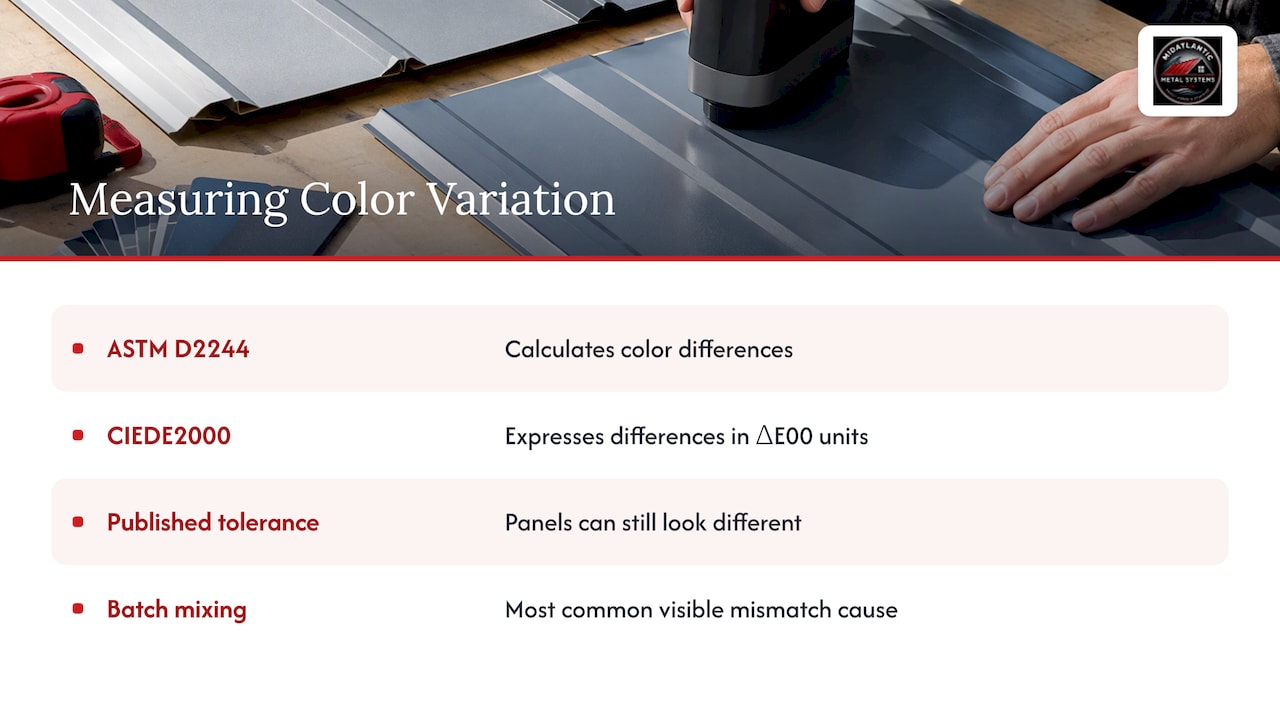
The industry measures the gap rather than arguing about it by eye. ASTM D2244 is the standard practice for calculating color differences from instrument readings, and it describes expressing the difference in CIEDE2000 (ΔE00) units. Two panels can sit inside a published tolerance and still look different when they sit side by side on one wall or roof plane. A tolerance protects the manufacturer. Only batch control protects your customer’s view of the roof.
The European coil-coating association’s colour guidance for prepainted metal on buildings is blunt on this: batch-to-batch variation is a normal byproduct of coil coating, and mixing batches on one visible area is the most common cause of visible mismatch. It is a European document, but the physics of coil coating are the same on this side of the Atlantic.
The five causes you will actually meet on a job
1. Mixed batches on one plane
This is the big one. A roof ordered in two or three shipments, or panels pulled from different coils, can show bands where the batch changes. On a long standing seam run the seams make each panel a distinct vertical stripe, so a shift between neighbors reads clearly.
To prevent it, ask that all panels for a given roof plane come from one production run. The run is often identifiable by a date of manufacture printed on the panel reverse, so check it when the bundles arrive rather than after they are on the roof.
2. Panel direction and light
Coated steel is not perfectly isotropic. The coating and the rolling direction of the coil can reflect light differently depending on which way the panel is facing. BlueScope’s technical bulletin on large single planes advises aligning panels in the same orientation, using the printing or branding on the underside as the reference, because rotating panels can create the look of a color difference, especially in metallic finishes.
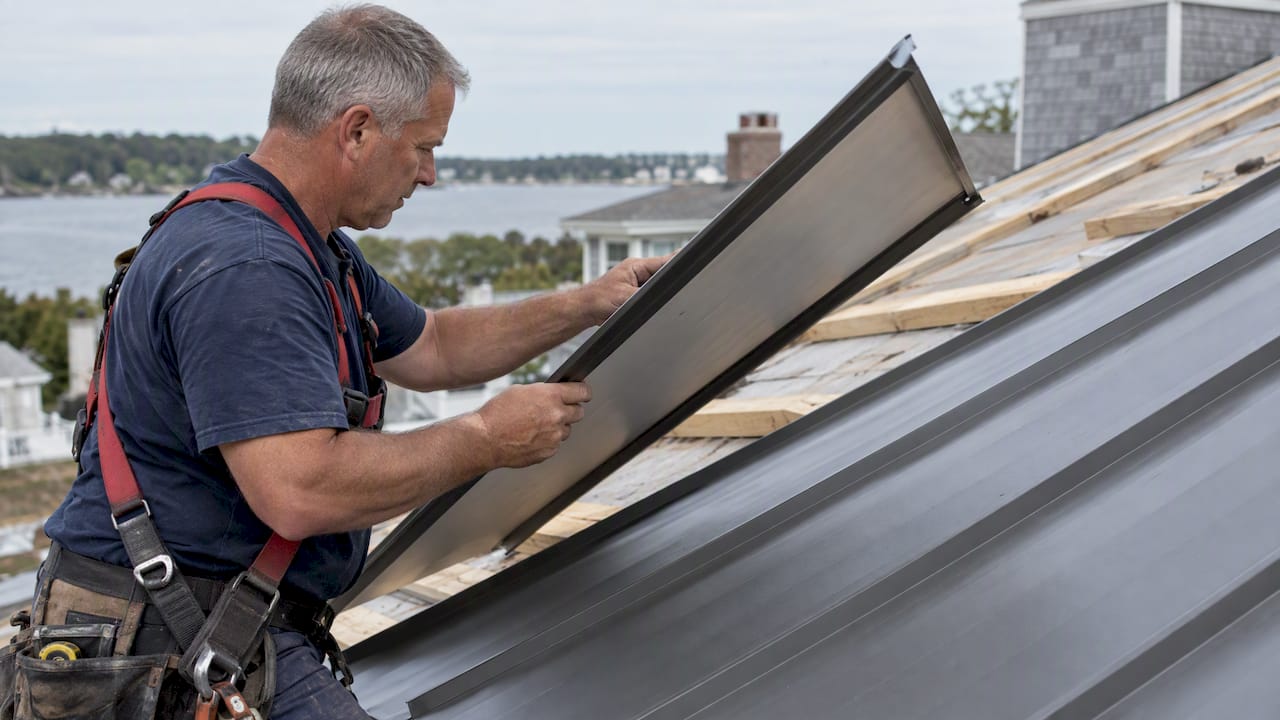
The practical rule for your crew: every panel goes up with the underside printing running the same way. Say it at the start of the job and again when a new crew member joins. It costs nothing, and it is the cause of many callbacks that look like paint defects.
3. The finish itself
Some colors are simply harder to hold steady than others. Metallic and deep-tone finishes depend on pigments being dispersed evenly, and any unevenness shows as a shift with the viewing angle. Cool-roof colors add another layer: Lawrence Berkeley National Laboratory’s research on solar-reflective nonwhite surfaces explains that dark colors can be made reflective by using pigments that reflect near-infrared light while absorbing visible light.
What that means for you is simple. If a customer picks a metallic or a deep, saturated color, set the expectation early that the finish will look different at different times of day and from different angles. That is the finish working as designed, not a defect.
4. Weathering and fading
A painted panel and a seven-year-old panel are not the same color, and a replacement panel installed in year seven will not match the rest. Fading is gradual and shows most on the sun-facing slopes. If one panel was swapped early, the contrast between old and new tends to grow with time, which is exactly what homeowners describe when they ask why two panels look different on a roof only a few years old.
The replacement problem is worth raising with owners at handover. Leave them with the color name, the paint system and the date of manufacture on file so a future repair is not a guess.
5. Natural metals that change on purpose
Copper, zinc and some other bare metals do not hold a color. They react with oxygen, moisture and sulfur in the air and form a surface layer. Copper moves from bright to brown and eventually to the familiar blue-green patina, a layer that also protects the metal underneath, as the chemistry text on corrosion describes. Untreated steel behaves differently: it rusts when moisture and oxygen get through, which is why painted and coated steel is the standard for roofing.
If a design calls for pre-weathered natural metal, confirm availability before you quote. The Metal Construction Association’s roofing education material warns that pre-patina products are introduced and discontinued often. For copper work, see our page on copper roofing and flashing.
Quick diagnosis: what are you looking at?
| What you see | Most likely cause | What to do |
|---|---|---|
| Bands of slightly different shade, panel to panel | Mixed production runs | Compare the manufacture dates on the panel reverse. Replace the odd-run panels before more go up |
| Panels look different from one end of the roof but match at the other | Panel rotated, or light angle | Check the underside printing direction on every panel |
| Looks uneven only at certain times of day | Metallic or deep-tone pigment, viewing angle | Judge from a distance at several hours before escalating |
| One or two panels clearly different on an older roof | Replacement panels against faded originals | Document and discuss with the owner. Do not repaint large areas |
| Patchy, glossy or dull spots near a repair | Wrong touch-up paint | Remove and refinish with a compatible system, or replace the panel |
How to judge color the right way
The ECCA guidance says not to assess color by inspecting individual panels up close. Wait until a reasonable area has been installed, then look at it from a normal viewing distance. Light, viewing angle and panel orientation all change how the eye reads uniformity, and a panel that looks off in your hand can look fine on the roof.
A workable approach for a punch list:
- Agree with the owner on the viewing distance and conditions before the job starts.
- Look at the installed roof in both morning and afternoon light.
- Photograph the plane from the ground, not from the ladder.
- If you still see a difference, compare dates and printing direction on the reverse before blaming the paint.
This protects you both ways. It stops a nitpick from becoming a re-roof, and it gives you a clean record when a defect is real.
Ordering to prevent the problem
Most color complaints are decided at ordering, not installation. A few habits help.
Do the takeoff for the whole plane first. Totaling your panel count for each roof plane before you order lets the supplier cover the whole plane in one go. Panels ordered in dribs and drabs are how a second batch sneaks in.
Order custom lengths. Standing seam panels cut to the exact length for each run mean fewer short offcuts and less need to reorder a few panels later because the field cuts ran short. A late reorder is a classic way to introduce a different run.
Add a small overage to the same order. Spare panels, trim and flashing from the same run make later repairs far easier than trying to match a single panel two years on.
Order trim and flashing with the panels. Trim is formed from coil too, and flashing that comes from a different run can show against the panels at ridges, eaves and gables. Coordinating them together is the easiest fix.
Write the color and finish on the order. Paint system, gloss level and color name should appear on every order and every delivery ticket for the job.
Touch-up paint: use it sparingly
A scratch from a ladder or a cut edge tempts a crew to reach for a can of paint. Be careful. The Metal Construction Association’s guidelines on field-applied touch-up systems note that factory-applied and field-applied paint will most likely never match or weather the same way, because the resins and pigments differ.
The guidance also points out that fluoropolymer (PVDF or FEVE) factory finishes are best paired with compatible fluoropolymer air-dry systems, and that such touch-up should be limited to minor blemishes. A cheap air-dry paint over a high-performance factory finish will weather unevenly and fade faster, and that mismatch gets worse every year. For anything bigger than a small nick, replace the panel instead of painting it.
Our perspective: color is a supply-chain decision
We supply contractors across Virginia, Maryland, Washington DC, Pennsylvania and West Virginia, and the color complaints we hear about rarely start with the paint. They start with a job that was ordered in pieces, delivered in pieces and installed by whoever had the panels in hand.
Our whole model is built around avoiding that. We make custom-length standing seam panels in 24-gauge and 26-gauge steel on Englert systems, in 1-inch mechanical lock and 1.5-inch snap lock profiles, and we deliver them cut to length at the job site. When panels arrive in the lengths you need, you can plan a roof plane, order it together and install it without waiting on a second shipment. On jobs where access or length makes delivery hard, on-site roll forming lets panels be formed where the roof is.
Our advice, for any supplier you use: confirm the production run before you sign off on delivery, keep the manufacture date with the job file, and walk the owner through what normal variation looks like before the first panel is set. A five-minute conversation on day one costs far less than a repair visit in month six.
— Matt Catino
Choosing color with variation in mind
Some colors forgive more than others. Without naming brands, here is how we would sort them when a customer is deciding.
- Solid mid-tones and light colors. The easiest to hold uniform and the easiest to repair later.
- Matte and flat dark finishes. Striking, but they show differences in light and any surface marking more plainly. Our matte black standing seam page and a 24-gauge matte black project in Sperryville, VA show how that finish reads on a finished roof.
- Metallic finishes. Most sensitive to direction and light. Install carefully and brief the owner on how the roof will shimmer.
- Natural metals. They change by design. Only choose them if the owner wants the change.
Look at real installed examples before choosing. Our project gallery and the standing seam color guide are good starting points, and small chips should always be viewed outdoors in the actual light the roof will see.
Order standing seam panels for your next job
If you are planning a roof and want panels cut to length, trim and flashing included, we can help with the takeoff and the delivery. See our 1-inch mechanical lock and 1.5-inch snap lock panels, our cut-and-drop delivery and our trim and flashing packages, or go to contractor supply to start an order. We work with contractors, builders and GCs, not homeowners buying direct.
A short jobsite checklist
- Confirm color name, finish and paint system on the order and the delivery ticket.
- Order all panels, trim and flashing for each visible plane together.
- On delivery, check the date of manufacture on the panel reverse for every bundle.
- Keep one orientation: underside printing runs the same way on every panel.
- Set up a demonstration area and judge it from a distance, in different light.
- Keep touch-up to small marks, with a compatible fluoropolymer product.
- Keep spare panels and the job record with the owner.
FAQ
Is some color variation between metal roof panels normal?
Yes. Coil coating is a continuous process, and small shade differences between production runs are normal even when every run meets its tolerance. The goal is not zero variation. It is keeping runs from mixing on the same visible roof plane.
Why do two panels on my roof look different?
The usual causes are panels from different production runs, a panel installed turned around so it reflects light differently, or a replacement panel set against faded originals. Check the manufacture date and the underside printing direction first. If the difference started years after install, fading against a newer panel is the likeliest answer.
Can I paint metal panels to fix a mismatch?
Only for small blemishes. Field-applied paint rarely matches or weathers like a factory finish, and the wrong chemistry can fade unevenly. Use a compatible fluoropolymer touch-up system on small marks and replace the panel when the area is large.
Do metal roofs fade over time?
All painted surfaces change slowly with sun exposure, and the sun-facing slopes show it first. Choose a quality factory finish, and keep the color and paint system on record so any future repair is done with the right match. A roofing contractor or the panel manufacturer can advise on the specific warranty for your finish.
Sources
- ASTM D2244: Standard Practice for Calculation of Color Tolerances and Color Differences
- Colour Consistency and the Use of Prepainted Metal Panels on Buildings (ECCA)
- COLORBOND steel: visual considerations in large single planes (BlueScope)
- Methods of creating solar-reflective nonwhite surfaces (Lawrence Berkeley National Laboratory)
- 17.7 Corrosion, Chemistry Fundamentals (UCF Pressbooks)
- Metal Roofing A to Z, Section 4 (Metal Construction Association)
- Application guidelines for field-applied touch-up paint systems on metal panels (Metal Construction Association)