Cool Roof vs. Dark Roof: What Contractors Should Spec

Cool roof vs. dark roof for metal: what reflectance, emittance and insulation really do, and how contractors can spec a dark standing seam finish that performs.
A cool roof is defined by how it behaves in sunlight, not by its color. A conventional dark roof absorbs most of the sun’s energy, while a cool roof reflects and emits more of it. A dark-looking standing seam finish can still qualify as cool when its pigments reflect near-infrared light, so the choice is rarely “white or black.” It is a choice between rated products. For a contractor, the job is to match a measured finish to the climate, the insulation and the code, then get panels cut to length and on site without delay. That is the work we do at Mid-Atlantic Metal Panels, with custom-length 24-gauge and 26-gauge Englert steel panels delivered to your job site.
TL;DR
- Dark conventional roofs reflect roughly 5 to 20% of sunlight and light roofs roughly 55 to 90%, according to the U.S. Department of Energy’s cool roof guide.
- Color alone does not decide it. Near-infrared-reflective pigments let a dark finish run cooler, and thermal emittance matters as much as reflectance.
- Cool roofs pay off most in warm climates and well-ventilated, poorly insulated buildings. In colder climates the heating penalty can cut into savings.
- Spec by measured, three-year aged solar reflectance and thermal emittance from the Cool Roof Rating Council directory, not by a color name.
- For Mid-Atlantic jobs, a dark or light finish both work on standing seam. The decision is performance data, code and the owner’s look.
Table of Contents
- What actually separates a cool roof from a dark roof
- Why color is a poor shortcut
- Does a dark roof make the building hotter?
- Cool roof or dark roof by climate
- What about durability and appearance?
- How to spec a dark or light standing seam roof
- Cool-roof coatings: where they fit
- Where we fit into the job
- Our view on dark versus cool
- FAQ
- Sources
What actually separates a cool roof from a dark roof
The U.S. EPA describes a cool roof as one that absorbs and transfers less of the sun’s heat into the building than a conventional roof. High solar reflectance matters most, and high thermal emittance helps further.
Two properties, in plain terms:
- Solar reflectance is the share of incoming sunlight a surface bounces back, on a 0 to 1 scale. A reading of 0.25 means 25% reflected.
- Thermal emittance is how well the surface releases the heat it did absorb. Also 0 to 1.
The DOE guide reports that typical dark roofs can exceed 150°F in full sun, while cool roofs can run more than 50°F cooler under the same conditions. Lawrence Berkeley National Laboratory’s Heat Island Group adds a useful comparison: a cool-colored roof reflecting 35% of sunlight can be about 22°F cooler on a typical summer afternoon than a visually similar conventional roof reflecting 10%.
That comparison is the one that matters for architectural work. Two roofs can look nearly the same to the owner and the designer, and behave very differently on the surface.
Why color is a poor shortcut
The 2023 Building America Solution Center guide from PNNL says color alone does not set infrared reflectance or thermal emittance. Special near-infrared-reflective coatings can make dark products cooler without changing how they look to the eye.
The same guide gives aged SRI figures for metal finishes. SRI, the Solar Reflectance Index, folds reflectance and emittance into one number so products can be compared. Three-year aged SRI for white metal finishes can reach 85 to 90, while dark brown and red metal finishes can exceed 30. White and very light finishes generally score higher, but infrared-reflective pigments lift the dark ones. If you want the contractor’s walkthrough of the index itself, our piece on what metal roof SRI means covers how to read it on a submittal.
The bare metal trap
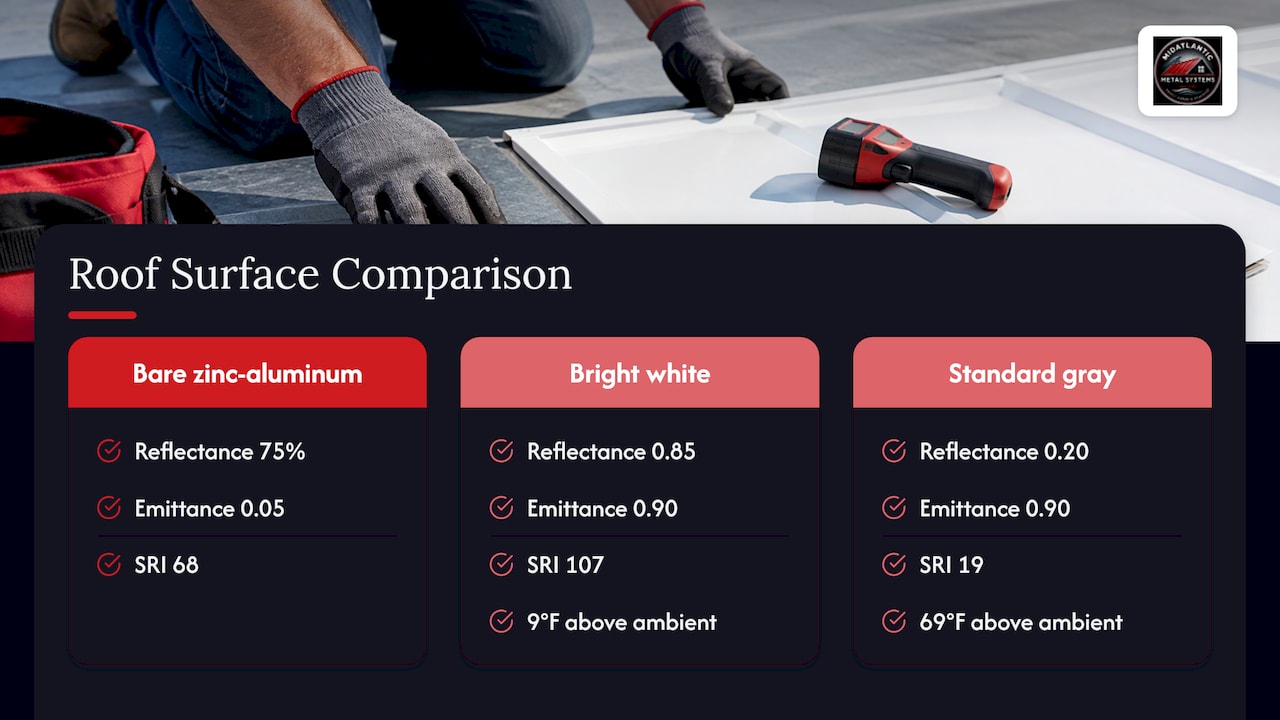
Shiny unpainted metal is the case that trips people up. The DOE guide notes that bare metal has low emittance, so it can stay warmer despite high reflectance. LBNL’s cool roof Q&A gives a worked example: a bare zinc-aluminum steel surface reflecting 75% of sunlight but with a thermal emittance of only 0.05, for an SRI of 68.
In the same Q&A, a bright white roof (reflectance 0.85, emittance 0.90, SRI 107) sits about 9°F above ambient air on a summer afternoon. A standard gray roof (reflectance 0.20, emittance 0.90, SRI 19) sits about 69°F above ambient. So the number to read is the rated one on the finished product, coating included.
Does a dark roof make the building hotter?
On the roof surface, yes. Inside the building, it depends on what sits between the deck and the occupants.
PNNL explains that insulation reduces how much the exterior roof temperature reaches the interior. A cool surface therefore helps less in a well-insulated building and more in a poorly insulated one. The DOE guide is explicit that a reflective roof does not replace insulation, because insulation slows heat flow in both directions.
That is why a dark metal roof over a properly built assembly is not the comfort problem many homeowners assume. The EPA reports that in homes without air conditioning, cool roofs can lower maximum indoor temperatures by about 2.2 to 5.9°F, which shows the effect is real but modest and tied to how the building is built. A well-sealed attic or deck with continuous insulation narrows the difference further. For a plain-language look at how insulation type changes what the surface temperature does to the rooms below, see this open cell vs. closed cell insulation guide.
For metal over insulation, our contractor guide on code-ready metal roof over insulation walks through the assembly. On hot-surface conditions, the high-temp underlayment guide covers what sits under dark panels.
Cool roof or dark roof by climate

PNNL’s guide reports a U.S.-wide simulation of average new and existing homes showing total HVAC savings of about 6 to 12% for relatively cool roofs and walls in warmer climate zones, with heating increases already counted in the total. The benefit is clearest where cooling dominates the energy bill. In colder climates, the heating penalty can reduce or outweigh the savings, a point the DOE guide also makes.
The Mid-Atlantic sits in the middle. Virginia, Maryland, DC, Pennsylvania and West Virginia have real cooling seasons and real heating seasons, so no single answer wins. Practical reading for a project in this region:
| Factor | Light or cool-rated finish | Dark conventional finish | Dark cool-pigment finish |
|---|---|---|---|
| Solar reflectance | Highest | Lowest, typically 5 to 20% per DOE | Higher than conventional dark |
| Cooling-season roof temperature | Lowest | Highest | In between |
| Winter heat gain | Lowest | Highest | In between |
| Look the owner wants | Light tones | Deep charcoal, black | Deep tones, same visible color |
| Best fit | Hot, sun-exposed, lightly insulated | Well-insulated, shaded, design-led | Design-led jobs that still need a rating |
Cool California’s product comparison puts numbers on metal: solar reflectance of 0.60 to 0.70 for white-painted metal, 0.40 to 0.70 for dark colors with cool pigments, and only 0.05 to 0.10 for conventional dark-painted corrugated metal. It lists a life expectancy of 20 to 50+ years for corrugated metal roofing. Those are generic category ranges, so use them for early planning and use rated data for the actual finish.
What about durability and appearance?
PNNL notes that algae can be more visible on light roofs, while smooth painted metal resists it better. A smooth painted standing seam surface helps keep either color looking clean. Cool surfaces also run through smaller temperature swings, which is one reason they are linked with less thermal stress on roofing materials, and standing seam systems are built to move with panel expansion and contraction.
For architectural and custom home work, appearance often decides first. Matte black, charcoal and deep bronze are popular on modern designs. One of our recent projects shows the look: 24-gauge matte black snap lock panels in Sperryville, VA. If the owner is set on black, the performance conversation is about which finish and which rating, not about giving up the color.
How to spec a dark or light standing seam roof
Use this order on a bid or submittal.
- Find the governing requirement. Energy codes in some jurisdictions require minimum reflectance and emittance on certain roofs. The Cool Roof Rating Council keeps a list of codes, programs and standards by jurisdiction, and some of those requirements apply to low-slope roofs rather than steep-slope metal. Confirm with the local building department which applies to your slope and occupancy. Our checklist for Mid-Atlantic IBC metal roofing checks covers slope and code points that affect panel choice.
- Pull rated values for the finish. The CRRC’s Rated Roof Products Directory lists solar reflectance and thermal emittance per product. Be aware that a listing does not by itself mean a product is “cool” under a given code. You still compare the numbers to the requirement.
- Use aged values. Interim ratings are shown until a product completes three years of weathering at an approved test farm, after which the aged values replace them. Dirt and weathering lower reflectance over time, so aged numbers are the fair comparison.
- Check both properties. Reflectance and emittance are independent, per LBNL, so a product with strong reflectance and weak emittance is not automatically cool.
- Match the assembly. Confirm insulation, ventilation and underlayment for the climate and the finish.
- Lock the color. Get the owner’s sign-off on a physical sample before panels are cut. Our page on color sample approvals for standing seam explains the process.
If an owner asks about the old ENERGY STAR label for metal roofs, we explain what replaced it so you are not quoting a program that no longer works the way it used to.
Cool-roof coatings: where they fit
PNNL lists coated metal among residential cool-roof options. Reflective coatings reduce solar absorption and roof temperatures, and the benefits are lower cooling loads and better comfort in some buildings. The limits are the same ones that apply to any cool surface: heating penalties in cold climates, the effect of insulation, soiling and aging, and the need to verify the product’s rating.
On a new standing seam job, the finish is applied at the coil stage, so the rating belongs to the panel system you are buying. For an existing roof, a field-applied coating is a different decision from specifying new panels.
Where we fit into the job
Once you have settled the finish, the next problem is logistics. We supply 1-inch mechanical lock and 1.5-inch snap lock standing seam panels in 24-gauge and 26-gauge steel, made on Englert metal systems, to roofing contractors, builders and general contractors in Virginia, Maryland, Washington DC, Pennsylvania and West Virginia.
Our cut-and-drop delivery means panels arrive at the job site cut to the lengths your takeoff calls for, which helps reduce waste and keeps crews on schedule. Dark and light finishes both go through the same process, so the performance decision does not slow the order. For long runs or tight access, on-site roll forming is available, and our trim and flashing packages are coordinated with the panels so the details match the field color. You can see projects in the gallery or review panel specs.
Ready to price a job? Start with our standing seam panel lines or the contractor supply page.
Our view on dark versus cool
We hear “cool roof vs. dark roof” framed as a fight, and on a standing seam job it usually is not one. The owner picks a look. The contractor owes them a finish that performs and a roof that goes on without delays.
Our position is simple. Judge the finish by its measured reflectance, emittance and aged SRI, not by its name. A deep charcoal with the right pigments and a pale gray can both be sound choices, and the assembly underneath, insulation, ventilation and underlayment, does as much for comfort as the color on top.
Where we help most is the part that eats schedules: custom-length panels cut and delivered to the job site, trim and flashing packages that match, and on-site roll forming when a site makes delivery of long panels hard. Contractors in the Mid-Atlantic come to us for architectural-grade 24-gauge and 26-gauge Englert steel panels and for coordinated support from takeoff to delivery. That is how we keep a color decision from becoming a schedule problem.
Matt Catino
FAQ
Is black a good color for a metal roof?
Yes, when it is chosen with its rating in mind. Conventional dark finishes absorb more solar energy than light ones, but near-infrared-reflective pigments let dark finishes run cooler without changing their appearance. Compare measured reflectance, emittance and aged SRI for the finish, and confirm the insulation and code requirements for the project.
Will a dark roof make the house hotter inside?
The roof surface will get hotter, but the interior effect depends heavily on insulation and ventilation. PNNL says a cool surface matters less in well-insulated buildings and more in poorly insulated ones. A properly built assembly limits how much surface heat reaches the living space.
Is a white roof always better than a dark roof?
Not always. White roofs generally reflect more sunlight and cut cooling demand more, and the benefit is clearest in warm climates. In colder climates, the winter heating penalty can reduce or outweigh the savings, which is why the DOE recommends weighing climate and insulation. Mixed heating and cooling regions like the Mid-Atlantic call for a look at the whole assembly.
How do I verify a metal roof is actually “cool”?
Look up the product’s solar reflectance, thermal emittance and three-year aged values in the Cool Roof Rating Council directory, then compare them to the requirement that applies to your project. Color alone is not proof of compliance, and the requirement can vary by slope and jurisdiction.
Sources
- Using Cool Roofs to Reduce Heat Islands, U.S. EPA
- Guidelines for Selecting Cool Roofs, U.S. Department of Energy
- Cool Roofs and Walls to Reduce Heat Gain, PNNL Building America Solution Center
- Cool Roofs, Lawrence Berkeley National Laboratory Heat Island Group
- Cool Roof Q & A, Lawrence Berkeley National Laboratory
- Product Comparison, Cool California
- Roof Rating Program, Cool Roof Rating Council
- Codes, Programs and Standards, Cool Roof Rating Council