Contractors’ Metal Panel Crane Lifts: Protect Finishes, Reduce Lifts

Protect metal panel finishes during crane lifts with five rigging practices. Cut and drop delivery and on site roll forming can also reduce crane work.
Lifting metal panels with a crane safely means matching the crane and below-hook attachment to the load, assigning a qualified rigger and a signal person, and following OSHA rigging and signaling rules at every step. Use nylon slings or spreader bars rather than chain, inspect rigging before the shift, and never let anyone stand under a suspended load. Stop the lift if communication breaks down or wind exceeds safe limits.
TL;DR:
- Use vacuum lifters or clamps for finished architectural panels, and sling palletized bundles over spreader planks to prevent surface damage and bowing.
- Use nylon or canvas slings at least 2 inches wide, protect edges with planks, and add a spreader bar to prevent inward pressure.
- Verify bundle weight and crane capacity at the actual working radius, then check outrigger support, overhead clearance, and wind limits before lifting.
- Use a qualified rigger for every pick, assign a signal person when the operator’s view is blocked, and stop immediately if communication fails.
- Stage bundles in installation order and order panels cut to run length, reducing on site rework, staging, and unnecessary crane handling.
Table of Contents
- Which crane types and below-hook attachments work best for metal panels
- Rigging techniques to prevent damage and maintain stability
- Pre-lift checklist: weight, reach, ground, wind, and staging
- OSHA rules and on-site safety practices for crane lifts of metal panels
- Practitioner mistakes to avoid and quick pro tips for efficient, damage-free lifts
- Reducing crane handling through better panel logistics
- A practical way to cut down on crane lifts
- FAQ
- Sources
Which crane types and below-hook attachments work best for metal panels
Most panel lifts call for a mobile crane such as a rough-terrain or truck-mounted unit, sized to the load at its maximum working radius rather than its closest reach. Smaller jobs with light bundles and short lift heights sometimes get handled with a telehandler or boom lift instead, but once panels are long, heavy, or need to clear a roofline, a crane with proper rigging is the safer call.
The below-hook attachment matters as much as the crane itself:
- Plate lifting clamps grip single steel plates or sheets directly, working well for flat, rigid pieces without pre-drilled holes.
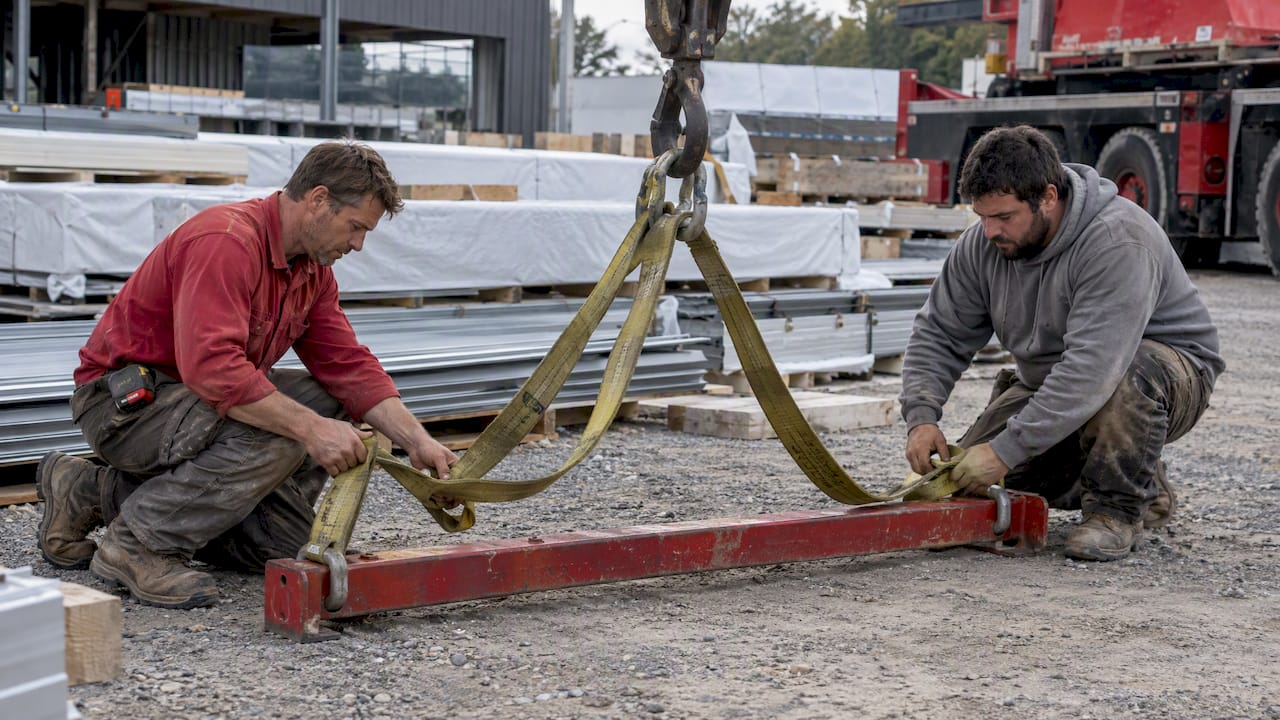
- Spreader bars hold sling legs apart to prevent bundles from bowing or bending during the lift, especially useful on long panel runs.
- Vacuum lifters suction onto finished panel faces, cutting the risk of surface marks on pre-painted or coated material.
- Soft-edge pads and spreader planks sit between the sling and the panel edge to stop point loading and crushing.
Finished architectural panels generally do better under vacuum or clamp attachments, while palletized bundles headed for staging areas are more commonly rigged with slings over spreader planks.
Rigging techniques to prevent damage and maintain stability
Rigging choice drives whether panels arrive at the installer ready to use or scratched and bent. A short sequence keeps both the load and the finish intact:
- Select wide nylon or canvas slings, generally at least 2 inches across, rather than wire rope or chain, which bite into coated surfaces.
- Place slings beside the wooden crate framing, not directly against bare panel edges, and lay spreader planks or cross-boards under the sling path.
- Bring in a spreader bar whenever the pick points span a distance that would otherwise force the sling legs to angle inward and squeeze the load.
- Locate the center of gravity on bundled panels before rigging, then adjust pick points so the load hangs level rather than tipping to one end.
- Treat single-panel lifts differently from bundle lifts: a single sheet needs edge protection and a controlled tag line, while a bundle needs balanced spreader planks across its full length.
These placement and spreader-bar practices mirror the handling procedures described in ATAS building panel guidance, which also cautions against turning crates on their side mid-lift.
Pro Tip: Run a dry fit on the ground with the spreader bar and slings before the first hook-up of the day, so adjustments happen at eye level instead of thirty feet in the air.
Pre-lift checklist: weight, reach, ground, wind, and staging
A lift plan starts with numbers, not guesswork. Confirm total bundle weight, the radius at which the crane will actually operate (not just the shortest possible reach), and the worst-case pick point if the load shifts during the hoist. Cross-check those figures against the crane’s load chart at that specific radius, since capacity drops fast as the boom extends.
Before mobilization, walk the ground conditions:
- Check soil bearing capacity and outrigger pad placement, adding mats on soft or uneven ground.
- Reconfirm the crane chart at the planned radius once the final set-up position is locked in.
- Set a wind-alert threshold and plan to pause lifts if gusts exceed the manufacturer’s limit, since panel bundles carry a large surface area that catches wind like a sail.
- Coordinate delivery windows so bundles arrive staged and ready, cutting the time the crane sits idle waiting on material.
- Mark and barricade the drop zone, confirm any street or site permits, and check swing clearance against overhead lines, scaffolding, or neighboring structures.
OSHA rules and on-site safety practices for crane lifts of metal panels
Two OSHA standards govern most of what happens on a panel lift. 29 CFR 1926.753 requires that a qualified rigger handle all rigging in steel erection work, that hooks carry self-closing safety latches, and that loads be rigged to prevent unintentional displacement; it also bars employees from working under a suspended load except under narrowly defined conditions. 29 CFR 1926.1419 requires a dedicated signal person whenever the operator’s view of the load or landing area is obstructed, and it requires the lift to stop immediately if communication between operator and signal person is interrupted.
Day-to-day practices that satisfy these rules include:
- A competent person inspects rigging, hooks, and slings at the start of each shift, not just at the start of the job.
- A qualified rigger checks sling condition and hook configuration before every pick, not only the first one.
- The signal person uses a single, agreed-upon set of hand or radio signals, confirmed with the operator before the lift begins.
Communication failure stops the lift every time: OSHA’s signal standard treats lost communication as grounds to halt operations immediately, which makes it one of the simplest and most effective controls on a crane deck. Multiple-crane lifts add another layer, requiring a documented lift plan from a qualified person and certified rigging assemblies rated for the shared load.
Practitioner mistakes to avoid and quick pro tips for efficient, damage-free lifts
Most panel-lift problems trace back to a handful of repeated mistakes:
- Using chain or wire rope directly against a finished panel, which scars or dents the coating within seconds.
- Showing up without confirmed bundle weights, which forces the crew to idle while someone finds a scale or a spec sheet.
- Letting radio or hand-signal roles go undefined, so two people end up giving conflicting directions mid-lift.
- Trying to force a standard sling-and-hook setup onto a load that really needs a spreader bar or vacuum lifter.
Confirming bundle weights and staging panels the day before a lift is a small step that pays off directly in reduced crane idle time, a point rigging-service guidance backs up from large-scale panel installation work.
Pro Tip: If a lift keeps requiring workarounds, mid-pick adjustments, or extra hands to steady the load, that is a signal to call for a different attachment or a larger crane rather than push through with what is on site.
Reducing crane handling through better panel logistics
Every bundle that avoids the crane entirely is a lift with zero rigging risk. We see contractors cut their crane time significantly when panels arrive cut to length and staged in the order they will be installed, rather than as oversized stock that needs reworking on site. On-site roll forming compounds that benefit further by producing continuous panel lengths right at the building, skipping the bundling and multi-point lifts that long stock normally requires.
— Matt Catino
A practical way to cut down on crane lifts
Fewer bundles on site means fewer crane cycles, less rigging exposure, and less chance of a finish getting scratched mid-lift. Our cut-and-drop delivery service delivers custom-length standing seam panels cut to the exact run length, so crews skip the oversized stock that drives extra handling. For roofs where hauling long panels isn’t practical, our on-site roll forming produces panels right at the building, cutting out staging and transport lifts altogether. We also supply trim and flashing packages alongside panel orders so crews aren’t scheduling separate deliveries and separate lifts for the same roof section.
Reach out through our contractor supply page to check availability for your job site across Virginia, Maryland, Washington DC, Pennsylvania, and West Virginia.
FAQ
How do you lift heavy objects with a crane?
Rig the load with equipment sized to its weight and shape, such as slings, spreader bars, or lifting clamps, placed to keep the center of gravity centered under the hook. A qualified rigger checks the rigging and a signal person directs the operator through the pick, following OSHA’s rigging rules for suspended loads.
What OSHA standard covers cranes?
29 CFR 1926.753 governs hoisting and rigging in steel erection, including qualified rigger requirements and rules against working under suspended loads. 29 CFR 1926.1419 sets signal-person requirements and requires a stop to operations if communication breaks down.
What are the four types of cranes used on construction sites?
Common categories include mobile cranes (truck-mounted or rough-terrain), tower cranes for tall structures, crawler cranes for heavy loads on soft ground, and overhead or gantry cranes for shop and yard work. Panel lifts on most job sites rely on mobile cranes paired with the right below-hook attachment for the load.
What materials are commonly used in crane rigging?
Rigging for metal panels typically uses nylon or canvas webbing slings, spreader bars, and protective planks or soft-edge pads rather than wire rope or chain, which can mark finished surfaces. Hooks are fitted with self-closing safety latches as required under OSHA’s hoisting standard.
Can digital tools help manage lift plans and permits on site?
Crews increasingly use digital documentation platforms, such as construction-focused workflow tools, to create and sign lift plans, permits, and rigging checklists on a phone or tablet rather than on paper. That keeps a dated, signed record of inspections and approvals tied to each lift.
Sources
- 1926.753 - Hoisting and rigging. | Occupational Safety and Health Administration
- ATAS BUILDING PANEL TRANSIT, JOB SITE HANDLING AND STORAGE PROCEDURES
- Crane Services for Commercial Solar Panel Installation | Rigging Force