3 Ways Contractors Fabricate Curved Standing Seam Without Rework
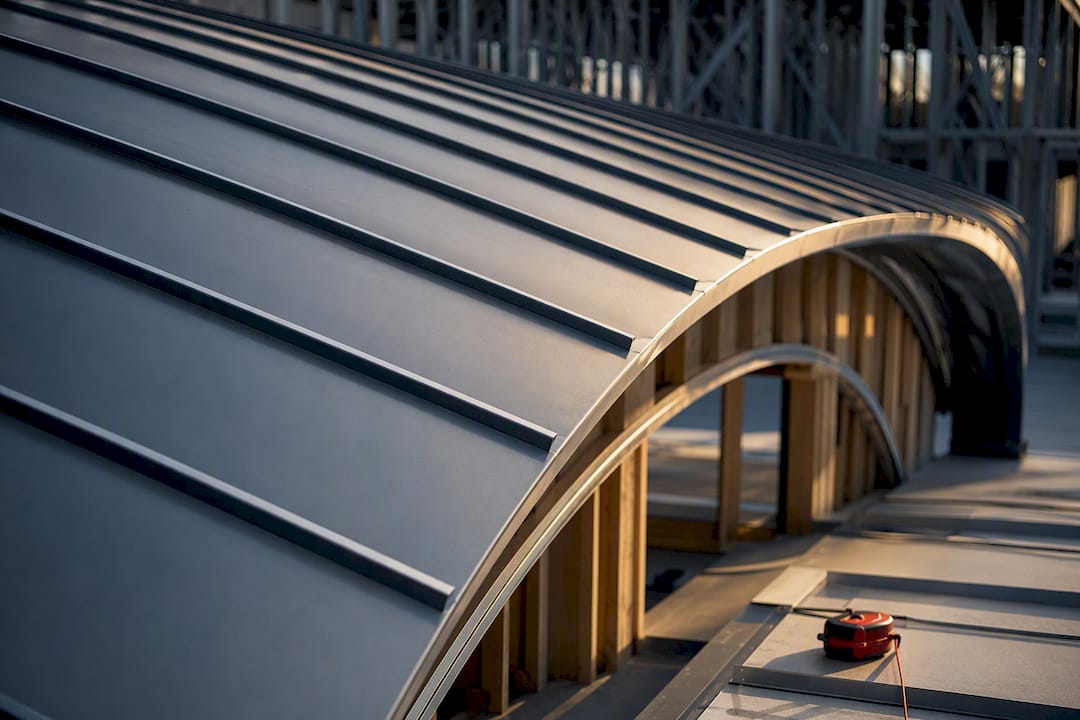
A contractor playbook for curved standing seam: three fabrication workflows, minimum radius limits, installation fixes, and delivery options.
Curved standing seam is a metal roofing system where standing seam panels are radius-formed to follow a curved surface instead of running straight, most often on barrel vaults, entry canopies, and arched building fronts. It delivers the same interlocking, watertight seam as flat standing seam roofing, but getting there takes specialized tooling, either at the factory or on the job site. If your project has a curve tighter than a gentle bow, plan for specialist fabrication from day one, not after the bid is signed.
TL;DR:
- Factory-curved panels provide the tightest tolerances but require lead time, making them ideal for long runs and tight radii.
- Minimum radius limits depend on panel profile, material, and seam type, with aluminum accepting tighter curves than steel.
- Field forming with portable tools offers flexibility for complex or irregular curves, but demands skilled labor and patience.
- Material selection affects bendability, with copper and aluminum being more forgiving than steel, especially for tight radii.
- Proper substrate preparation, clip spacing, and detailed flashing are critical to prevent oil-canning, leaks, or seam disengagement during installation.
Table of Contents
- What Is Curved Standing Seam Used For?
- Panel Profiles, Seam Types, and Minimum Radius Guidelines
- Fabrication Methods: Factory-Curved vs. Field Forming
- Choosing Materials and Gauges for Curved Panels
- Installation Detailing and Common Site Challenges
- Design, Estimating, and Specifying Best Practices
- How MidAtlanticMetalPanels Supports Curved Standing Seam Projects
- When to Bring in a Specialist Fabricator
- Get Curved Standing Seam Panels Delivered to Your Job Site
- Sources
- FAQ
What Is Curved Standing Seam Used For?
Curved standing seam shows up wherever a design calls for a rolled or arched roofline instead of a flat plane. Radius-formed panels are the standard approach for barrel vaults, arched entryways, and canopy structures where a hard break in the roofline would kill the design intent.
The appeal isn’t purely visual. A continuous curved seam keeps the same interlocking watertightness as a straight run, so you’re not sacrificing performance for looks. In most applications, curved panels are architectural cladding over a structural substrate rather than the load-bearing element itself, though some barrel-vault assemblies do ask the panel to contribute stiffness across the span.
Common applications include:
- Barrel-vaulted roofs on churches, pavilions, and event spaces
- Entry canopies and porte-cocheres at commercial and institutional buildings
- Arched façade accents that transition from vertical wall to curved roof
- Dormers and turret caps where a straight panel simply won’t wrap the geometry
Panel Profiles, Seam Types, and Minimum Radius Guidelines
Seam height drives how tight a curve you can form without distorting the panel. The three common families are 1 inch, 1.5 inch, and 2 inch seam heights, and each comes in either a snap-on or a mechanically seamed double-lock version. Snap-on systems clip together by hand and curve more forgivingly. Double-lock seams get crimped closed with a mechanical seamer and hold up better in high-wind or high-snow-load regions, but that extra material at the seam resists bending, which pushes the minimum radius wider.
Radius limits exist because the flat pan between seams has to stretch or compress as it wraps a curve, and metal only tolerates so much of that before it ripples or the seam leg deforms. Minimum radius guidance varies by profile and material, and tighter radii often force a switch to a different seam type entirely.
| Profile type | Approx. min. radius, steel | Approx. min. radius, aluminum | Notes |
|---|---|---|---|
| 1" snap-on seam | Tighter radii achievable | Slightly tighter than steel | Best for hand-forming on curved canopies |
| 1.5" snap-on seam | Moderate radius range | Moderate, slightly better than steel | Common general-purpose curved profile |
| 2" mechanical double-lock | Widest radius requirement | Wider than snap-on, but stiffer seam | Reserved for larger barrel vaults needing structural seam strength |
Always confirm exact figures with the panel manufacturer and project-specific engineering before locking in a profile, since alloy, temper, and coil width all shift the numbers.
Fabrication Methods: Factory-Curved vs. Field Forming
Three workflows dominate curved standing seam fabrication, and the right one depends on radius, run length, and how much you can control on site.
- Factory-curved panels. A shop pre-curves panels to exact radius specs before shipping. This gives the tightest tolerances and the least field adjustment, and it’s the default choice for tight radii or long production runs where consistency matters more than flexibility.
- On-site roll forming and cut-and-drop workflows. A mobile roll former produces panels to length right at the job site, which cuts transport headaches for long spans and trims material waste since you’re not hauling finished panels on a flatbed. On-site roll forming pairs well with cut-and-drop delivery for projects where panel length or access makes factory shipping impractical.
- Portable shrinker/stretcher and end-seaming anvils. These hand tools work the panel flange incrementally, shrinking or stretching the metal until it holds the target curve. Portable curving machines and seaming anvils let a skilled installer dial in radius on site, panel by panel, which is invaluable on compound curves that don’t match any standard factory radius.
Pro Tip: Shrinker/stretcher work rewards patience over speed. On copper and other soft, detail-sensitive materials, take the curve in small incremental passes and check fit against a radius template before locking in the seam. Rushing it is how you end up with a wavy flange nobody can hide.
Each method carries trade-offs. Factory curving needs lead time and locks in the radius before delivery. Field forming and hand tools give real-time flexibility but demand a crew that already knows how to read a curve and correct it before the seam closes.
Choosing Materials and Gauges for Curved Panels
Material choice and gauge decide how far a panel will bend before it fights back. Steel and aluminum dominate curved standing seam work, with copper reserved for higher-end architectural details where the extra malleability and cost are justified.
- 24-gauge and 26-gauge steel are the standard curved-panel gauges; 26-gauge bends more readily but sacrifices some rigidity, while 24-gauge holds a crisper line on larger vaults.
- Aluminum in comparable thicknesses generally accepts tighter radii than steel, which is why it shows up often on smaller canopies and tight-radius accents.
- Copper offers the most forgiving forming characteristics of the common roofing metals, but its cost limits it mostly to entryways and feature elements.
- Coatings and paint systems can crack or lose adhesion on tight radii, so factory-curved panels with pre-tested coatings are safer than curving a painted flat panel past its rated bend tolerance.
- Thermal expansion allowance matters more on curved runs than straight ones, since a curved clip layout has less room to absorb movement, making correct clip spacing and floating-clip selection a real specification item, not an afterthought.
Installation Detailing and Common Site Challenges
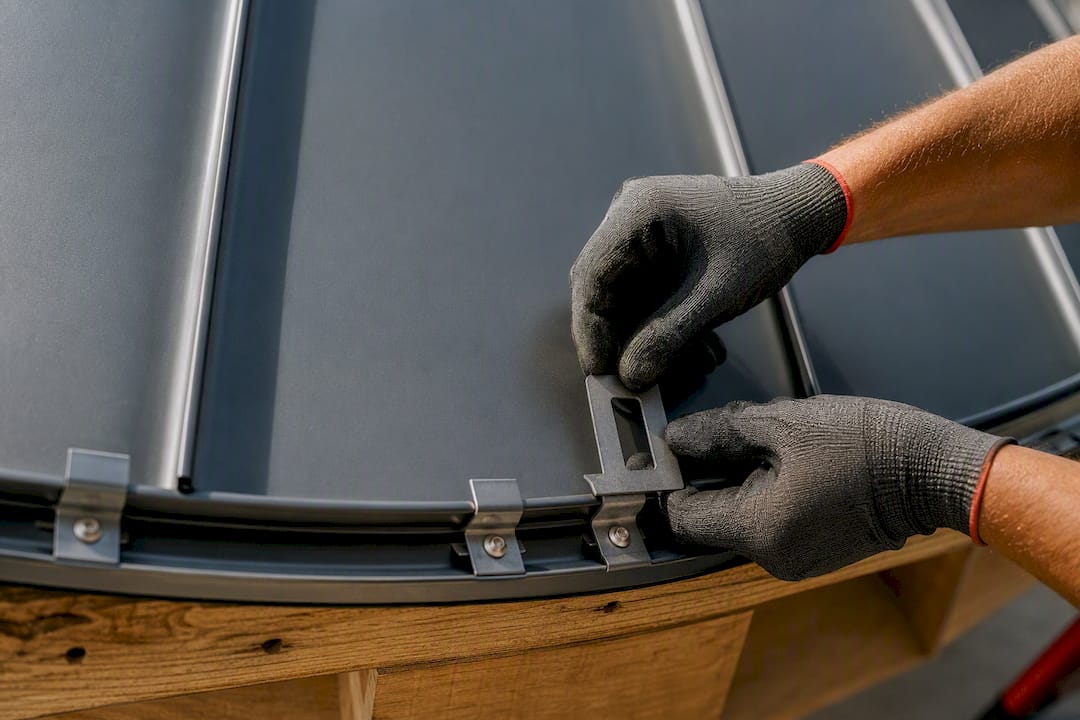
Getting a curved panel to hold its shape after installation depends as much on the substrate as the panel itself. Some snap-on seam systems are non-structural and specify a solid deck rather than open framing, so verify substrate requirements before the panel order goes out. Clip spacing on curves typically tightens up compared to straight runs, since the curve introduces additional stress points along the seam.
Key installation notes:
- Confirm whether the assembly needs solid deck, nailbase, or a bearing plate before panels arrive on site.
- Use temporary fastening to hold panel position while seaming, especially on tighter radii where the panel wants to spring back.
- Detail flashing transitions carefully anywhere a curve meets a straight run or terminates at an eave, since that’s where water finds the path of least resistance.
- Watch for oil-canning on shallow curves, seam disengagement on radii pushed past the panel’s rated minimum, and leaks at poorly detailed curve-to-straight transitions.
Pro Tip: Dry-fit a test section of curved panel and flashing before committing the whole run. It’s a lot cheaper to catch a bad radius or a flashing mismatch on one panel than after twenty are seamed together.
Following SMACNA-style installation best practices for clip spacing and seam engagement translates directly onto curved work, just with tighter tolerances than a flat run.
Design, Estimating, and Specifying Best Practices
Nesting curved panel layouts efficiently on the coil saves real money, since curved cuts generate more scrap than straight ones if the layout isn’t planned around the radius.
- Plan panel nesting before ordering to minimize scrap from curved cuts and reduce the number of coil changeovers.
- Decide between cut-and-drop and long factory lengths early, since factory-curved runs typically need longer lead times than field-formed cut-and-drop panels.
- Flag cost drivers up front, including custom trim, any compound curves, and the added field labor curved seaming always requires versus straight runs.
- Request full engineering notes and shop drawings from the fabricator, including radius tolerances and seam type, before finalizing the bid.
Estimating software built for complex takeoffs helps level bids on curved assemblies where scrap rates and labor hours are harder to eyeball than on a straight standing seam job.
How MidAtlanticMetalPanels Supports Curved Standing Seam Projects
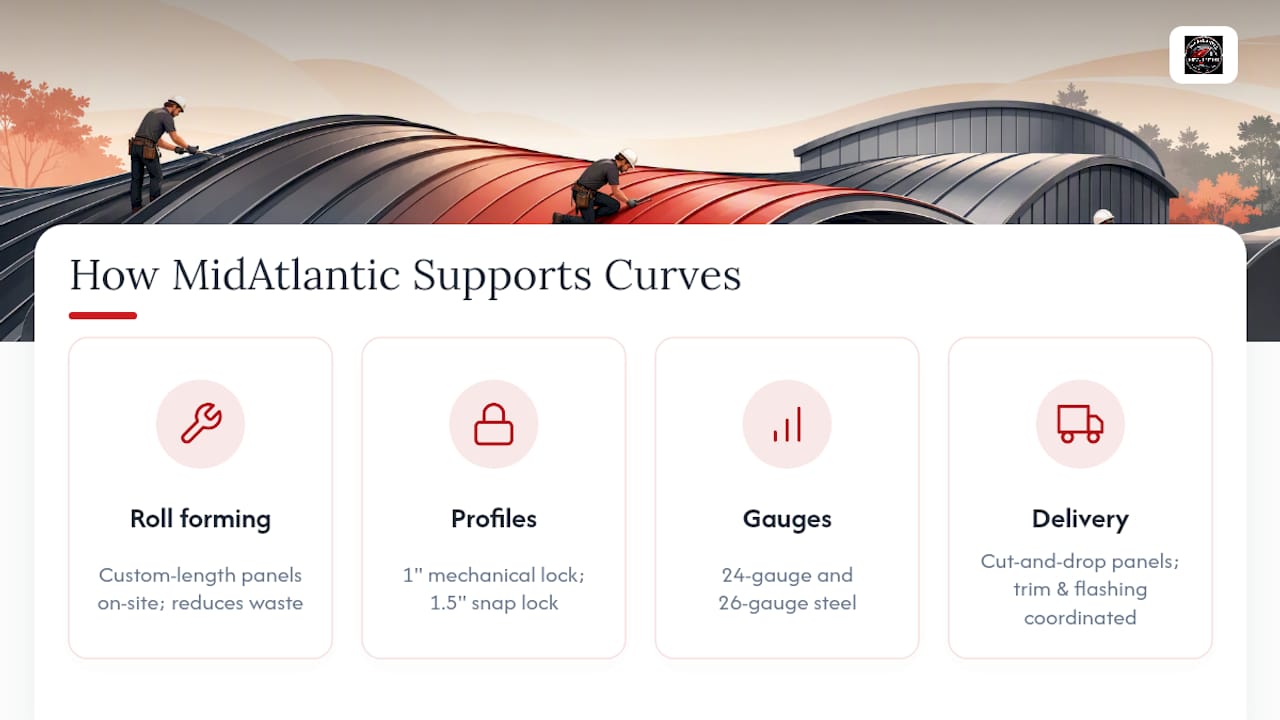
A contractor-focused supplier provides fabrication flexibility required for curved work in this region. Our on-site roll forming service produces custom-length panels right at the job site, cutting transport constraints and material waste on long or unusually shaped runs.
We manufacture 1" mechanical lock and 1.5" snap lock standing seam panels using Englert systems in 24-gauge and 26-gauge steel, and we coordinate trim and flashing packages alongside panel delivery so curve-to-straight transitions and end conditions get detailed correctly the first time. Cut-and-drop delivery provides crews with exact panel lengths on schedule, reducing the need for field-cutting overruns.
When to Bring in a Specialist Fabricator
Not every crew should attempt tight-radius curving. If the specified radius sits near the material’s published minimum, or the project involves compound curves, bring in a fabricator with dedicated curving experience rather than testing your luck on a live job. Weigh the schedule cost of outsourcing against the risk of a botched panel run eating your labor budget twice. Get radius tolerances and seam specs in writing before the first panel gets cut.
— Matt Catino
Get Curved Standing Seam Panels Delivered to Your Job Site
MidAtlanticMetalPanels cuts the guesswork out of curved panel sourcing. Instead of waiting weeks on a distant factory run, contractors in our service area get on-site roll forming and cut-and-drop delivery timed to their actual schedule, plus matching trim and flashing packages so nothing gets held up waiting on a separate order.
Before you request a quote, have your radius specs, preferred seam profile (1" mechanical or 1.5" snap lock), and rough panel lengths ready. It speeds up the estimate and avoids back-and-forth later. Browse examples of completed curved and straight standing seam work in our project gallery, then reach out through our architectural metal roofing page to start your quote.
Sources
- AIA Florida design inspiration and metal recommendations (PDF)
- Making Curved Standing Seam Panels | Stortz
- Roofing Contractor Bid Software | ArosBid
FAQ
What Is a Curved Standing Seam Roof?
It’s a standing seam metal roof where panels are radius-formed to follow a curved surface, most commonly used on barrel vaults, canopies, and arched entryways rather than a flat plane.
Can Standing Seam Metal Be Used on a Curved Roof?
Yes, standing seam panels regularly get curved through factory pre-forming or field techniques like roll forming and shrinker/stretcher tooling, though the achievable radius depends on the profile and material chosen.
What Is a Curved Roof Called?
A curved roof used in this context is generally called a barrel vault or barrel roof when it forms a continuous arch, though canopy and arched-entry designs use the same curved standing seam approach on a smaller scale.
How Do You Bend Standing Seam Roof Panels?
Panels get bent either at the factory using precision curving equipment before shipping, or on site with portable shrinker/stretcher tools and seaming anvils that incrementally work the panel flange to the target radius.
Does MidAtlanticMetalPanels Supply Panels for Curved Roofing Projects?
MidAtlanticMetalPanels supplies 1" mechanical lock and 1.5" snap lock standing seam panels, along with on-site roll forming and cut-and-drop delivery, to contractors working on curved and straight roofing projects across its service area.