ENERGY STAR Metal Roofs: What Replaced the Label
The ENERGY STAR roof label ended in 2022. See what replaced it for metal roofs, how SRI and CRRC ratings work, and how LEED heat island credits apply.
You can no longer buy an “ENERGY STAR metal roof,” because EPA ended the ENERGY STAR program for roof products on June 1, 2022. What specs, codes and green building programs ask for now is a third-party rating of solar reflectance and thermal emittance, usually from the Cool Roof Rating Council (CRRC), and for LEED, a Solar Reflectance Index (SRI) value that meets the credit threshold. This guide shows contractors and builders how to meet those requests on a standing seam job.
TL;DR
- EPA sunset the ENERGY STAR specification for roof products effective June 1, 2022. Packaging and literature may no longer carry the mark.
- The working replacement is a CRRC product rating: initial and aged solar reflectance, thermal emittance and SRI for a specific coating and color.
- LEED heat island credits ask for SRI thresholds, not a label. Many steel roofing finishes can meet them, but color matters.
- Being cool-rated or LEED-friendly does not by itself earn a federal tax credit.
- Collect the manufacturer’s SRI documentation before you order panels, not after the submittal is rejected.
Table of Contents
- What happened to the ENERGY STAR roof label
- The replacement: CRRC ratings, SRI and emittance
- LEED credits for metal roofing
- Local cool roof rules in our market
- Does a cool-rated metal roof earn a tax credit?
- Perspective: why we spec by rating, not by label
- Ordering panels for a rated roof
- A quick checklist before you order
- FAQ
- Sources
What happened to the ENERGY STAR roof label
EPA’s decision memo finalized the sunset of the ENERGY STAR specification for roof products. Brand owners had to stop using the ENERGY STAR name and mark on roof products from June 1, 2022. The memo also records that commenters pointed to strong commercial-sector standards for efficient roofs, and that a simple pass/fail label was a poor fit for the cost-effectiveness choices residential buyers face.
The Cool Roof Rating Council tracked the change and says that no roofing products on the market are certified to ENERGY STAR after that date. Its later information sheet adds that a product still showing the label on packaging is technically no longer certified as meeting a performance standard, and that EPA prohibits the label on roofing packaging and literature. That is why you still see old spec language and old web pages that mention ENERGY STAR metal roofs: they were written before the sunset and never updated.
What this means on a real bid:
- If a spec, municipal ordinance or incentive form says “ENERGY STAR roofing,” it is out of date. Ask the specifier what rating they will accept instead. In most cases it is a CRRC-rated product meeting a stated reflectance or SRI value.
- Do not hand a customer a submittal that claims ENERGY STAR status for a roof panel. The claim is no longer valid.
- The energy performance of the roof did not change when the label did. Reflective finishes still reflect.
The replacement: CRRC ratings, SRI and emittance
The CRRC runs the CRRC-1 Product Rating Program, a third-party system that has existed since 2002. It rates roofing products on solar reflectance and thermal emittance, each from 0 to 1, and lists more than 3,000 products in a public directory. Its 2022 information sheet explains the key difference from the old label: nearly any roofing product can be tested and rated, and each jurisdiction sets its own requirements for what counts as a cool roof.
Three numbers matter:
| Property | What it measures | Why it matters on a metal roof |
|---|---|---|
| Solar reflectance | Share of sunlight the surface reflects (0 to 1) | Lighter and cool-pigment finishes reflect more |
| Thermal emittance | How readily the surface releases absorbed heat (0 to 1) | Painted metal has high emittance; bare metal has low |
| SRI | Combines both into one index | The figure LEED and many codes quote |
Each number comes in an initial value (new) and an aged value (typically after three years of weathering). Codes and credits specify which one they accept, so read the line carefully. For a deeper walk through the index itself, see our explainer on metal roof SRI and how to use it.
Why the finish matters more than the metal
Bare metal reflects well but releases heat poorly. A painted finish adds the emittance that makes a roof perform. A 2001 Oak Ridge National Laboratory study found that, for predominantly cooling-load climates, a painted metal surface with moderate reflectance and high emittance gave the best thermal performance. For predominantly heating-load climates, the best performer had moderate reflectance and low emittance.
That matters in the Mid-Atlantic, where you design for both a hot summer and a cold winter. David McAlister’s field research on painted metal roofs makes the same point: the best surface properties depend on the dominant climate load. In his side-by-side tests on Habitat homes in Fort Myers, Florida, white reflective metal roofs cut cooling energy use by 18 to 26 percent and peak demand by 28 to 35 percent. Fort Myers is a cooling-dominated climate, so treat those figures as a hot-climate result, not a promise for a Pennsylvania farmhouse.
EPA’s heat island program gives a broader picture. It states that in air-conditioned homes, a cool roof can reduce peak cooling demand by 11 to 27 percent, and in homes without air conditioning it can lower maximum indoor temperatures by 2.2 to 5.9°F. The same page lists metal shingles or tiles coated with reflective paint among steep-slope cool roof technologies.
Choosing a color
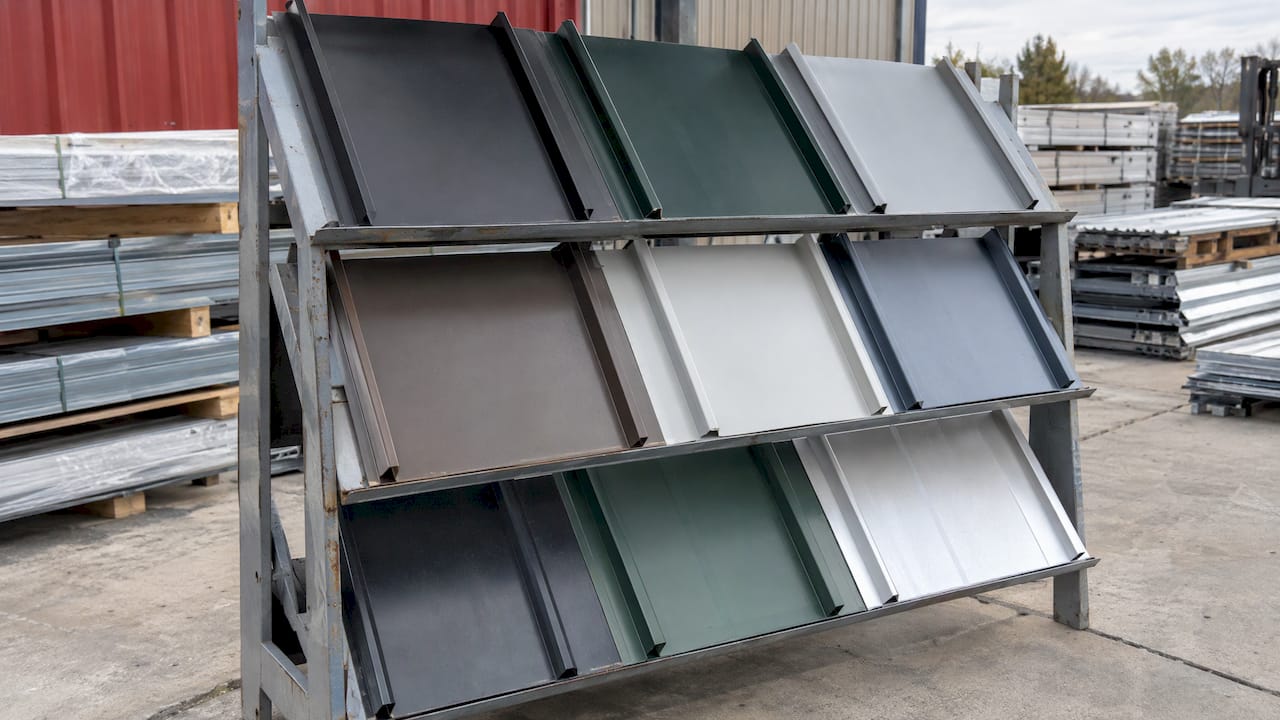
Dark roofs are still on the table. Many architects want matte black or deep green on a standing seam roof, and cool-pigment technology exists so that darker colors can reach higher reflectance than their ordinary versions. The practical step is to match your color choice to a rating. Check the coating’s CRRC listing for the exact color name before you commit, then confirm it against the project requirement. Browse our standing seam metal roof colors and ask your supplier rep for the paint system’s rating documents for the color you pick.
LEED credits for metal roofing
Metal roofing does not earn LEED points because it is metal. It earns them through specific credits, and the one that applies most directly is Heat Island Reduction.
Heat Island Reduction
Under LEED v5, the Heat Island Reduction credit offers up to 2 points for BD+C New Construction and Core & Shell, and 1 point for O+M Existing Buildings when cool roofs are used. The CRRC’s LEED page notes that the roof requirement relies on an aged SRI at or above the table thresholds, and when an aged value is not available, the initial SRI must meet the applicable table value.
Many projects are still registered under LEED v4.1. For BD+C, Option 1 requires roofing with an aged SRI of at least 82 on low-slope roofs (2:12 or less) or 39 on steep-slope roofs (more than 2:12). The 3-year aged alternatives are 64 and 32. The materials must cover at least 75 percent of the total roof area. Most standing seam jobs are steep-slope, which is where the lower thresholds apply.

Steel suppliers have long said that many steel roofing products reach the reflectance or SRI criteria, and that reflective pigment technology allows a wider range of colors to qualify. The same fact sheet notes that the LEED v4 Reference Guide allows a default value of 25 percent post-consumer recycled content for any steel product, with higher values possible when supported by supplier-specific information. That can feed the materials credits, though the heat island credit is the cleaner fit for roof surface performance.
Homes follow a different track. The LEED v4.1 Single Family draft named ENERGY STAR qualified roof products in appropriate slopes as an acceptable strategy under its nonabsorptive materials option. Because that label is gone, confirm with the project’s LEED rater which rating they now accept.
What to hand the green rater
The USGBC reference guide tells teams to gather manufacturer documentation of SRI. Selected materials may meet either the initial SRI threshold or the 3-year aged threshold, and they do not have to meet both. A practical packet looks like this:
- The CRRC product ID or the manufacturer’s rating letter for the exact coating and color.
- Initial and aged solar reflectance, thermal emittance and SRI values.
- The roof area by slope, so the 75 percent calculation can be shown.
- The color and gauge on the order, matched to the rated product.
The fastest way to lose a point is a color swap after submittal. If the owner changes from a light gray to a darker bronze, the SRI changes with it.
Landscape also counts toward the same credit family. Shade and vegetation lower surface temperatures, and tree cover and urban heat evidence is worth a look when your site plan has room for nonroof measures alongside the roof.
Local cool roof rules in our market
LEED is voluntary. Local code is not. Some jurisdictions write reflectance or SRI minimums into law. The CRRC’s codes page lists examples such as a 3-year aged SRI of 64 for certain roof types, and some cities set separate initial SRI minimums for low-slope and steep-slope roofs.
If you work in Washington, DC, read our breakdown of DC cool roof requirements and the 75 percent test. For Virginia, Maryland, Pennsylvania and West Virginia, the energy code adopted by the county or city is the document to check, because adoption and amendments differ by jurisdiction. Confirm with the building official before you order.
Code review also covers slope and underlayment. Our IBC metal roofing checks cover slopes down to 1/4:12, and our guide to metal roof over insulation covers assemblies where the energy code and the roof build-up meet.
Does a cool-rated metal roof earn a tax credit?
Not automatically. The IRS lists the qualified energy-efficiency improvements under the 25C credit as exterior doors, exterior windows and skylights, and insulation or air-sealing materials or systems. The credit is generally 30 percent of qualifying costs, up to $1,200 a year, for property placed in service on or after January 1, 2023, and before January 1, 2033, per the IRS FAQ published in January 2025. A roof surface does not appear on that list, so neither a high SRI nor LEED eligibility creates a federal credit by itself.
Because tax law changes, send homeowners to the current IRS page or their tax professional rather than promising a credit. Local utility or municipal incentives sometimes reference cool roof ratings, which is one more reason to keep the CRRC paperwork on file.
Perspective: why we spec by rating, not by label
We hear “ENERGY STAR metal roof” on estimating calls almost every week, and the honest answer is that the label is gone. What contractors need is a rated finish, the right color for the climate, and panels that arrive at the correct length so the roof goes on once.
Our work is cut-and-drop standing seam, 24-gauge and 26-gauge steel on Englert systems, in 1-inch mechanical lock and 1.5-inch snap lock profiles. When a project carries an SRI or LEED requirement, we think the order should start with the rating documents for the color, then the takeoff, then the trim and flashing package in the same finish, so the whole envelope reads as one system to the rater.
Panels cut to the job length also mean fewer end laps and less scrap, and a cleaner submittal because the quantities match the plan. That is how we try to make green-building paperwork less of a fight on a tight schedule.
Matt Catino
Ordering panels for a rated roof
We supply roofing contractors, builders and general contractors across Virginia, Maryland, Washington DC, Pennsylvania and West Virginia. Our 1-inch mechanical lock and 1.5-inch snap lock standing seam panels come in 24-gauge and 26-gauge steel, cut to length and delivered to the job site through cut-and-drop delivery.
If your plan set includes an SRI or cool roof requirement, send the color, slope and roof area with your request through our contractor supply page, and our team can work the takeoff with you. You can size materials in advance with the metal roofing materials calculator, and match trim to the panel color through our trim and flashing packages. Panel dimensions and profile details are on the panel specs page.
A quick checklist before you order
- Read the spec for the exact words. “ENERGY STAR” means ask the specifier for the current accepted rating.
- Identify the roof slope. Above 2:12 is steep-slope under the LEED thresholds above; at or below it is low-slope.
- Choose the color, then pull its CRRC rating or manufacturer letter for that exact color.
- Check whether the project needs initial or aged values, and which edition of LEED or local code applies.
- Calculate the share of roof area covered by the rated material.
- Order trim and flashing in the matching finish, and keep every rating document in the project file.
FAQ
Can I still advertise a metal roof as ENERGY STAR?
No. EPA prohibits the ENERGY STAR mark on roofing packaging and literature after the program’s sunset on June 1, 2022. Describe the roof by its CRRC-rated solar reflectance, thermal emittance and SRI instead.
What replaces ENERGY STAR for metal roofs?
The CRRC-1 Product Rating Program is the most widely used replacement. It rates products on solar reflectance and thermal emittance, and its public directory lets specifiers and building officials look up a coating and color. Each jurisdiction decides what values it will accept.
Can a metal roof help earn LEED points?
Yes, through the Heat Island Reduction credit when the roofing meets the required SRI and covers enough of the roof area. Under LEED v4.1 BD+C that area is at least 75 percent. Whether a given color qualifies depends on its rated values, so gather the manufacturer’s documentation first.
Does a reflective metal roof qualify for the federal energy tax credit?
Not on that basis alone. The IRS FAQ for the 25C credit lists doors, windows and skylights, and insulation or air-sealing materials, and a roof surface is not among them. Check the current IRS guidance or ask a tax professional before telling a customer to expect a credit.
Sources
- ENERGY STAR Roof Products Sunset (EPA decision memo)
- ENERGY STAR Roofing Program Sunsets (Cool Roof Rating Council)
- CRRC information sheet, January 2025
- CRRC information sheet, 2022
- CRRC codes, programs and standards
- CRRC: LEED certification
- EPA: Using Cool Roofs to Reduce Heat Islands
- Oak Ridge National Laboratory: Thermal Performance of Painted and Unpainted Metal Roofs
- Painted Metal Roofs Are Energy-Efficient, Durable (McAlister)
- USGBC LEED v4.1 BD+C rating system
- USGBC LEED v4.1 Single Family draft
- USGBC heat island reduction credit reference guide
- Steel Market Development Institute: LEED v4 fact sheet for steel roofing
- IRS FS-2025-01: Energy efficient home improvement credit FAQ
- Trees and urban heat: evidence for planners and homeowners