Ice Dams on Metal Roofs: Causes, Prevention and Underlayment

Ice dams on metal roofs come from heat loss, not the panels. Learn the causes, where ice and water shield goes, and how contractors cut leak risk.
Ice dams on metal roofs form for the same reason they form on any roof: heat from the building melts snow, and the meltwater refreezes at the cold eave. Metal sheds snow well, but it does not change that physics. The fixes that work are in the assembly: air sealing, insulation, ventilation, an ice barrier underlayment at the eaves and valleys, and a sensible plan for sliding snow. This guide is written for contractors and builders who spec, order and install standing seam roofs in snow country.
TL;DR
- Ice dams come from heat reaching the roof deck, so the cure is air sealing, insulation and ventilation, not the roof covering alone.
- Self-adhering ice and water membrane at eaves and valleys is the backup layer when water does get behind the ice. NRCA recommends it where the average January temperature is 30°F or lower.
- Snow guards do not cause or prevent ice dams. They control where snow lets go.
- Heated cable gives meltwater a path off the roof. It does not stop ice from forming.
- Long, continuous panels mean fewer horizontal laps for backed-up water to find. Order lengths to the eave.
Table of Contents
- How ice dams form on a metal roof
- Where the heat comes from
- Do metal roofs prevent ice dams?
- Snow guards and ice dams
- Ice and water shield under metal roofing
- Prevention checklist for contractors
- Panel length, laps and eave details
- If an ice dam forms or a roof leaks in winter
- Our perspective
- Order panels, trim and flashing for snow country
- FAQ
- Sources
How ice dams form on a metal roof
The mechanism is simple. According to the University of Minnesota Extension, an ice dam needs three things at once: snow on the roof, higher roof areas above 32°F, and lower areas below 32°F for a sustained period. Snow melts over the warm zone, runs down the slope, and refreezes where the roof is colder, usually at the eave overhang.

The Building America Solution Center lists the common causes as insufficient insulation or thermal bridging, air leakage, heat sources in the roof, and differences in snow thickness. Building Science Corporation’s BSD-135 describes the same chain: heat reaches the sheathing through missing insulation or air leaks, melts the snow, and the water refreezes at the cold eave.
NRCA’s ice damming guidance adds the part that matters for leaks. The ice formation acts like a dam and makes meltwater back up beneath the primary roof covering, where it can reach the building interior.
Why the panel is not the cause
A standing seam panel is a poor place for snow to cling, and a metal roof is no more likely than another roof type to cause an ice dam. What decides whether the deck gets warm is what sits below the panels: how much heat leaks up from the living space, how well the insulation is placed, and whether air moves under the deck. A new metal roof over a leaky ceiling plane will still show ice at the eave, because the heat source did not change when the roof did.
For contractors, this matters at the customer conversation. A homeowner who sees icicles after a re-roof may blame the new panels. Walk them through the assembly instead, and the attic air leaks that need sealing.
Where the heat comes from
On most callbacks the heat source is one of a handful of repeat offenders:
- Attic bypasses. Open top plates, recessed lights, duct chases, plumbing and wiring penetrations, and attic hatches let warm air rise into the roof space.
- Thin or uneven insulation. Gaps over wall plates and thermal bridging at rafters leave warm strips in the deck.
- Heat sources in the roof. Ducts, flues and mechanical equipment in or under the roof assembly warm the deck above them.
- Uneven snow depth. Drifts and snow that stays deep against walls or dormers insulate the deck and shift where melt starts.
Air leakage is the one that surprises people. Warm indoor air carries far more heat into the attic than conduction through insulation does, and the same principle applies to openings in any building envelope. If you want a plain-language look at how leaks form and get fixed at openings, this explainer on common causes of air leakage is a useful companion for the envelope side of the problem.
Do metal roofs prevent ice dams?
Not by themselves, and it is worth being exact about what a metal roof does contribute. Smooth, slick panels let snow slide off before it builds a deep bank, and a roof that sheds can have less snow sitting over a warm deck. That is a real benefit. It is not a guarantee, and it does nothing about heat loss from the building below.
The IIBEC guidance on metal roof icing says building heat is the primary cause of ice dams and icicles on warm roofs that drain to cold eaves. Adding insulation helps, but ventilation is the key to keeping a cold roof cold. Building Science’s BSD-102 agrees that in cold climates the main ice-dam job of ventilation is to hold the roof at a cold temperature, which controls melting and refreezing, and to carry away moisture moving up from the conditioned space.
So the honest answer for your customer: the right metal roof system on a well-built, well-sealed, well-ventilated assembly performs very well in winter. The roof covering is one part of that system.
Snow guards and ice dams
Snow guards come up in every ice dam discussion, and the confusion is common. They are about sliding snow, not about ice formation.
A 2004 ORNL/ASHRAE conference paper on snow retention states that snow guards do not cause ice dams, because they have no effect on roof temperatures. The same paper explains the theory: restrain the base of a snow bank and you restrain the bank. It also notes that placing retention near the eave is effective because snow banks densify and build wedge patterns.
What this means on a job:
- Decide snow retention based on what is below the eave: doors, walkways, driveways, lower roofs, gutters, landscaping.
- Do not sell snow guards as an ice dam fix. They will not stop meltwater from refreezing.
- Lay out retention to the manufacturer’s guidance and the loads the roof was designed for, and coordinate with the panel profile and seam type you are using.
- Remember that any protrusion above the panel surface can act as a crude snow guard, as the ORNL paper points out. Think about that at ridge details, skylight curbs and similar features before the first storm.
Ice and water shield under metal roofing
This is where contractors have the most control. Ice and water shield is a self-adhering, polymer-modified bitumen membrane. If an ice dam does back water up the slope, it is the layer that keeps that water from reaching the deck and the interior.
ASTM’s D1970 specification covers these materials as underlayment for eaves or valleys to prevent leakage of shingle, tile or metal roofs from water backup due to ice dams. So yes, metal roofs are explicitly in scope.
When to use it
NRCA recommends water and ice-dam protection membranes where the average January temperature is 30°F or lower. It also notes that the 2012 International Building Code requires an ice barrier where there is a history of ice forming along the eaves and causing water backup. Local code adoption varies, so confirm what your jurisdiction enforces before you bid. Our contractor article on IBC metal roofing checks covers other code items worth confirming at the same time.
How far up the slope
NRCA’s preferred approach is a single layer of self-adhering polymer-modified bitumen sheet complying with ASTM D1970, started at the eave and extended upslope to a point 24 inches, measured horizontally, from the inside of the exterior wall line. The code language for the alternative is at least two layers cemented together.
Building Science’s BSD-135 frames it as a water-management question: the membrane should rise high enough to resist a 6 to 8 inch height of water above the edge of the wall insulation. On a deep overhang or a thick insulated assembly, 24 inches of horizontal coverage may not be enough to reach that height, so measure from the wall line rather than the fascia.
Deck and installation details
GCP’s technical letter TL-0007 on architectural metal roofing is a manufacturer’s instruction, so treat it as that. It says the membrane goes directly onto a clean, dry, continuous structural deck with no voids, damaged or unsupported areas. It also says mechanically fastened rigid insulation can go over the self-adhered membrane, and that rigid insulation should not be hot mopped onto it.
Field habits that pay off:
- Keep the deck dry and swept. Adhesion fails on dust and moisture.
- Run the membrane from the eave up, lapped shingle fashion so water sheds over every seam.
- Carry it up valleys, and plan the tie-in at penetrations before panels go on. Chimney and skylight areas collect snow and meltwater, so the flashing and membrane have to be one detail. See our guides to chimney flashing and skylight flashing on standing seam.
- Mind temperature limits and handling in the cold. Our winter metal roof installation guide covers working through the season.
If your assembly includes rigid insulation above the deck, read our article on metal roof over insulation so the layer order and fastening match what the code expects.
Prevention checklist for contractors
Prevention is a stack of small decisions. Run through this list on every cold-climate quote:
| Layer | What to check | Why it matters |
|---|---|---|
| Air sealing | Attic hatches, top plates, penetrations, recessed lights | Stops warm air from reaching the deck |
| Insulation | Continuous coverage over wall plates, no gaps | Keeps heat in the living space |
| Ventilation | Clear intake and exhaust path where the assembly calls for it | Holds the deck cold and moves moisture |
| Ice barrier | Self-adhering membrane at eaves and valleys, to the right height | Backup if water gets behind ice |
| Panels | Continuous lengths from eave to ridge where practical | Fewer laps at the eave line |
| Flashing | Eave, valley and penetration flashing coordinated with the membrane | Water has no easy route in |
| Snow retention | Sized and placed for what is below the eave | Controls release, not ice formation |
The order matters. The first three rows reduce how often ice dams form. The next three reduce the damage when they do. The last row manages the safety of the roof’s edge.
Heated cable: what it does and does not do
The IIBEC paper on electric heating systems is clear that these systems do not stop icings from occurring. They provide a path for meltwater to drain off the roof, which greatly reduces the size of ponding and icing and lowers leak risk. Position them as a targeted tool for a problem eave or valley, after the building-side fixes, not a replacement for them.
Panel length, laps and eave details
A metal roof leaks from ice backup mostly at joints: horizontal end laps, penetrations, and eave and valley terminations. Fewer joints in the wet zone means fewer paths for backed-up water.
This is one reason many contractors like cut-and-drop delivery, where panels arrive cut to the lengths on the takeoff. When the panel runs eave to ridge in one piece, there is no end lap in the area where ice sits. Our cut-and-drop metal roofing page explains how we handle ordering, and our guide on how long standing seam panels can be covers length limits. For long runs or tight access, on-site roll forming lets a crew form panels at the job.
Trim matters just as much at the eave. Drip edge, eave closures and valley flashing should be ordered as a coordinated package with the panels, so the membrane, trim and panel edge all lap in the same direction. Our trim and flashing packages are built for that.
If an ice dam forms or a roof leaks in winter
Your customers will call you in January, so have a plain script ready. The signs are water stains or moisture in the attic or ceiling, large icicles at the roof edge, and ice forming over gutters, according to Travelers’ ice dam guidance.
That same guidance suggests, only if the roof can be reached safely from the ground, using a roof rake to clear snow 3 to 4 feet from the edge. To open a drainage channel, it suggests calcium chloride ice melt in a nylon stocking, not rock salt (sodium chloride). If the roof cannot be reached safely, hire a contractor.
Safety comes first on a metal roof. Wet or frosted panels are slippery, and a roof rake from the ground is a very different job from climbing onto a snow-covered slope. Do not send a homeowner up a ladder in icy conditions, and do not chip at ice with a hatchet or shovel, which can damage panels, seams and finishes. A roofing contractor with fall protection should handle anything beyond a rake from the ground.

Once the weather clears, trace the leak. Water often enters well above where it shows up inside, so check eave terminations, valleys and penetrations, and look for attic air leaks that fed the problem. If the repair turns into a larger scope, a roof repair cost breakdown helps set expectations with the owner.
Our perspective
We supply standing seam panels to contractors across Virginia, Maryland, Washington DC, Pennsylvania and West Virginia, so we hear about winter callbacks every year. The pattern is consistent: the roof gets blamed, and the cause turns out to be heat and air coming up from below.
Our view is that a standing seam roof is one of the strongest choices a contractor can put on a cold-climate building, as long as the assembly is treated as a system. Seal the ceiling plane, insulate and ventilate to the design, put a proper ice barrier at the eaves and valleys, and then let the panel do what it is built to do.
That is why we focus on how panels get to the job. Custom-length cut-and-drop panels reduce end laps and waste. Coordinated trim and flashing packages mean the eave, valley and penetration details are planned with the panels instead of improvised on the roof. Our 1-inch mechanical lock and 1.5-inch snap lock panels come in 24-gauge and 26-gauge Englert steel, so you can match the profile to the project. When access or length is a challenge, on-site roll forming gives your crew another option.
Ask us early about the eave and valley details on a snow-load job. A few minutes on the takeoff is cheaper than a winter leak call.
Matt Catino
Order panels, trim and flashing for snow country
If you are bidding a standing seam roof where ice dams are a real risk, we can help you get the materials right the first time. We supply 1-inch mechanical lock and 1.5-inch snap lock standing seam panels cut to your lengths and delivered to the job site, along with matching trim, flashing and accessories, and takeoff support for contractors.
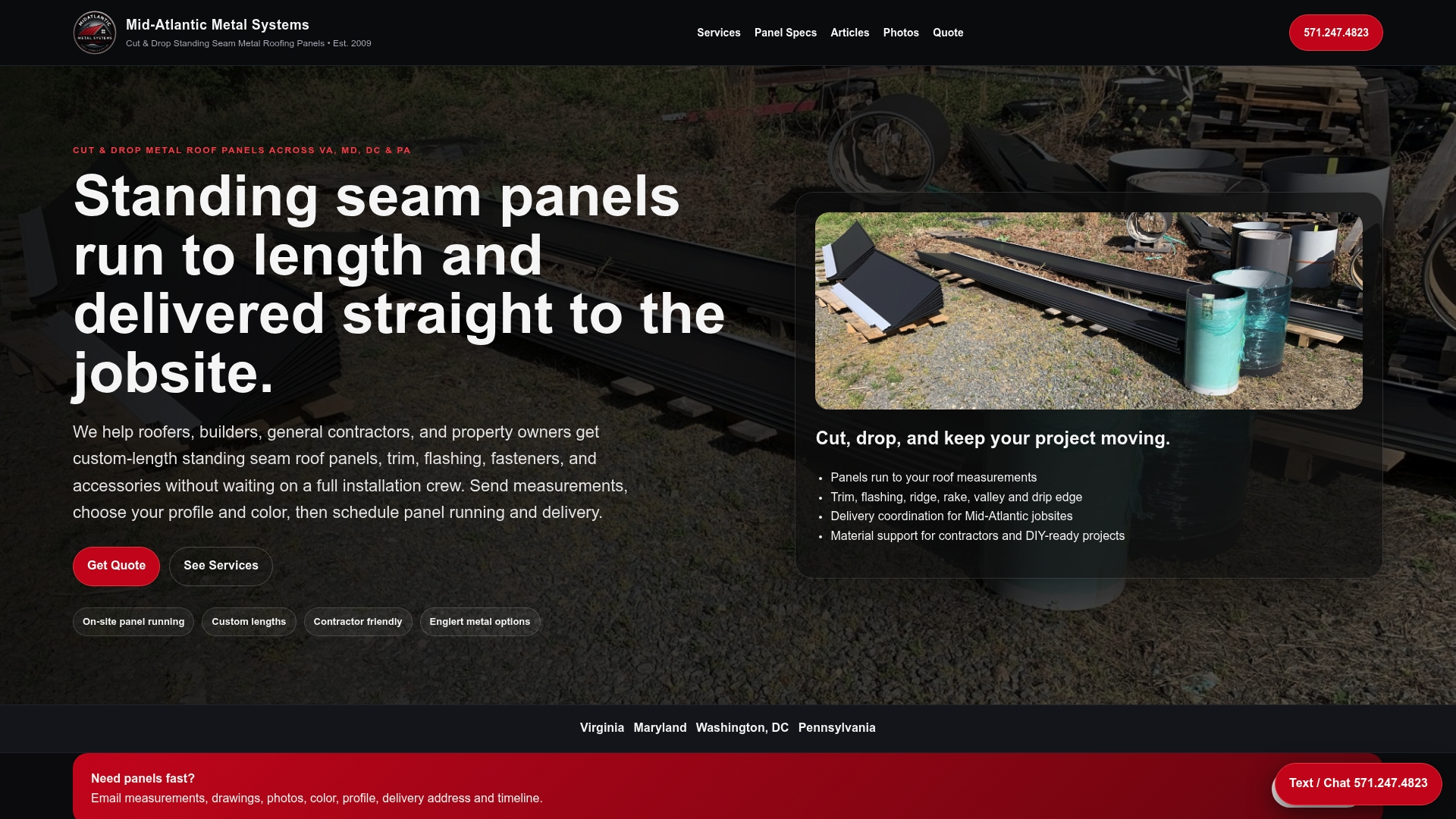
Send us your plans and eave details through our contractor supply page, and see our panel specs for gauges and profiles.
FAQ
Do metal roofs get ice dams?
Yes, they can. Ice dams are driven by heat escaping from the building and snow melting over a warm deck, which applies to any roof covering. A smooth metal surface sheds snow readily, but air sealing, insulation, ventilation and an ice barrier at the eaves still decide how the roof performs.
Do you need ice and water shield under a metal roof?
In cold climates, usually yes at the eaves and valleys. NRCA recommends ice dam protection membranes where the average January temperature is 30°F or lower, and the 2012 IBC requires an ice barrier where eave ice has a history of causing water backup. Check the code your local jurisdiction has adopted and the panel manufacturer’s underlayment requirements.
How far up the roof should ice and water shield go?
NRCA’s preferred method is a single layer of ASTM D1970 self-adhering membrane from the eave to a point 24 inches, measured horizontally, inside the exterior wall line. Building Science says the membrane should rise high enough to resist 6 to 8 inches of water above the edge of the wall insulation, so check the height on deep-overhang roofs.
Does homeowners insurance cover ice dam damage?
Often, though the policy decides. Massachusetts’ Division of Insurance says damage from the weight of ice and snow or from ice dams is generally covered, but only for the damaged area, and not wear and tear or neglect. Oregon’s Division of Financial Regulation says sudden and accidental ice dam events may be covered and tells owners to review exclusions with their insurer.
Sources
- Construct Roofs and Attics for Ice Dam Prevention, Building America Solution Center
- BSD-135: Ice Dams, Building Science Corporation
- BSD-102: Understanding Attic Ventilation, Building Science Corporation
- Dealing with and preventing ice dams, UMN Extension
- Ice damming season, NRCA
- The Pitfalls of Snow Retention on Metal Roofing, ORNL/ASHRAE
- Electric Heating Systems for Combatting Icing Problems on Metal Roofs, IIBEC
- ASTM D1970 Standard Specification for Self-Adhering Polymer Modified Bituminous Sheet Materials
- TL-0007 Use Under Architectural Metal Roofing, GCP Applied Technologies
- How to Identify and Help Remove an Ice Dam, Travelers
- Frequently Asked Questions about Homeowners Insurance, Mass.gov
- Storm damage, Oregon Division of Financial Regulation
- Common causes of air leakage
- Roof repair cost breakdown