Metal Roof SRI: What It Means and How to Use It

Metal roof SRI explained for contractors: how it's calculated, typical values by finish, what it does to cooling costs, and how to spec it right.
SRI, the Solar Reflectance Index, is a single number from roughly 0 to 100 that shows how well a roof surface stays cool in the sun. A standard black surface scores 0, a standard white surface scores 100, and a higher number means a cooler roof. For a metal roof, the number depends mostly on the finish and color, and it drops as the panel ages and gets dirty. If a spec, a code section or a customer asks for an SRI, you need the right number from the right source, and you need to know what it will and won’t do for the building.
TL;DR
- SRI combines solar reflectance and thermal emittance into one score. Black reference is 0, white reference is 100, and the score can go below 0 or above 100.
- Finish drives the number. Examples from Lawrence Berkeley National Laboratory: standard gray around 19, clean bare zincalume steel around 68, bright white around 107.
- Use the aged rating from a CRRC-listed product when a spec or code asks for proof. Initial values overstate what the roof will do after a few years.
- Energy savings are real but modest and climate-dependent. They are largest in hot, cooling-dominated regions and smaller in cold ones.
- Ask for the SRI on the specific finish and color before you order panels, not after the takeoff is done.
Table of Contents
- What SRI actually measures
- Typical SRI values for metal roof finishes
- How color, coatings and aging change the number
- Does a higher SRI save money?
- Where SRI shows up in specs and codes
- How to check SRI before you order
- Our perspective
- Planning a job with an SRI requirement?
- Choosing a finish when SRI is only part of the decision
- FAQ
- Sources
What SRI actually measures
A roof gets hot because it absorbs sunlight. How much hotter than the air depends on two properties. Solar reflectance is the share of sunlight the surface bounces back. Thermal emittance is how readily the surface gives off the heat it has absorbed. Both are expressed from 0 to 1.
The Cool Roof Rating Council (CRRC) explains that SRI is calculated from measured solar reflectance and thermal emittance. The calculation estimates the surface temperature under standard conditions defined in ASTM E1980, then compares that temperature against a standard black surface and a standard white surface. The roof lands somewhere on the scale between them.
The two reference surfaces are fixed. Lawrence Berkeley National Laboratory (LBNL) defines the reference black as solar reflectance 0.05 and emittance 0.90, which is SRI 0, and the reference white as reflectance 0.80 and emittance 0.90, which is SRI 100.
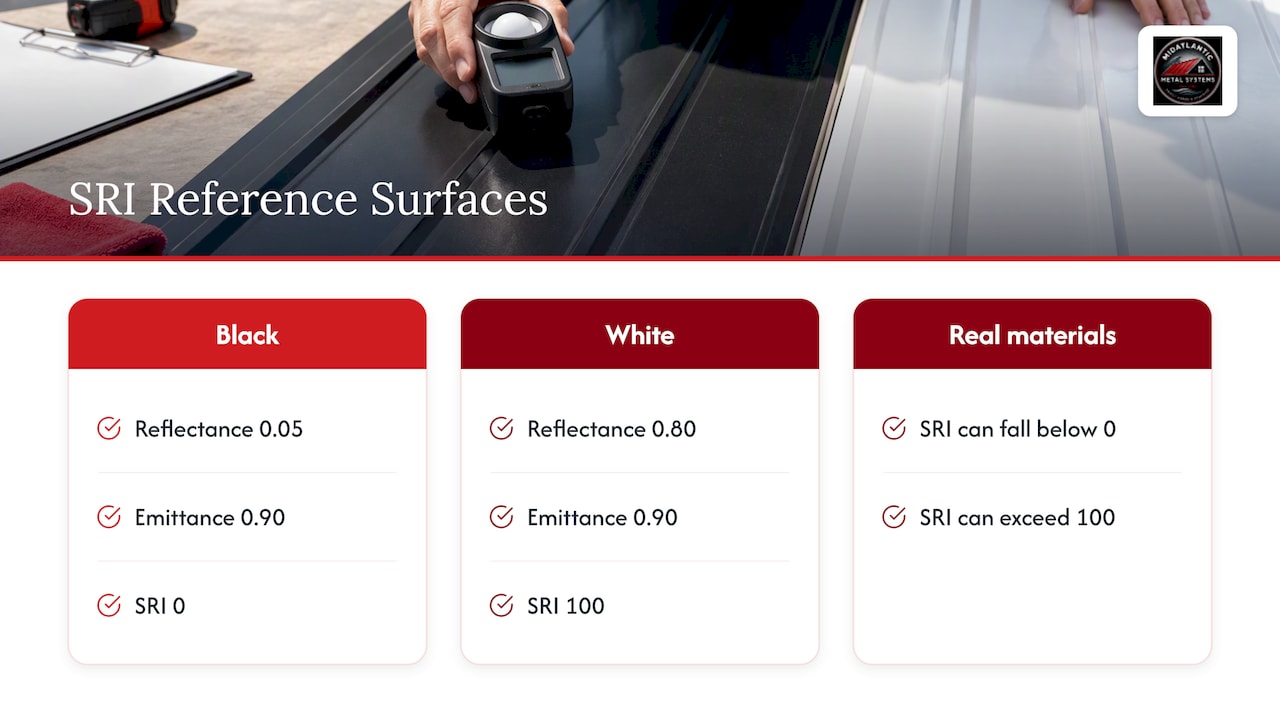
The scale is not capped. CRRC notes that SRI typically runs 0 to 100, but unusually hot materials can go negative and unusually cool ones can exceed 100. That is why a bright white metal roof can show a value above 100.
Why emittance matters on metal
Metal is where SRI gets interesting. Bare metal can reflect a lot of sunlight, but it is a poor emitter, so it holds onto heat. Painted metal emits well. The California Energy Commission’s worksheet points out that high-emittance roof surfaces release absorbed heat relatively quickly. CRRC adds that emissivity and color are not directly correlated, and low-emissivity materials tend to retain heat.
The practical takeaway: a shiny, unpainted panel is not automatically a cool one. Reflectance alone does not tell you the story, and SRI exists to fold both properties into one comparable figure.
Typical SRI values for metal roof finishes
There is no single SRI for “a metal roof.” It depends on the substrate, the coating and the color. LBNL’s cool roof guide gives a useful set of anchor points:
| Surface | SRI | Source note |
|---|---|---|
| Bright white roof | 107 | LBNL example |
| Clean bare zincalume steel | 68 | LBNL example |
| Cool red tile | 38 | LBNL example |
| Standard gray | 19 | LBNL example |
The figures come from the LBNL cool roof Q&A, where the same document notes that the bare zincalume surface runs warmer than the bright white roof but cooler than the cool red tile and the standard gray. One trade article in the search results also puts a white-coated metal roof at an average of 71 to 82 SRI, but treat anything like that as a ballpark. Your actual number is on the manufacturer’s data for the specific color.
Two cautions when reading any table like this:
- Bare metal changes. Bare steel oxidizes and dulls. That is why its aged rating can differ a lot from its clean rating.
- Same-looking colors are not the same. Two dark bronze finishes can have very different SRI values depending on the pigment, as the next section explains.
How color, coatings and aging change the number
Cool pigments
About half of incoming sunlight is near-infrared, which you cannot see. LBNL explains that cool colors use pigments or coatings that reflect that near-infrared portion, so a dark cool color can have solar reflectance about 0.4 higher than a standard dark color of the same appearance. That matters on architectural projects, where owners want dark charcoal, bronze or black, and still need the roof to perform.
If your customer insists on a dark color and a code or program requires a minimum SRI, a cool-pigment version of that color is often the way to square the two. Look at our standing seam metal roof colors page for the palette, then confirm the rating for your chosen color with the coating manufacturer’s documentation.
Aging and dirt
Reflectance does not stay at factory level. LBNL notes that soiling, biological growth and oxidation of bare metal can reduce reflectance or change emittance, which is why it reports three-year weathered ratings. Metal sheds dirt better than many membranes, and a steeper pitch helps rain do its work. Even so, the aged value is the honest one.

The California Energy Commission’s worksheet reflects this too: it records both initial and aged solar reflectance and thermal emittance, and compliance uses products tested and labeled by CRRC.
Does a higher SRI save money?
Sometimes, and by less than the marketing suggests. The U.S. Department of Energy’s guide reports potential annual savings of up to $0.20 per square foot for a white commercial roof and up to $0.05 per square foot for a cool-color home roof. Those are upper bounds. The same guide says savings vary by climate and building characteristics, depend on aged radiative properties, and are greatest in hot and warm climates.
The DOE also flags the flip side: in cold climates a cool roof can add to winter heating load. In the Mid-Atlantic, where we deliver, summers are hot enough for cooling to count but winters are real. That makes SRI a good tiebreaker rather than the main reason to pick a panel.
Here is how that plays out by building type:
- Low-slope commercial roofs with big rooftop units and little insulation: the most to gain. Cooler surfaces reduce load on the air conditioning.
- Well-insulated houses with vented attics: gains are small. Insulation and air sealing do more per dollar.
- Unconditioned buildings, barns, shops: the benefit is comfort and less peak heat under the panel, not a utility bill.
A reader who posted on a roofing forum asked whether focusing on SRI would cut attic temperatures more than spending on insulation and ventilation. For most houses the honest answer is that ventilation, air sealing and insulation come first, then color.
Where SRI shows up in specs and codes
Energy codes
Many jurisdictions with cool-roof rules write them into the energy code, usually for low-slope roofs on conditioned buildings, and they differ by state, climate zone and building type. Before you bid, check the code your authority having jurisdiction has adopted. Do not assume what one state requires applies across the line in the next one. California is the most-cited example, and its Energy Commission requires that products be tested and labeled by CRRC to use the SRI path. If your project is in Virginia, Maryland, Pennsylvania, West Virginia or Washington DC, confirm with your local building department whether any cool-roof provision applies to your roof type.
LEED
Green building programs use SRI directly. Under LEED v4, the heat island reduction credit sets an initial SRI of 82 and a three-year aged SRI of 64 for low-slope roofs, and it accepts aged values as an alternative way to qualify a product. If you are bidding a LEED project, ask the design team which version applies and whether they want initial or aged values on the submittal.
Slope matters
SRI is calculated for a horizontal surface. CRRC states that it does not apply to vertical wall products. Steep-slope standing seam is closer to vertical than a flat membrane, so programs usually set lower thresholds for steep roofs than for low-slope ones. Always read the slope category in the requirement.
How to check SRI before you order
This is the part that saves callbacks. A short process:
- Find out if anyone requires a number. Check the plans, the specification section on roofing, the energy code path in the permit set, and any green-building certification or utility program.
- Get the rated value for your exact product. SRI belongs to a specific coating and color, not to a gauge or a panel profile. Request the manufacturer’s data sheet or the CRRC rated product listing.
- Note initial versus aged. If the spec says aged, an initial figure does not satisfy it.
- Verify the math if you have to. SRI can be computed from reflectance and emittance. The DOE’s Building America Solution Center lists an SRI calculator based on ASTM E1980 that returns both SRI and roof surface temperature. It is useful for sanity-checking a submittal, not a substitute for rated data.
- Lock the color before the takeoff. Changing color late can change the coating system, the lead time and the SRI. Get the choice confirmed in writing with the owner or architect.
- Keep the documents with the job file. Inspectors and owners ask for them months after the install.
Common mistakes
- Using a generic “metal roof SRI” figure from a web page in a submittal.
- Quoting an initial SRI when the spec asks for aged.
- Assuming a shiny unpainted panel is cool because it looks reflective.
- Treating SRI as a substitute for insulation and ventilation.
- Applying a roof SRI threshold to a wall application.
Our perspective
We supply standing seam to roofing contractors, builders and general contractors across Virginia, Maryland, Washington DC, Pennsylvania and West Virginia, and SRI questions usually reach us late. A customer has signed off on a color, the takeoff is done, and then a spec line or an owner’s sustainability request turns up asking for a number.
Our advice is to ask the question at bid time. Our standing seam is made with Englert metal systems in 24-gauge and 26-gauge steel, in 1-inch mechanical lock and 1.5-inch snap lock profiles. Gauge and profile are structural and aesthetic choices. SRI comes from the finish and color, so those two decisions should be made together, not one after the other.
We also think SRI gets oversold to homeowners and undersold to commercial contractors. On a big low-slope or low-pitch commercial building with heavy cooling load, the finish choice is worth real attention. On a custom home with a good envelope, pick the color that the owner will love and make sure the number is acceptable, not heroic.
Finally, because we cut panels to length and deliver them to the jobsite, the cost of a late color change is not only the paint. It is a reorder, a new lead time and a crew standing around. Getting the finish confirmed up front is the cheapest efficiency measure on the job.
— Matt Catino
Planning a job with an SRI requirement?
If your project needs a specific color or rated finish, send us the plans and the roofing spec section early. We build custom-length standing seam panels and coordinate trim and flashing packages so the finish matches across the whole roof, then deliver to the jobsite. Our contractor supply team can help you work through the takeoff and the color and finish questions before you commit.
For projects where long runs are hard to get onto the site, on-site roll forming lets panels be formed where the work is, in the same finish family. You can also see finished installations in our gallery.
Choosing a finish when SRI is only part of the decision
SRI sits next to other criteria that matter just as much on a standing seam job.
| Criterion | What to check |
|---|---|
| Cooling benefit | Aged SRI for the exact color, climate, building use |
| Appearance | Color range, gloss, how it reads on long panel runs |
| Durability | Coating system, substrate, exposure |
| Compliance | Energy code path, green program, utility incentives |
| Schedule | Finish availability and lead time |
| Detailing | Trim and flashing in the same finish as the panels |
That last row is easy to forget. A cool roof with trim in a different coating has a different effective performance and a different look. Order the trim and flashing in the same program as the panels so the color, the finish and the paperwork stay consistent. For design-led work, our architectural metal roofing page shows how this plays out on higher-end projects.
FAQ
What is a good SRI for a metal roof?
It depends on what the job requires. Anything above 78 is typically what people mean by a highly reflective roof, but there is no universal minimum. Check the spec, the code path and any green program, and compare aged values where they are asked for. LEED v4, for example, uses 82 initial and 64 aged for low-slope roofs.
Can SRI be higher than 100?
Yes. The scale is anchored to a standard black surface at 0 and a standard white at 100, but CRRC says that unusually cool materials can exceed 100. Bright white coated metal is the usual example.
Do dark metal roofs have to be low SRI?
Not necessarily. Cool pigments reflect near-infrared light that dark standard colors absorb, so a dark cool color can reflect noticeably more than a standard version of the same shade. Confirm the rating for the specific color rather than assuming.
Is SRI the same as solar reflectance?
No. Solar reflectance is only the share of sunlight reflected. SRI also includes thermal emittance, so it captures how well the surface sheds the heat it absorbs. That is why a shiny bare metal panel and a painted one can rank differently.
Does a high SRI always lower my energy bill?
No. The DOE says savings depend on climate and building characteristics, and are greatest in hot and warm climates. Cold climates may see a winter heating penalty, so weigh SRI against insulation, ventilation and local conditions.
Sources
- What is the Solar Reflectance Index? (CRRC, 2024)
- Cool roof Q&A (Lawrence Berkeley National Laboratory)
- Cool Roof and Wall FAQs (CRRC)
- For Home and Building Owners (CRRC)
- SRI Calculation Worksheet SRI-WS (California Energy Commission)
- Guide to Cool Roofs (U.S. Department of Energy)
- SRI Calculator (Building America Solution Center)
- Solar Reflectance & SRI Measurements for LEED (Surface Optics)