Metal Roofing Accessories for Contractors: A Practical Guide
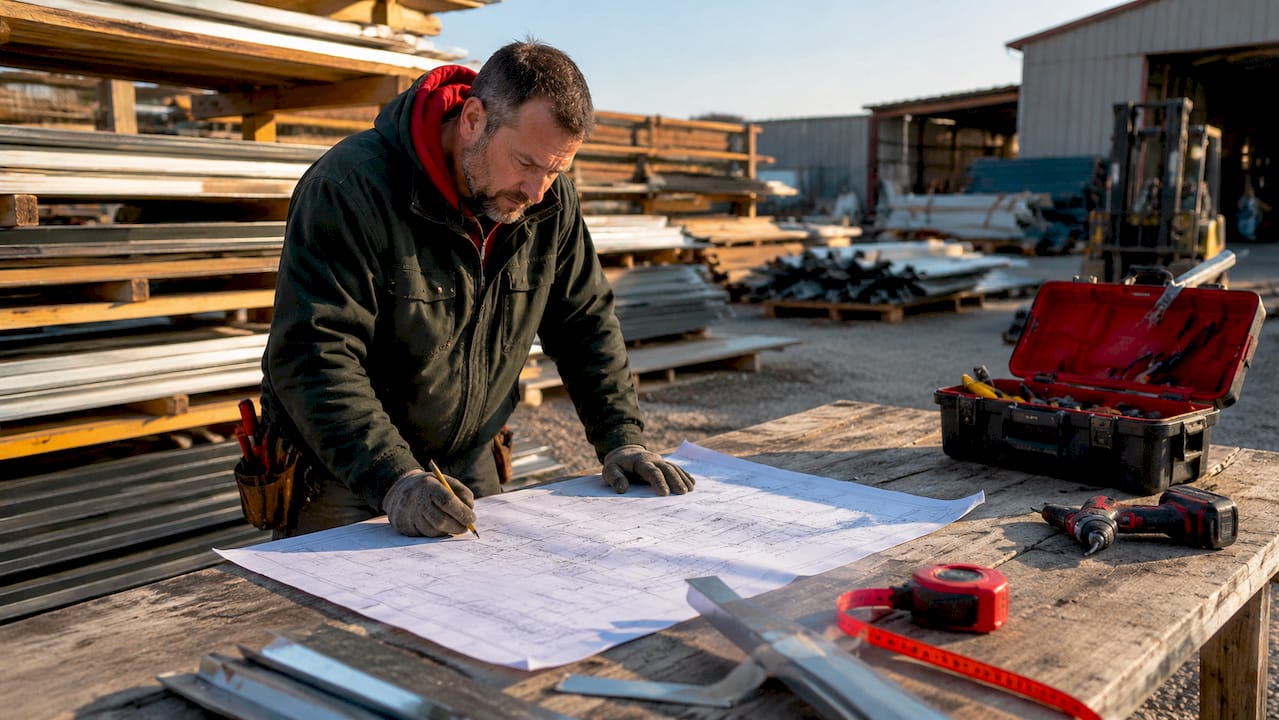
Discover what are metal roofing accessories and how they enhance installation quality. Learn essential components for a weather-tight system!
Metal roofing accessories are specialized components that work alongside metal panels to create a complete, weather-tight roofing system. These parts include underlayments, flashings, trims, fasteners, closures, and penetration adapters. Every one of them affects installation quality, long-term performance, and whether your system holds up under the thermal cycling and wind loads that Mid-Atlantic climates deliver. Knowing what are metal roofing accessories, and which ones belong on your next job, separates a tight, callback-free installation from one that leaks by year three.
What are metal roofing accessories and their primary types?
Metal roofing accessories are the supporting components of a metal roofing system. They are not decorative add-ons. Each category performs a distinct structural or weatherproofing function that the panels alone cannot provide.
Underlayments form the secondary waterproof barrier between the metal panels and the roof deck. Standard felt fails under metal roofs because panel surface temperatures can exceed 200°F on a summer afternoon. Products like G.A.P. WaterGuard™ SA MetalGuard Trax are rated to 265°F using a tri-laminate hybrid synthetic surface with a high-temperature SBS modified bitumen core, and they carry Miami-Dade HVHZ approval. That rating matters on any job where thermal cycling is a daily reality.
Flashing and trim seal every edge, valley, ridge, and wall transition where water would otherwise find a path. Metal roofing trims protect at eaves, ridges, rakes, and valleys while giving the system a finished appearance. York 316 self-adhering stainless steel flashing takes this further by adhering to multiple substrates and delivering superior corrosion resistance, making it the right call for coastal and commercial projects.

Penetration accessories handle pipes, vents, and HVAC curbs. The Marco Industries Metal Roof Multi-Flash Sealing Vent Adapter uses a flexible aluminum base, a stainless steel clamp, and a continuous sealant bead to create a weather-tight seal around roof penetrations across multiple panel types and pitches. These adapters eliminate one of the most common leak points on any metal roof.
Closures and foam tapes seal the open ribs at eaves and ridges against wind-driven rain and insects. They are profile-specific, meaning you need the right foam closure for your exact panel geometry. Using a generic closure on a 1.5" snap lock panel leaves gaps that no amount of sealant will fix permanently.
Fasteners and clips secure both panels and trims while allowing the thermal movement that metal demands. A standing seam system using concealed clips lets panels float independently, preventing the oil-canning and fastener pull-through that plague exposed-fastener systems when installers over-torque screws.
Pro Tip: Always verify that your foam closures, clips, and trims are sourced from the same manufacturer as your panels. Profile tolerances vary between manufacturers, and a mismatch of even a few millimeters creates air gaps that undermine the entire system.
How do accessory materials compare for durability and performance?
Material choice in metal roofing accessories is not a secondary decision. It determines how long the system performs without maintenance and how well it handles the specific exposure conditions of your project.
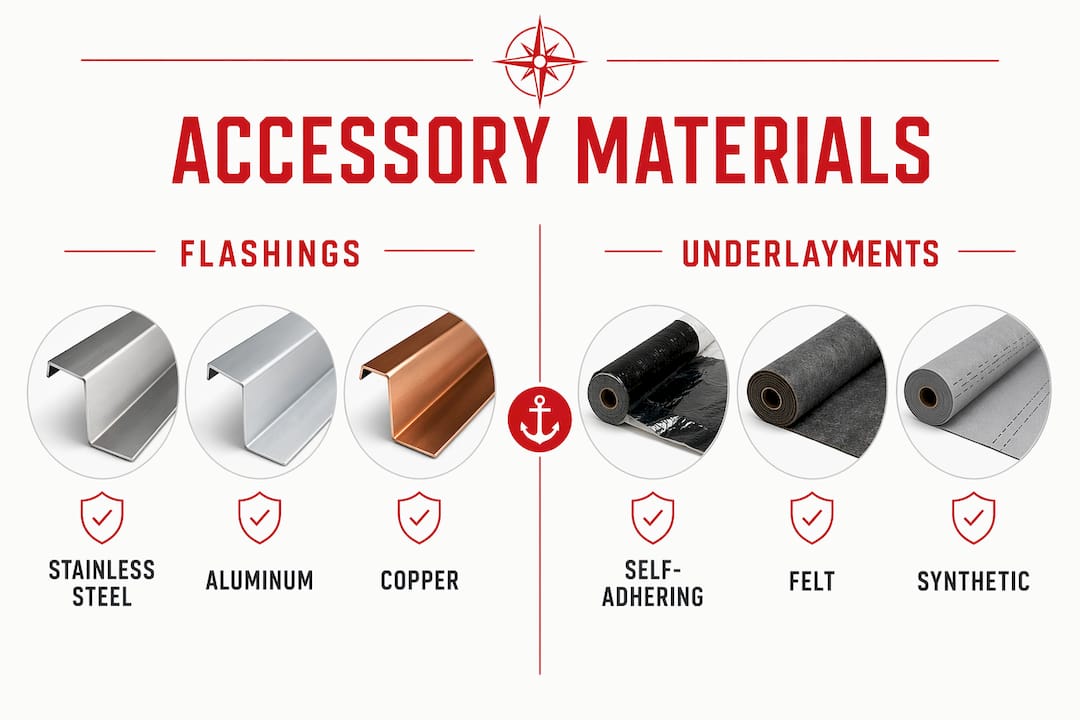
| Accessory | Material Option | Key Benefit | Best Application |
|---|---|---|---|
| Flashing | Type 316 stainless steel | Superior corrosion resistance, flexible | Coastal, commercial, high-humidity |
| Flashing | Aluminum | Lightweight, cost-effective | Inland residential, low-exposure |
| Underlayment | Self-adhering SBS modified bitumen | High-temp stability, watertight bond | Metal roofs in hot or HVHZ climates |
| Underlayment | Traditional felt | Low cost | Not recommended under metal panels |
| Vent adapter base | Flexible aluminum | Conforms to panel profiles | Standing seam and exposed-fastener |
| Fasteners | Stainless steel with neoprene washer | Corrosion-resistant, weather-sealed | All metal roof applications |
Stainless steel flashing, specifically York 316 SA flashing, outperforms aluminum at transitions subject to standing water or salt air. Aluminum is more workable on complex profiles but oxidizes faster in coastal environments. For most projects in Virginia, Maryland, and Pennsylvania, aluminum trim works well on interior details while stainless steel earns its cost at critical transitions like chimneys and skylights.
Self-adhering underlayments represent the clearest performance gap in this category. Traditional felt absorbs moisture, degrades under UV exposure during construction delays, and loses adhesion when metal panel temperatures spike. A self-adhering SBS product bonds directly to the deck, stays put under heat, and maintains its waterproof integrity even if a panel is removed for repair years later.
Vent adapter design is where standing seam and exposed-fastener systems diverge sharply. Standing seam versus exposed-fastener systems have fundamentally different seam geometries, and a boot designed for one will not sit flush on the other. Penetration accessories must fit the panel rib profile precisely and accommodate thermal movement without breaking the sealant bead.
Modern systems increasingly use interlocking edges and concealed fasteners to eliminate exposed attachment points that become water entry paths over time. This design approach reduces long-term maintenance costs and is the reason concealed-clip standing seam systems consistently outperform exposed-fastener systems on 20-plus-year performance records.
Pro Tip: On projects near the coast or in high-humidity zones, specify Type 316 stainless steel for all flashing at penetrations and transitions. Type 304 is adequate for inland work, but 316 resists chloride corrosion at a level that pays for itself within the first decade.
Why accessories are critical for installation efficiency and longevity
The right accessories do not just prevent leaks. They reduce installation time, protect your crew, and determine whether the system qualifies for the manufacturer’s warranty.
Trim components, fastening systems, and system design differences significantly affect performance over time, even when two roofs look identical from the ground. A contractor who specs the correct accessories from the start avoids the callbacks that erode profit margins on otherwise well-executed jobs.
Here is where accessories prevent the most common installation failures:
- Thermal expansion damage. Clips that allow panels to float prevent fastener pull-through and oil-canning caused by daily temperature swings of 100°F or more on dark metal surfaces.
- Underlayment adhesive failure. Standard adhesives degrade under the heat generated by metal panels. High-temperature-rated products maintain their bond through years of thermal cycling.
- Penetration leaks. Roof boots that do not match the panel profile leave gaps at the base. Penetration accessories must fit panel profiles precisely, with bases sitting flush and sealant applied continuously at the correct fastener spacing.
- Wind-driven rain infiltration. Foam closures at eaves and ridges block the air channels that panel ribs create. Without them, wind pressure forces water up under the panels.
- Installer slip hazards. The tri-laminate Trax surface on WaterGuard SA MetalGuard Trax provides a secure walking surface on steep slopes, reducing slip risk during installation. Safety and productivity improve together.
- Warranty voidance. Most panel manufacturers require compatible, approved accessories. Using off-spec components voids the system warranty regardless of how well the panels themselves are installed.
Pre-fabricated accessories like multi-flash vent adapters also speed up the job. A ready-to-fit adapter with a built-in sealant guide takes minutes to install correctly. A field-fabricated alternative takes longer and introduces more variables.
Practical considerations when selecting and installing accessories
Selecting the right accessories starts before you pull the first panel off the truck. These steps will keep your project on schedule and your system performing at spec.
-
Assess climate and exposure first. Projects in coastal Virginia or Maryland require corrosion-resistant materials at every transition. Inland Pennsylvania jobs have more flexibility, but high-temperature underlayments are non-negotiable anywhere metal panels are used.
-
Match accessories to your exact panel system. A 1" mechanical lock panel and a 1.5" snap lock panel use different clip geometries, different foam closures, and sometimes different trim profiles. Verify compatibility before ordering. MidAtlanticMetalPanels supplies trim packages and contractor supply solutions matched to specific panel systems, which removes the guesswork.
-
Read the manufacturer installation guidelines before the job starts. Accessory installation sequences matter. Underlayment goes down before trim is set. Sealant is applied at specific stages, not as a final patch. Skipping steps to save time creates the exact failure points you will be called back to fix.
-
Verify sealant compatibility. Not all sealants bond to all accessory materials. Silicone works on most metal surfaces but does not adhere well to some foam closures. Butyl tape is the standard for sealing trim laps on standing seam systems. Check the accessory manufacturer’s recommendation before applying anything.
-
Check local code requirements. Some jurisdictions in the Mid-Atlantic region mandate specific underlayment ratings or flashing materials, particularly in high-wind zones. Miami-Dade HVHZ approval on products like WaterGuard SA MetalGuard Trax signals compliance with the most demanding standards, which often satisfies local inspectors in wind-exposed areas.
-
Budget for quality accessories upfront. The cost difference between a standard foam closure and a profile-matched, UV-stabilized closure is small per unit. Across a full roof, the premium is modest. The cost of a callback to re-seal a ridge because the closures compressed and failed is not.
-
Use roof flashing best practices at every transition. Flashing is the most common source of metal roof leaks, and most failures trace back to improper installation rather than material failure. Overlap dimensions, fastener spacing, and sealant placement all matter.
Key takeaways
Metal roofing accessories are the components that convert individual panels into a sealed, durable system, and selecting the wrong ones is the leading cause of premature metal roof failure.
| Point | Details |
|---|---|
| Accessories define system performance | Underlayments, flashings, closures, and fasteners each prevent a specific failure mode. |
| Material selection is climate-driven | Use Type 316 stainless steel flashing and high-temp underlayments in coastal or hot climates. |
| Profile compatibility is non-negotiable | Accessories must match your exact panel geometry to sit flush and seal correctly. |
| Quality accessories protect your warranty | Off-spec components void manufacturer warranties regardless of panel installation quality. |
| Pre-fabricated accessories save time | Ready-to-fit vent adapters and trim packages reduce installation variables and speed up the job. |
Why I stopped treating accessories as an afterthought
Early in my career, I watched a well-installed standing seam roof develop persistent leaks at every pipe penetration within two years. The panels were perfect. The problem was generic pipe boots that did not match the panel rib profile, combined with a standard felt underlayment that had degraded under the heat. The contractor had saved maybe $400 on accessories across the whole job. The callback cost ten times that.
What I have seen since then confirms that the accessory specification decision is where most metal roofing failures are actually made, not during panel installation. Contractors who understand accessory-level detail before the job starts set realistic expectations, order the right materials, and finish without surprises.
The trend I find genuinely useful right now is the move toward fully coordinated accessory packages from panel suppliers. When your trim, flashing, closures, and underlayment are all spec’d and sourced together, the compatibility questions disappear. You spend your time installing, not troubleshooting.
My honest advice: treat the accessory budget as part of the panel budget, not a separate line item to cut. The panels get the attention because they are visible. The accessories are what make the system work.
— Matt Catino
Get panels and accessories matched to your system from MidAtlanticMetalPanels
MidAtlanticMetalPanels supplies Roanoke standing seam panels and Norfolk standing seam panels in 24-gauge and 26-gauge steel, cut to length and delivered directly to your job site across Virginia, Maryland, Washington DC, Pennsylvania, and West Virginia. Every panel system comes with access to matched custom trim and flashing packages, so your accessories are spec’d to your exact panel profile from the start. If you are tired of sourcing panels from one supplier and hunting down compatible accessories from three others, MidAtlanticMetalPanels is built to solve that problem. Contact the team for a quote on your next project.
FAQ
What are metal roofing accessories?
Metal roofing accessories are the components that complement metal panels to form a complete roofing system. They include underlayments, flashings, trims, fasteners, closures, and penetration adapters, each serving a specific weatherproofing or structural function.
What types of underlayment work best under metal roofs?
Self-adhering, high-temperature-rated underlayments are the correct choice for metal roofs. Products like G.A.P. WaterGuard SA MetalGuard Trax are rated to 265°F and maintain their bond through the thermal cycling that standard felt cannot withstand.
How do I choose the right vent adapter for a standing seam roof?
Select a vent adapter designed specifically for your panel profile and seam geometry. The base must sit flush on the panel surface, and the sealant must be applied continuously around the full perimeter to prevent wind-driven water infiltration.
Do metal roofing accessories affect the manufacturer warranty?
Yes. Most panel manufacturers require the use of compatible, approved accessories. Installing off-spec closures, fasteners, or underlayments voids the system warranty even if the panels themselves are correctly installed.
When should I specify stainless steel flashing over aluminum?
Specify Type 316 stainless steel flashing on coastal projects, commercial buildings, or any application with high humidity and salt air exposure. Aluminum is acceptable for inland residential work but corrodes faster in chloride-rich environments.