Rainwater Harvesting From a Metal Roof: A Contractor's Guide

What contractors need to know before a client collects rain from a standing seam roof: panel and finish choice, gutters, first-flush, Virginia rules and storage.
Smooth metal is one of the best roofs you can put over a rainwater system, and the decisions that make it work are yours, not the tank installer’s: panel profile, coating, panel length, trim and gutter details. Virginia’s health guidance names smooth metal or slate as the most efficient catchment surfaces, while composite shingles, wood shingles and tar-and-gravel may leach chemicals. If a client asks about harvesting, your roof is already the best starting point. Getting it right is a matter of specifying it correctly and ordering it as one coordinated package.
TL;DR
- Smooth metal sheds water cleanly and loses little to absorption, which is why state and university guidance favors it for catchment.
- No roof makes water drinkable on its own. Research on roofing materials found that even metal needs first-flush diversion, filtration and disinfection before potable use.
- Coating matters more than the metal. Virginia’s 2024 rule bans galvanized collection surfaces and zinc-, lead- or chromium-based paints, and requires NSF-certified paint for potable systems.
- Gutters for harvesting are ordinary gutters plus screens and one first-flush diverter per downspout. Match them to the panels so the warranty holds.
- Custom-length panels, delivered and stored correctly, give you a clean surface with no end laps and less jobsite handling.
Table of Contents
- Why metal is the roof clients ask about
- What metal does not do: water quality
- Coatings and finishes: where the specification can go wrong
- What the rules say: Virginia as the worked example
- Gutter design for rainwater harvesting
- The system the roof feeds
- Maintenance the homeowner should be told about
- Storing metal panels before installation
- Ordering the roof for a harvesting job
- Our approach to harvesting roofs
- Get the roof package in one order
- FAQ
- Sources
Why metal is the roof clients ask about
A roof for harvesting has two jobs: shed water quickly and add as little as possible to it. Metal does both. The Texas A&M AgriLife Extension’s fact sheet on complex rainwater systems rates metal as arguably the best rooftop material, with minimal water loss, and notes that asphalt or composite shingles should be limited to irrigation and garden use because of possible leaching.
Virginia Cooperative Extension adds a practical detail for sizing: metal retains less water than textured materials such as clay tile. Less retained water means more of each storm reaches the tank.
A standing seam roof adds to this. Concealed fasteners mean no exposed penetrations to leak or collect debris, and long panels run eave to ridge without horizontal laps where dirt and moisture can sit. That is one reason cut-and-drop ordering suits these jobs. Our custom-length panels are cut to the roof plane’s measured run and delivered to the site, so the water path from ridge to gutter is one continuous surface. If you want the detail on run lengths, see how long standing seam panels can be.
What metal does not do: water quality
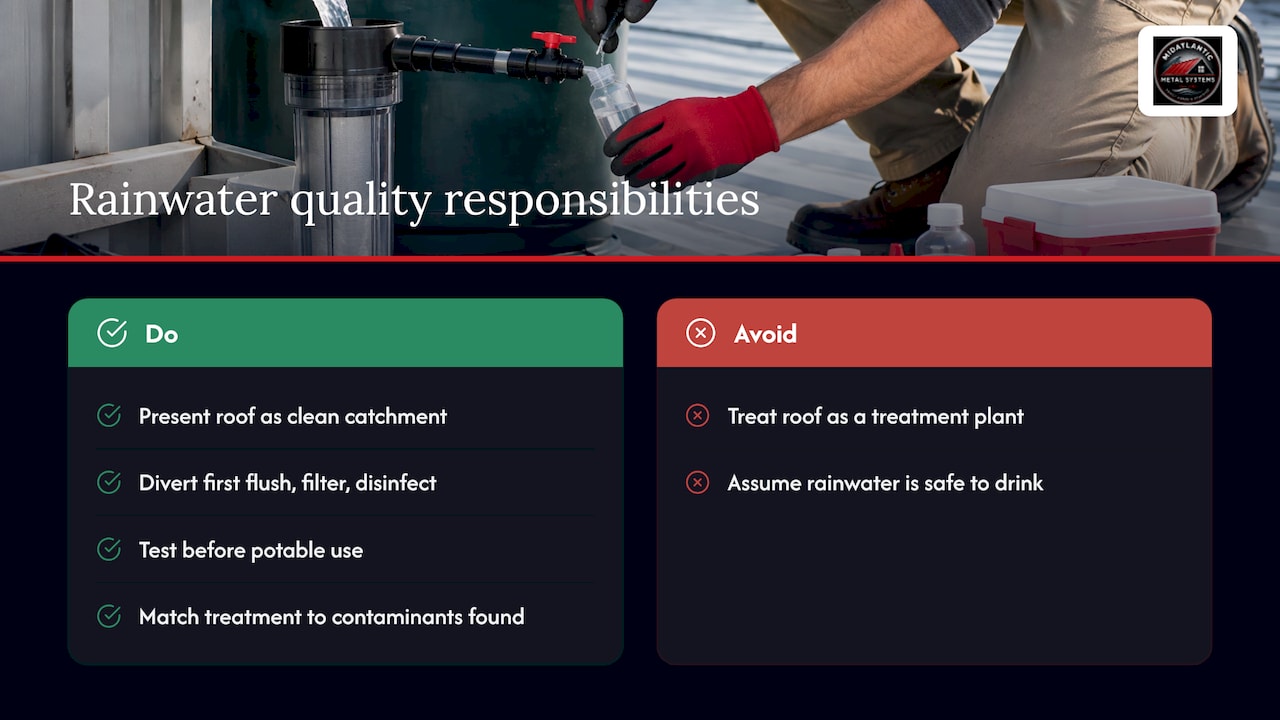
Set the client’s expectations early. The roof is a clean catchment surface, not a treatment plant.
A peer-reviewed study by Mendez and colleagues, The effect of roofing material on the quality of harvested rainwater, found that metal roofs produced water with lower fecal indicator bacteria than asphalt shingle or green roofs. It also concluded that water from every roofing type tested needed first-flush diversion, filtration and disinfection at a minimum to meet EPA drinking water standards.
The CDC says the same thing in plain terms: rainwater is not necessarily safe to drink without first removing germs and chemicals, and people who drink, cook or bathe with it should test regularly and pick treatment that removes the contaminants found. Bird droppings, pollen, dust and atmospheric deposition land on every roof.
For your side of the job, the practical line is simple. Build and sell the roof as the catchment surface. The tank, filtration and disinfection belong to whoever designs the water system, and for potable use they fall under the health authority’s permit. Water treatment is its own trade; the Water Quality Association’s white paper says rainwater should be tested for microbiologicals, metals and organic chemicals before potable use, with disinfection as a minimum. Homeowners weighing what happens after the water leaves the tank can read about whole-house versus drinking water filters.
Coatings and finishes: where the specification can go wrong
This is the part contractors skip and clients regret. The metal itself is rarely the issue. The coating and any exposed bare edges are.
Two official sources draw the line:
- The Hawaii CTAHR/DOH catchment guide says the most common catchment roofing is metal painted or enameled with nontoxic paint. It advises against lead-containing components, uncovered galvanized metal, zinc, asbestos, tar, asphalt and pesticide-treated wood, and recommends letting a new roof weather and rinse before connecting gutters to the tank.
- Virginia’s 12VAC5-635-230, effective November 20, 2024, prohibits galvanized metal collection surfaces and lead-, chromium- or zinc-based paints. For potable use it requires collection-surface paint certified to NSF/ANSI/CAN 61-2020 or P151, with materials labeled accordingly.
So before you quote a harvesting job, ask the client three questions:
- Will the water be potable, or non-potable (irrigation, toilet flushing, laundry)?
- Which state and county rules apply, and which end-use tier does the system fall into?
- Does the authority require certified coatings on the collection surface for that tier?
For a non-potable or irrigation-only system the bar is lower. For potable systems in Virginia, put the finish and its certification documentation on the submittal before you order, not after the panels arrive. Our panel specs page lists the gauges and profiles we supply, in 24-gauge and 26-gauge Englert steel, so you can match the panel to the system designer’s requirements.
What the rules say: Virginia as the worked example
We supply Virginia, Maryland, Washington DC, Pennsylvania and West Virginia, and rules differ by state. Virginia is the clearest recent example, so use it as a model and then check your own jurisdiction.
Virginia published 12VAC5-635 on October 21, 2024, effective November 20, 2024. According to the Virginia Register entry, it set four end-use tiers, requires construction and operation permits for potable systems, exempts rain barrels, and registers nonpotable systems without permitting.
Two more requirements land directly on your roof and gutter work:
- Virginia’s design rule requires gutters, downspouts and conveyance to have screens or debris excluders, prefiltration ahead of the storage unit, and an automatic first-flush device placed after prefiltration and accessible for maintenance.
- For potable systems, the regulation’s testing requirements call for initial and periodic testing, including at minimum total coliform or E. coli, nitrate and nitrite, pH and lead.
Other states approach it differently. Minnesota’s rule 4714.1602 allows collection only from roof surfaces, not parking areas or surface runoff, and requires gutters and downspouts to meet the state building code’s storm drainage requirements. California’s non-potable guidelines, as in Ventura County’s handout, note that being exempt from a permit does not exempt a system from code requirements. Texas treats harvesting as a stormwater tool: the Texas GLO manual gives credit of up to 75% of rooftop impervious cover for qualifying systems.
The takeaway: confirm with the local building department, and the health department for potable systems, before the roof is ordered. Rules have changed in the last two years in Virginia, and the roof submittal is where it shows up first.
Gutter design for rainwater harvesting
Good news: harvesting gutters are not exotic. Virginia Cooperative Extension says gutters and downspouts for these systems are essentially no different from conventional ones. The added consideration is screens and first-flush diverters, with each downspout getting its own.
Here is what to build in:
- Size and slope. The Texas GLO guidance says gutters should be properly sized and located, sloped toward the downspout with the outside face lower than the inside, and downspouts should provide 1 square inch of opening per 100 square feet of roof.
- Screens at the gutter and the downspout. Leaf screens or gutter guards keep the heaviest debris out. Virginia requires prefiltration ahead of storage, with debris screens no larger than 0.15 cm openings where they are not self-cleaning.
- One first-flush diverter per downspout. Virginia’s guidance says diverted volume depends on the roof surface, debris and the number of dry days before the storm. Roof washers are typically 30 to 50 gallon boxes with a 30-micron filter. First-flush runoff should discharge onto an adequately sized splash pad per the Texas guidance.
- Accessible maintenance points. If the first-flush chamber or the filter sits behind a finished soffit, it will not get cleaned.
On a standing seam roof, the gutter attachment is where problems start. Fastening a gutter bracket through a panel the wrong way can void the panel warranty and create a leak. Our guide on how to match gutters to metal panels and keep the warranty walks through it, and the trim and flashing package is where eave drip edge and gutter apron are coordinated with the panels so water lands in the gutter rather than behind it.
Do metal roofs need gutters for harvesting?
In practice, yes. A harvesting system needs the roof’s runoff gathered at a known point where it can be screened and diverted. Without gutters, water leaves the eave across its whole length and the screening, first-flush and conveyance equipment the regulations describe has nowhere to attach. Metal roofs also shed water fast, and snow and ice can slide off in sheets, so plan eave protection and snow retention with the gutter layout. Our guide to ice dams on metal roofs covers the cold-climate side, which matters across our service area.
Gutter guards reduce cleaning but do not remove it. Homeowners can see how often guards need cleaning by type and tree cover, and the maintenance routine below assumes it stays on the schedule.
The system the roof feeds
The Virginia guidance describes the full chain: roof catchment, gutters and downspouts, leaf screens, downspout strainers, first-flush diverters, opaque screened tanks, and pumps with filtered floating intakes. Three details are worth passing to your client:
- Tanks should be opaque to prevent algae growth, and every inlet, outlet and overflow should be screened against mosquitoes and rodents.
- The pump intake should float a few inches below the water surface with a filter on it.
- For piping, Tucson’s design standards guide recommends Schedule 40 PVC painted for UV resistance, sheet-metal leaf catchers, accessible debris filters and first-flush devices, installed level.
For non-potable indoor use, Virginia’s guidance recommends 5-micron filtration with filters certified to ANSI/NSF Standard 61, then disinfection by chlorine, UV (NSF/ANSI 55 Class B minimum) or ozone.
Maintenance the homeowner should be told about
Hand the client a one-page routine when you close out the job. The Texas GLO guidance says to check the system annually and after every rainfall: remove debris from the first-flush standpipe after each rain, keep gutters and downspouts clear, flush the bottom of the storage container and clean the filters. Philadelphia’s cistern chapter likewise calls for regularly cleaning gutters, gutter screens, first-flush chambers and catch basins to cut sediment load to the cistern.
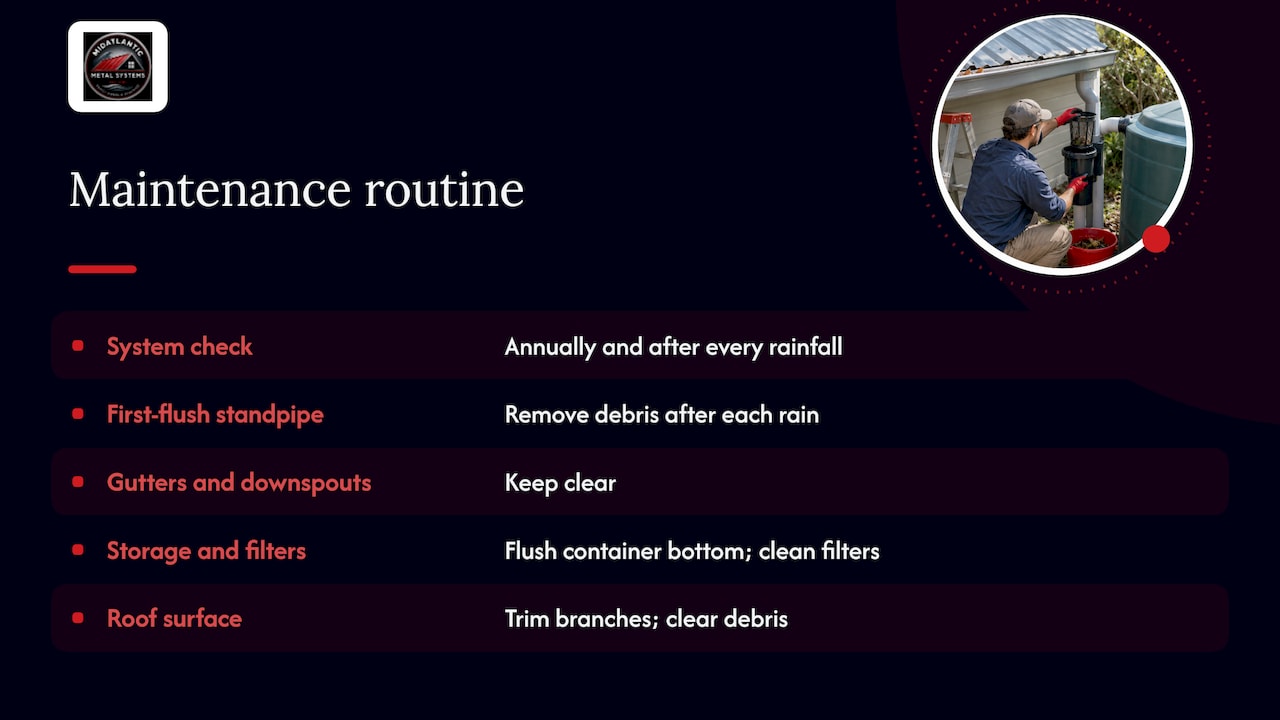
The roof itself needs little: keep overhanging branches trimmed and the surface free of debris. A roof that is easy to rinse is part of why metal suits this use.
Storing metal panels before installation
Harvesting clients care about a clean surface, so how panels sit before install matters. Metal Roofing Magazine’s guide to handling standing seam panels gives the basics:
- Panels arrive blocked and banded or crated. Leave them in that configuration until they go on the roof.
- Store them in a protected area away from water and snow, elevated on blocks and sloped so water drains.
- Put padding between panels and green concrete, which out-gasses for its first 30 days.
- Jobsite storage can stretch for months, up to a year, exposing panels to staining, corrosion and dents.
The same article makes the point that the best case is not to store panels at all. That is the argument for ordering to the schedule: with cut-and-drop delivery, panels are cut to length and delivered to the jobsite for installation rather than sitting for weeks, and the lengths come from your takeoff, so there are fewer offcuts to stack and scrap. Our piece on how to reduce roofing waste covers the ordering side.
Ordering the roof for a harvesting job
A checklist for the takeoff and order:
- Confirm the end use (potable or not) and the jurisdiction’s tier before choosing the finish.
- Choose the panel. Our 1-inch mechanical lock and 1.5-inch snap lock standing seam panels come in 24-gauge and 26-gauge steel. Pick the profile and gauge for slope, wind and appearance, then confirm the coating documentation the system requires. Slope and deck choices are covered in metal roof deck types, and permit rejections in Virginia often trace back to wind zones, covered in Virginia roofing wind zones.
- Order panels, trim and flashing together. Eave, gutter apron, valley and closure details should come from one package.
- Measure each downspout location before the gutter order, so every downspout gets its own screen and first-flush device.
- Schedule delivery for when the crew is ready to install, not weeks before.
Our approach to harvesting roofs
We supply contractors, and the question we hear is rarely about tanks. It is about what the roof has to be so the tank works. Our answer is a continuous, smooth standing seam surface with the trim and gutter details planned before the panels are cut.
That is why we push cut-and-drop ordering on these jobs. Panels cut to the measured run arrive ready to install from eave to ridge, with no field splices and little to store. Where access or run length is a problem, our on-site roll forming puts a roll former on the site so long panels do not have to be trucked in.
The water system is a separate design, and the permit is the client’s authority’s call. The roof is ours to get right, and we make it easy to get the right panel, finish and trim into one order.
Matt Catino
Get the roof package in one order
We supply custom-length standing seam panels, trim and flashing packages, and contractor takeoff support across Virginia, Maryland, Washington DC, Pennsylvania and West Virginia, delivered to the jobsite. For harvesting jobs, start with the contractor supply page and tell us the end use, so the panels, trim and gutter details are planned together.
If the job site is hard to reach or the runs are long, on-site roll forming is another way to get continuous panels to the roof.
FAQ
Can you collect rainwater from a standing seam metal roof?
Yes. Virginia’s health guidance names smooth metal as one of the most efficient catchment surfaces. Check that the finish suits the intended use, since Virginia bans galvanized collection surfaces and zinc-, lead- or chromium-based paints.
Is water from a metal roof safe to drink?
Not without treatment. The CDC says rainwater is not necessarily safe to drink until germs and chemicals are removed, and research found that even metal roofs need first-flush diversion, filtration and disinfection. Potable systems in Virginia also require permits and water testing.
Do I need a permit?
It depends on the state and the use. In Virginia, potable systems need construction and operation permits, nonpotable systems are registered without permitting, and rain barrels are exempt. Other states differ, so check with the local building department before ordering.
How many first-flush diverters does a roof need?
One per downspout, according to Virginia’s guidance. The volume diverted depends on the roof surface, debris and how long it has been dry before the storm, and the device must be accessible for cleaning.
Sources
- Virginia Department of Health rainwater guidance, Version 1.0
- Texas A&M AgriLife: Rainwater Harvesting, Complex Systems fact sheet
- Virginia Cooperative Extension: Rainwater Harvesting Systems
- Mendez et al., effect of roofing material on harvested rainwater quality
- CDC: Collecting Rainwater and Your Health
- Water Quality Association rainwater catchment white paper
- Rainwater Catchment Systems for Hawai’i
- Virginia 12VAC5-635-230, Materials and equipment
- Virginia Register: 12VAC5-635
- Virginia 12VAC5-635 design requirements
- Virginia 12VAC5-635 full regulation
- Minnesota Rule 4714.1602
- Ventura County non-potable rainwater catchment guidelines
- Texas GLO: Rainwater Harvesting, 5.8
- City of Tucson design standards and site plan guide
- Philadelphia Water: Cisterns
- Metal Roofing Magazine: Handle Your Standing Seam Panels Like a Professional
- Whole house vs. drinking water filters
- How often to clean gutter guards