Self-Adhered Underlayment: Exposure Limits and Choices

How self-adhered underlayment works, how long it can stay exposed (30 to 180 days by product), and what contractors should check before the roof covering goes on.
Self-adhered underlayment is a membrane with a factory-applied adhesive back that bonds straight to the roof deck and seals around fasteners. It is the layer that keeps water out if the roof covering above it is breached. Exposure time depends on the product. Published limits run from 30 to 180 days, and the clock starts the day the sheet is fastened down. Always check the manufacturer’s data sheet and any local product approval for the exact product on your deck.
This guide is written for roofing contractors, builders and general contractors. It covers how the membrane works, where codes call for it, how to schedule around exposure limits, and what to confirm before you order panels.
TL;DR
- Self-adhering bituminous membrane seals to the deck, to itself at the laps and around nail shanks, which is why it is the standard answer to ice dam leaks at eaves.
- Exposure limits are product-specific. Published figures range from 30 days to 180 days, and rainy days do not pause the count.
- Local product approvals can be stricter than the sell sheet. Florida evaluation reports, for example, cap some underlayments at 30 days.
- Confirm the membrane meets ASTM D1970 and that your local code accepts it for the way you plan to use it (eaves only or full deck).
- Sequence the job so panels are on site and ready before the underlayment’s clock runs out.
Table of Contents
- What self-adhered underlayment is and how it protects the roof
- Where codes call for it
- How long self-adhered underlayment can stay exposed
- What happens when the limit is exceeded
- Choosing a self-adhered underlayment: a contractor checklist
- Scheduling underlayment around panel delivery
- Our perspective on underlayment and panel timing
- Getting panels on site before the clock runs out
- FAQ
- Sources
What self-adhered underlayment is and how it protects the roof
Self-adhering underlayment is a bituminous membrane, usually polymer-modified asphalt with a reinforcing layer and a release film you peel away. You press it onto a clean, dry deck and it bonds. It has been used on steep-slope roofs for many years, primarily to help prevent water entry from ice dams at the eaves of shingled roofs in cold climates, according to the Asphalt Roofing Manufacturers Association (ARMA).
The key property is the seal. The adhesive asphalt bonds the membrane to itself and to the deck, and it closes around the shanks of fasteners driven through it. ARMA explains that this means water forced under the roof covering by wind or ice dams does not reach the deck or attic space below. A mechanically fastened felt or synthetic sheet leaves a hole at every fastener. A self-adhered sheet is designed not to.
That matters under metal. Standing seam clips and exposed or concealed fasteners penetrate whatever is under the panel, and the membrane is your secondary water barrier if wind-driven rain gets past a seam, a trim detail or a penetration. The panel is the weather surface. The underlayment is the backup.
Where codes call for it
Two code points come up constantly on contractor jobs.
Low slopes. ARMA notes that building codes require a double layer of mechanically fastened underlayment or a single layer of self-adhering underlayment on slopes from 2:12 up to 4:12. If you are working near the bottom of that range, the self-adhered option is often the simpler build. For how slope drives material choices on the shingle side, see this explanation of roof slope and shingle choice.
Ice dam zones. Where ice dams are likely, the typical detail runs the membrane from the eave edge to at least 24 inches, measured horizontally, inside the exterior wall line of the building before the roof covering goes on. Your local code official has the final word on the requirement in your county, and metal roofing sometimes carries its own provisions. Our contractor notes on IBC metal roofing checks down to low slopes and on metal reroof code requirements cover the code side for panel work.
How long self-adhered underlayment can stay exposed
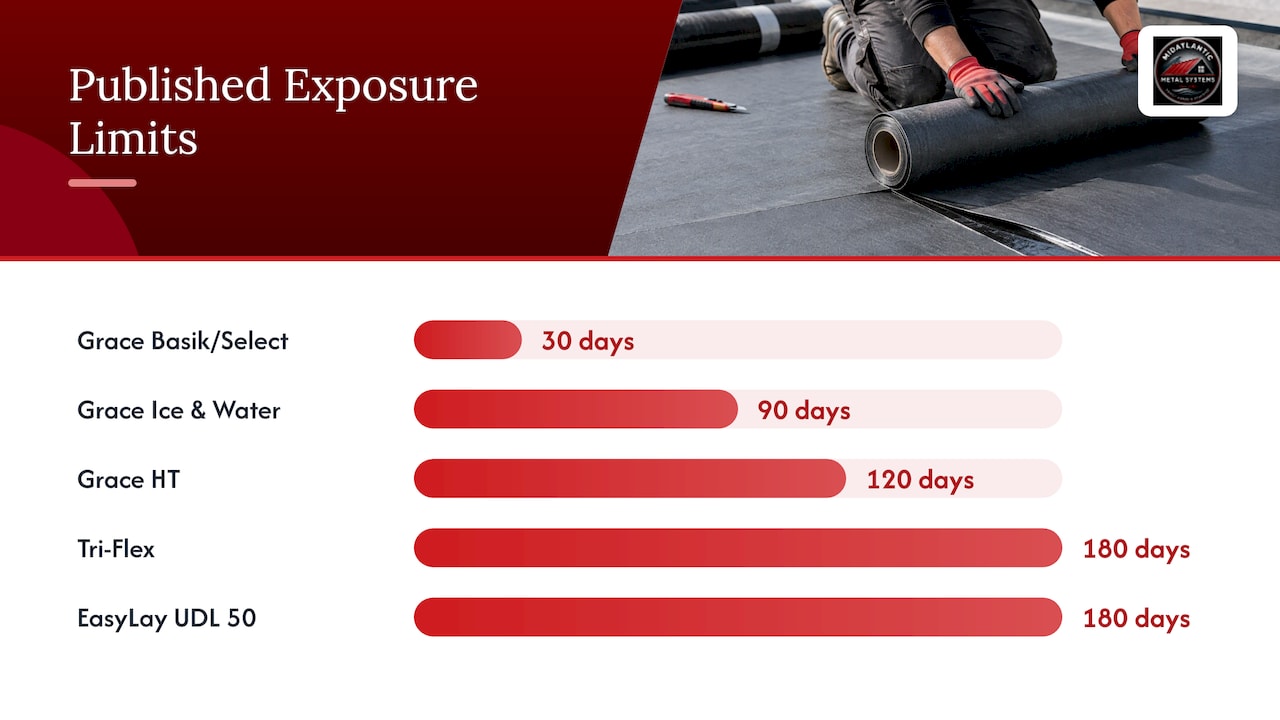
This is the question that causes the most schedule trouble. There is no single number. Every manufacturer publishes its own limit for each product, and the limits differ a lot.
A survey of published figures by The Roofing Brief shows limits from 30 to 180 days across products. The manufacturer documents themselves give a clearer picture for the self-adhered lines:
| Product line | Published exposure limit | Source |
|---|---|---|
| Grace Ice & Water Shield | 90 days | GCP Technical Letter 3 |
| Grace Ice & Water Shield HT | 120 days | GCP Technical Letter 3 |
| Grace Ultra | 120 days | GCP Technical Letter 3 |
| Grace Roof Detail Membrane | 90 days | GCP Technical Letter 3 |
| Grace Basik, Grace Select | 30 days | GCP Technical Letter 3 |
| Tri-Flex | 180 days | GCP Technical Letter 3 |
| LeakBarrier EasyLay UDL 10 | 30 days | Tarco bulletin LB-18-07A |
| LeakBarrier EasyLay UDL 15 and Basic | 90 days | Tarco bulletin LB-18-07A |
| LeakBarrier EasyLay UDL 50 | 180 days | Tarco bulletin LB-18-07A |
These figures come from manufacturer documents dated 2016 and 2018. Product lines and instructions get revised, so treat the table as an illustration of the spread and read the current data sheet for the product you are actually buying.
When the clock starts
The count begins when the sheet is fastened down, not when the weather clears. The Roofing Brief gives a practical example: a deck dried in on March 1 with a 90-day product has to be covered by roughly May 30, regardless of how many of those days were unworkable. Winter days count as well, because the published limit is a flat calendar figure and not a UV dose budget.
For a crew, that turns into a simple rule: write the underlayment’s limit on the job ticket the day it goes down, and count backward from it when you schedule panel delivery.
Why the local approval can override the sell sheet
The number on the marketing sheet is not always the number you can use. Product approvals can be stricter. The Florida Building Code evaluation report FL27945-R2 states that all underlayments shall be exposed for a maximum of 30 days unless otherwise stated. In another case, the Trinity ERD report FL15487 limits several GAF synthetic underlayments to 30 days, against a 180-day figure in the manufacturer’s marketing.
The 180-day figure on a sell sheet is also narrower than it sounds. GAF’s own footnote says it refers to standardized testing that the product will not physically degrade from UV, and is not related to withstanding water, snow or wind. That is a synthetic example, but the lesson carries over: read the limit as a statement about one failure mode, then read the installation conditions around it.
Miami-Dade County’s Notice of Acceptance 22-0708.05, approved August 18, 2022, is a good example of a limit written into a regulatory document. It states that Grace Ice & Water Shield HT shall not be left exposed to weather for longer than 120 days.
In the Mid-Atlantic, the practical takeaway is to check three places in order: the manufacturer’s installation instructions, any evaluation report or approval your jurisdiction relies on, and your building department’s written requirements. Use the strictest of the three.

Extra precautions for long or rough exposure
Some manufacturers add conditions. Epilay’s Protectite Ultra instructions allow up to 365 days of UV exposure but say severe weather or jobsite conditions may require a shorter period. They recommend doubling lap widths or sealing seams for extended exposure of 30 days or more, or when driving rain or strong wind is expected. That is a synthetic product, not a self-adhered one, but it shows what manufacturers expect on a long dry-in: more laps, sealed seams and better fastening.
Owens Corning’s RhinoRoof U20 sheet is another example of fastening rules tied to time. It requires cap nails of at least 1 inch diameter for exposure beyond 24 hours and up to 60 days. Again, read the sheet for your own product.
What happens when the limit is exceeded
The limit exists for a reason. The Roofing Contractor magazine authors Art Aisner and Tanja Kern wrote that premium underlayments are not meant to serve as the primary roof, because sun, UV, rain and snow would alternately oxidize and wash away the asphalt-rubber blend until the membrane fails.
Within the permitted period, the picture is milder. GCP’s Technical Letter 3 explains that UV will not affect the membrane in any significant way during its maximum exposure limit and heat is unlikely to affect performance, though appearance may change. It adds that after the maximum period it is normal to see slight wrinkling, slight color change in the non-slip surface and a little edge curling. So a membrane that looks a little tired inside its window is not automatically a problem. A membrane past its window is a decision for the manufacturer’s guidance and your inspector, not a judgment call from the truck.
One caution on the other side. Martin Holladay, writing in Fine Homebuilding about synthetic underlayments, observed that there is little evidence a 12-month product performs differently from a four- or six-month one. His point supports the practical approach: do not buy on the biggest exposure number alone. Choose on code compliance, conditions and schedule.
Choosing a self-adhered underlayment: a contractor checklist
- Confirm ASTM D1970. Codes require self-adhering bituminous membranes to meet ASTM D1970, and newer codes require a label showing compliance. The standard, ASTM D1970/D1970M:2025, covers thickness, adhesion to plywood, flexibility at -20°F, tear resistance, nail sealing and side lap integrity.
- Match the use to the code. For eave protection, confirm the required width with your local code. For full-roof use, ARMA advises confirming with local codes that self-adhering membranes are acceptable.
- Check ventilation. Self-adhered sheets act as vapor retarders. ARMA says that over an entire deck, the absence of adequate ventilation may contribute to premature deterioration of the roof system and deck, including condensation under the deck. Our guide to code-ready metal roofing over insulation is relevant when insulation is part of the assembly.
- Read the exposure limit and approvals. Take the manufacturer limit, then any stricter local approval. Write it down.
- Check the deck. Self-adhered membranes need a clean, dry, sound deck. Our overview of metal roof deck types helps when you are deciding what the membrane will bond to.
- Plan for movement under the panel. Metal expands and contracts, and the layer beneath matters. See our notes on slip sheets under metal roofs for how panel binding gets avoided.
Scheduling underlayment around panel delivery
Exposure limits are a scheduling problem more than a materials problem. Most overruns happen for three reasons: the deck was dried in early, the panel order was not finalized, or weather stopped the install.
A workable sequence looks like this:
- Finish takeoff and confirm panel lengths, trim and flashing before the underlayment goes down.
- Lock the delivery window and write the underlayment limit date next to it.
- Dry in only the areas your crew can cover with panel inside the window.
- Treat details (valleys, penetrations, eaves) as the first areas to go under panel, since they carry the highest leak risk.
- If a delay pushes you toward the limit, call the underlayment manufacturer’s technical line before the window closes, not after.
Cold weather adds its own wrinkles, from adhesion on cold decks to slower days on the roof. Our winter metal roof installation guide covers the field side, and remember that winter days still count against the limit.
In D.C., the permit and document side adds another layer. Our notes on D.C. roofing code and DOB submittals and cool roof requirements in D.C. are useful when you plan the sequence for a District job. If you are going metal over an existing roof, read what contractors must check on metal over shingles first.
Our perspective on underlayment and panel timing
We supply standing seam panels to contractors, so we see the same pattern on jobs across Virginia, Maryland, D.C., Pennsylvania and West Virginia. The underlayment is rarely what fails the schedule. The gap between dry-in and panels on the roof is.
That is why we built our service around custom-length, cut-and-drop delivery. When panels are cut to the lengths on your takeoff and delivered to the jobsite, your crew can move from membrane to metal without a wait for stock lengths, field cutting or reorders. Trim and flashing packages ordered with the panels mean the details that need to go on first are on site when the roof is ready for them.
On projects where access or schedule is tight, on-site roll forming gives you panels made at the job, in the lengths the roof needs. Our 1-inch mechanical lock and 1.5-inch snap lock panels come in 24-gauge and 26-gauge Englert steel, and our team supports contractors through takeoff so the material order and the roofing sequence line up.
Our advice is simple: pick the underlayment, write down its exposure limit, and let that date drive the panel order, not the other way around.
Matt Catino
Getting panels on site before the clock runs out
If you are planning a standing seam job, send us your takeoff and the dry-in schedule. We can cut panels to length and deliver them to the jobsite across Virginia, Maryland, Washington DC, Pennsylvania and West Virginia, with trim and flashing coordinated to the same order. See cut-and-drop delivery for how it works.
For remote or hard-to-reach sites, on-site roll forming puts the machine at the job. You can also browse our standing seam panel options or go to contractor supply to set up an order.
FAQ
How long can self-adhered underlayment be left exposed?
It depends on the product. Published limits for self-adhered lines run from 30 to 180 days, for example 90 days for Grace Ice & Water Shield and 120 days for its HT version. Check the current data sheet and any local approval, and count from the day the sheet is fastened.
Does rain or winter pause the exposure clock?
No. The published limit is a flat calendar figure, so rainy and winter days count. A deck dried in on March 1 with a 90-day product needs its roof covering by about May 30.
Is self-adhered underlayment required on every roof?
Not on every roof. Codes call for it, or an alternative, in specific cases such as low slopes from 2:12 to 4:12 and ice dam areas. Confirm the requirement with your local building department before you order.
What standard should self-adhered underlayment meet?
ASTM D1970. Building codes require self-adhering bituminous membranes to meet it, and newer codes require a label showing compliance. The standard covers properties such as adhesion, low-temperature flexibility, tear resistance and nail sealing.
Can I use self-adhered underlayment over the whole deck?
Often yes, but confirm with local code that it is acceptable for full-roof use. Because it acts as a vapor retarder, plan for adequate ventilation in the assembly.
Sources
- ARMA Technical Bulletin: Use of Self-Adhering Membranes as Underlayments in Steep Slope Roofing
- ARMA: Steep Slope Roofing Underlayment
- The Roofing Brief: Underlayment UV Exposure Limits by Product
- GCP Applied Technologies Technical Letter 3: Exposure Guidelines
- Tarco Technical Bulletin LB-18-07A: LeakBarrier EasyLay UDL Exposure Times
- Miami-Dade Notice of Acceptance 22-0708.05
- Florida Building Code evaluation report FL27945-R2
- Epilay Protectite Platinum installation instructions
- GAF Tiger Paw sell sheet
- Owens Corning RhinoRoof U20 specification sheet
- Roofing Contractor: The Membrane Beneath the Metal
- Fine Homebuilding: Synthetic Roofing Underlayments
- ASTM D1970/D1970M-25