Cut and Drop + Gantt Checks: Mid Atlantic Standing Seam Lead Times
A contractor's lead-time playbook for Mid Atlantic standing seam: three timing bands, cut and drop and onsite roll forming options, plus schedule...
Plan for three tiers: same day to about a week if you’re using a local roll-former or stock colors, 1 to 4 weeks for most domestic fabricator orders, and 12 or more weeks for specialty coils or large commercial jobs. The variable that moves you between those tiers almost every time is production model and color availability, so confirm both before you build your install date around a supplier’s quote.
TL;DR:
- Lead times for standing seam panels range from same day to 3 days for local, stock color orders, to 1-4 weeks for standard orders, and over 12 weeks for specialty products.
- Factors extending lead times include custom colors, heavy commercial volume, complex profiles, and ordering trim separately from panels.
- On-site roll forming and choosing stock colors or standard gauges can significantly reduce delivery time, often to just a few days.
- Confirming whether color requires a coil purchase and scheduling freight and site access in advance are crucial to meet project deadlines.
- Contractors should lock panel specifications early, request firm leads, and coordinate trim and accessories with panel orders to prevent schedule delays.
Table of Contents
- How Long Does It Take to Get Standing Seam Panels?
- What Makes a Standing Seam Quote Take Longer?
- When Should You Order Standing Seam Panels?
- Can You Get Standing Seam Panels Faster?
- What Jobsite Logistics Affect Delivery Timing?
- What Contractors Get Wrong About Scheduling Panel Orders
- Get a Firm Lead-Time Quote Before You Build Your Schedule
- Sources
- FAQ
How Long Does It Take to Get Standing Seam Panels?
Standing seam lead times split into three real-world bands, and knowing which one you’re in changes how you build a schedule.
Short turn: same day to 3 business days. This applies when a fabricator runs panels locally with portable rollforming equipment and you’re ordering a stock color. Case summaries from regional suppliers show same-day to 3-day turnaround is achievable when local production capacity exists, and some direct suppliers ship custom-length panels in 7 to 10 days for standard orders when next-day service isn’t regionally available.
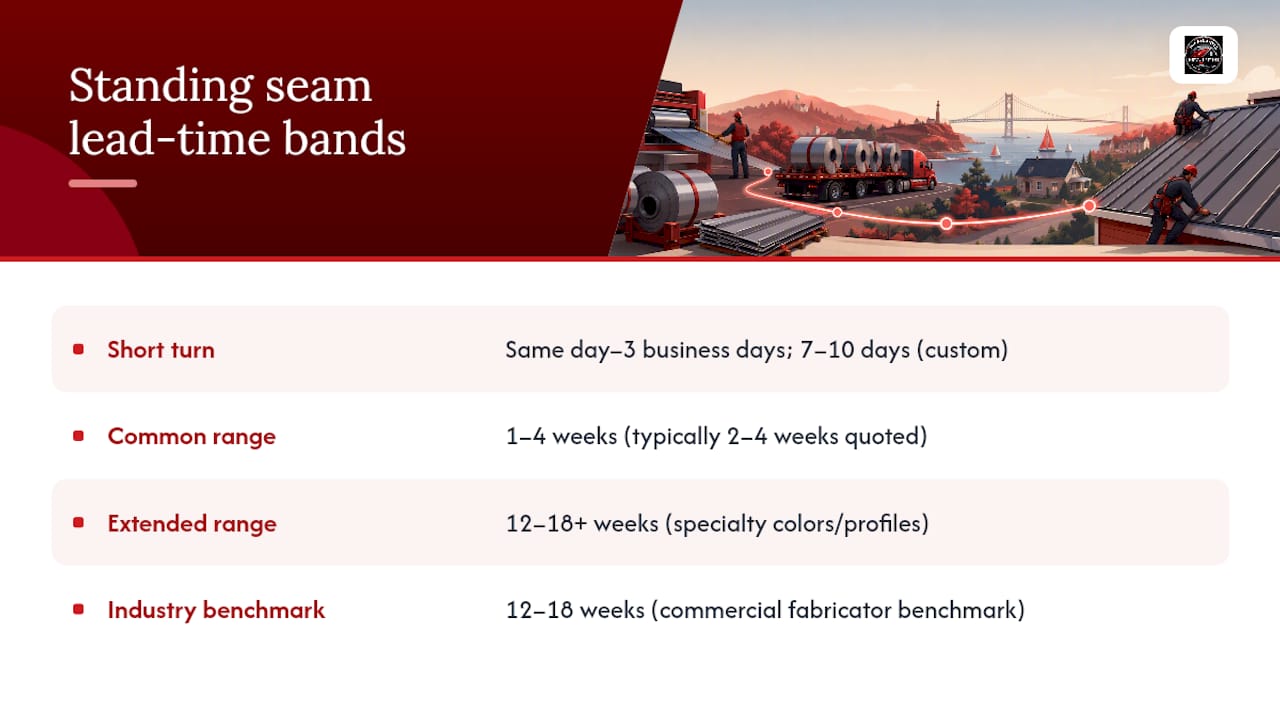
Common range: 1 to 4 weeks. Metal America’s supplier guidance recommends contractors plan 2 to 4 weeks from order placement to delivery for most standard orders, while large national manufacturers commonly quote 2 to 3 weeks plus shipping and some regional suppliers advertise 1 to 2 weeks for standard packages.
Extended range: 12 to 18 weeks or more. Specialty coil colors, unusual profiles, and heavy commercial volume push standing seam into a different category entirely.
Industry benchmark: A commercial construction lead-time table puts standing seam metal panels at 12 to 18 weeks for some domestic fabricator scenarios, noting standing seam tracks closer to structural steel lead times than membrane roofing. That’s a meaningfully different planning category than shingles or single-ply membrane, and it’s why treating standing seam like a commodity roofing material on your Gantt chart backfires.
What Makes a Standing Seam Quote Take Longer?
A handful of line items on a quote will tell you more about real delivery timing than the supplier’s marketing copy.
- Production model. Central fabrication plants ship on a batch schedule and add freight transit; local or on-site roll-forming compresses both.
- Profile and gauge. Mechanical lock panels typically require more precise forming tolerances than snap lock, and 24-gauge steel handles differently in production than 26-gauge, both of which affect queue placement.
- Color and coil availability. Stock colors ship off existing coil stock. Custom or low-demand colors mean waiting on a coil order from the paint mill, which can add weeks by itself.
- Order volume and season. Spring and early summer push most fabricators into their busiest production queues of the year.
- Trim and flashing inclusion. Ordering trim and flashing as a separate line item, rather than coordinated with the panel run, is a common source of schedule friction.
- Freight distance and carrier scheduling. Even a finished panel run can sit waiting on a truck booking if delivery wasn’t scheduled in advance.
Pro Tip: Ask your supplier one direct question before you sign a quote: “Is this color coming off stock coil or does it require a mill order?” That single answer often predicts your real lead time better than anything else on the page.
When Should You Order Standing Seam Panels?
Back-calculate your order date from your installation start, not the other way around. Supplier guidance from Metal America recommends building in a 3 to 4 week buffer for typical orders so a minor production delay doesn’t push delivery past your crew’s start date.
- Freeze the spec. Lock panel profile, gauge, and color before requesting a firm lead-time quote.
- Confirm trim and flashing scope. Decide whether they ship with the panel order or get sourced separately.
- Get measurement sign-off. Field verification should happen before the order goes in, not after.
- Place the order with a written ship date. Verbal estimates aren’t schedule commitments.
- Get production confirmation. A confirmed cut date, not just an order acknowledgment.
- Lock the delivery window. Coordinate this with site access and crew availability.
Before you place the order, walk the quote against this short checklist:
- Does the quote include clips and fasteners, or are those a separate purchase?
- Is the ship date a guarantee or an estimate?
- What’s the cutoff date for spec changes without a schedule reset?
- Is there an expedite option, and what does it cost?
Can You Get Standing Seam Panels Faster?
Yes, and the fastest lever most contractors underuse is production location. On-site roll forming eliminates the freight leg entirely because panels get formed at the jobsite in the exact lengths needed, which is a meaningfully different timeline than waiting on a central plant’s batch schedule and a freight carrier.
A few other moves compress the schedule without touching quality:
- Order cut-and-drop custom lengths instead of standard stock lengths that require field trimming and rework.
- Choose stock colors and standard gauge combinations rather than specialty coil orders.
- Split large roofs into a priority run that ships first, so crews start installing while the remainder is still in production.
- Confirm trim, flashing, and clips ship with the panel order rather than as a separate fabrication job.
Pro Tip: On a multi-phase roof, ask your supplier to prioritize the section your crew installs first. A staged delivery keeps your team productive on day one instead of waiting on a single, all-at-once shipment.
What Jobsite Logistics Affect Delivery Timing?
Production isn’t the only place a schedule slips. Delivery appointment windows matter because most freight carriers require advance booking, and a missed window can add days even after panels are finished.
Site access matters just as much. Confirm crane or telehandler needs before delivery day, not the morning of, and make sure someone is on site who can direct offloading. Standing seam roof panel delivery planning should also account for short-term storage. Panels left exposed or improperly stacked risk scratching or edge damage before they ever go on the roof.
- Book delivery appointments as soon as a ship date is confirmed, not after panels arrive at the terminal.
- Confirm offloading equipment and site access in advance.
- Store panels off the ground, protected from weather, if installation won’t start immediately.
- Sequence trim and accessories to arrive with or just ahead of panels so crews aren’t waiting mid-install.
What Contractors Get Wrong About Scheduling Panel Orders
The biggest scheduling mistake isn’t picking the wrong supplier. It’s treating standing seam like a shingle order that can be placed two weeks out and adjusted on the fly. Panels are a manufactured product tied to coil stock and a production queue, closer in behavior to structural steel than to commodity roofing.
What actually shortens a schedule isn’t finding a faster supplier so much as removing decisions that create delay: locking color early, coordinating trim with the panel order instead of treating it as an afterthought, and using cut-and-drop delivery or on-site roll forming when the calendar is tight. Coordinated trim packages and portable rollforming exist specifically because separate ordering and central-plant freight are where most schedules quietly slip.
— Matt Catino
Get a Firm Lead-Time Quote Before You Build Your Schedule
MidAtlantic Metal Systems is built around the exact problem this article covers: contractors who can’t afford a vague delivery estimate. Instead of quoting a generic production window and letting freight timing surprise you later, we offer cut-and-drop delivery and on-site standing seam roll forming across Virginia, Maryland, Washington DC, Pennsylvania, and West Virginia, so you get custom-length panels without waiting on a central plant’s batch queue.
Our 1-inch mechanical lock and 1.5-inch snap lock panels come in 24-gauge and 26-gauge Englert steel, and we coordinate trim and flashing packages with your panel order so you’re not chasing a separate fabrication timeline. If your project spec calls for crane coordination or precut packages to control site logistics, the same scheduling principles apply to precut building components generally.
Request a lead-time quote and production confirmation before you finalize your install date. Get the real numbers, not a placeholder estimate, so your Gantt chart holds up.
Sources
- Commercial Construction Material Lead Times (July 2026) | TCG
- How to Order Custom Metal Roofing Panels: What Contractors Need to Know | Metal America
- How Fast Can You Get a Metal Roof? | S3 Metals & supplier summaries
FAQ
How Far Ahead Should I Order Standing Seam Panels?
Build in a 3 to 4 week buffer before your installation start date for typical orders, and extend that to several months for specialty colors or large commercial jobs.
Why Do Standing Seam Lead Times Vary So Much Between Suppliers?
Production model is the biggest factor. Central fabrication plants add freight transit on top of batch production schedules, while local or on-site roll-forming can deliver panels in days rather than weeks.
Does Color Choice Really Affect Lead Time?
Yes. Stock colors ship from existing coil inventory, but custom or low-demand colors often require a new coil order from the paint mill, which can add several weeks.
Can MidAtlantic Metal Systems Deliver Faster Than a Standard Fabricator?
Some providers offer cut-and-drop delivery and on-site roll forming to reduce production and transit times compared to central-plant orders in the Mid-Atlantic region.
What Should I Confirm on a Quote Besides the Ship Date?
Confirm whether clips, fasteners, and trim ship with the panel order, since sourcing those separately is a common cause of last-minute install delays.