Contractors: Avoid Rework, Size Standing Seam Thermal Clips With SMACNA
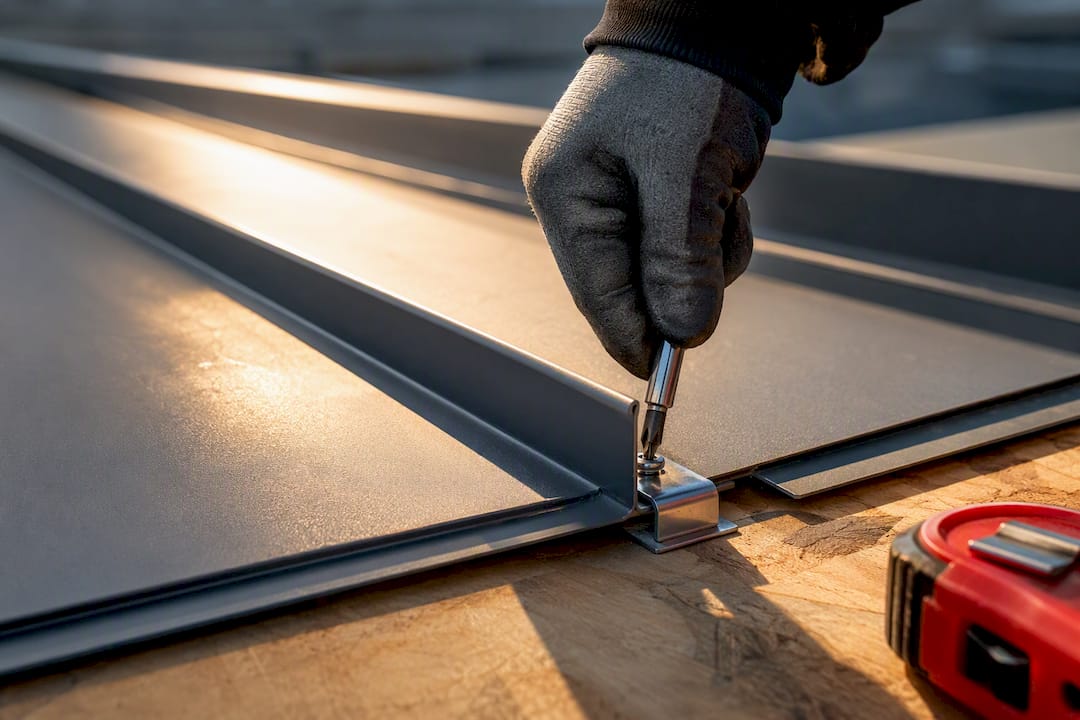
Playbook for contractors: calculate ΔL, confirm clip travel, detail trims and penetrations, and order custom length panels to avoid rework.
Standing seam roofs handle thermal movement by letting the panel slide over the deck rather than fighting the expansion, using floating or two-piece sliding clips and a single fixed point per run. Before you order panels, calculate the expected movement (ΔL), confirm it against the clip’s published travel limit, and check that trims, penetrations, and end laps won’t pin the panel in place.
TL;DR:
- Panel length, surface temperature swing, and material type determine expected thermal movement that must be accommodated with proper clip selection and placement.
- Aluminum panels expand nearly twice as much as steel over the same run length and temperature swing, requiring longer clip travel limits or shorter spans.
- Using a fixed clip system on long runs can cause failures like oil canning or seam issues; sliding clips are recommended for runs over approximately 12 to 20 feet, depending on material.
- Accurate calculation of panel movement before ordering and precise fixed point placement are critical to prevent costly rework and installation errors.
- Proper trim, penetration, and transition detailing with loose overlaps or slip joints allow panels to expand and contract freely without causing damage.
Table of Contents
- What Causes Standing Seam Thermal Movement?
- How Do Steel, Aluminum, and Copper Movement Compare?
- Fixed Clips vs. Sliding Clips: Which Do You Need?
- How Do You Calculate Movement Before Ordering Panels?
- How Do You Detail Trim and Penetrations for Movement?
- What Installation Mistakes Cause Thermal Movement Failures?
- What Do Industry Standards Say About Thermal Movement?
- Sequencing and Logistics for Thermal-Movement Compliance
- Get Custom-Length Panels Built for Your Clip Spec
- Sources
- FAQ
What Causes Standing Seam Thermal Movement?
Metal expands when it heats and contracts when it cools, and the math behind it is simple: ΔL = α × L × ΔT. Here, ΔL is the total movement, α is the material’s coefficient of linear expansion, L is the panel length, and ΔT is the temperature swing the panel actually experiences.
That last variable trips up more installers than any other. Panel surface temperature, not ambient air temperature, drives the calculation. A dark steel panel sitting in direct sun can run 150 to 200 degrees Fahrenheit hotter across a season than it does on a cold winter night, according to movement data cited by The Roofing Brief, so use panel temperature swings in your math, not the local weather forecast.
| Panel length | ΔT assumed | Approximate steel movement |
|---|---|---|
| 10 ft | 100°F | About 5/64 in. |
| 40 ft | 100°F | About 5/16 in. |
| 40 ft | 150°F | About 15/32 in. |
How Do Steel, Aluminum, and Copper Movement Compare?
Material choice changes your clip and run-length math more than almost any other design decision. A 40 ft panel moving through a 100°F temperature swing shows real daylight between metals, based on worked figures from The Roofing Brief:
- Steel (α ≈ 0.0000065 in./in./°F): about 5/16 inch of movement over 40 feet.
- Copper (α ≈ 0.0000098 in./in./°F): about 15/32 inch over the same run.
- Aluminum (α ≈ 0.0000128 in./in./°F): roughly 5/8 inch, nearly double steel’s movement.
Aluminum moves almost twice as much as steel across an identical run length and temperature swing. That gap means aluminum panels typically need longer clip travel, shorter maximum run lengths, or both, compared with a steel panel doing the same job. Finish color matters too: darker coatings absorb more solar energy and push panel surface temperature higher than a light gray or white finish would under the same sun, which widens your ΔT and your resulting movement on every calculation.
Fixed Clips vs. Sliding Clips: Which Do You Need?
Every standing seam panel run needs exactly one anchored point. Everything else on that run has to be free to move, and the clip system you choose determines how that happens.
One-piece fixed clips hold the panel rigidly at the seam. They work fine on short runs where total movement stays small, but they offer no built-in travel, so the panel itself has to do all the sliding against the clip pan.
Two-piece sliding clips separate into a base that fastens to the deck and a top piece that engages the seam, letting the panel glide over the base as temperatures shift. The travel lives inside the clip instead of at the fastener, which is why MBCI’s white paper on controlling thermal movement recommends them for most runs above roughly 30 feet.
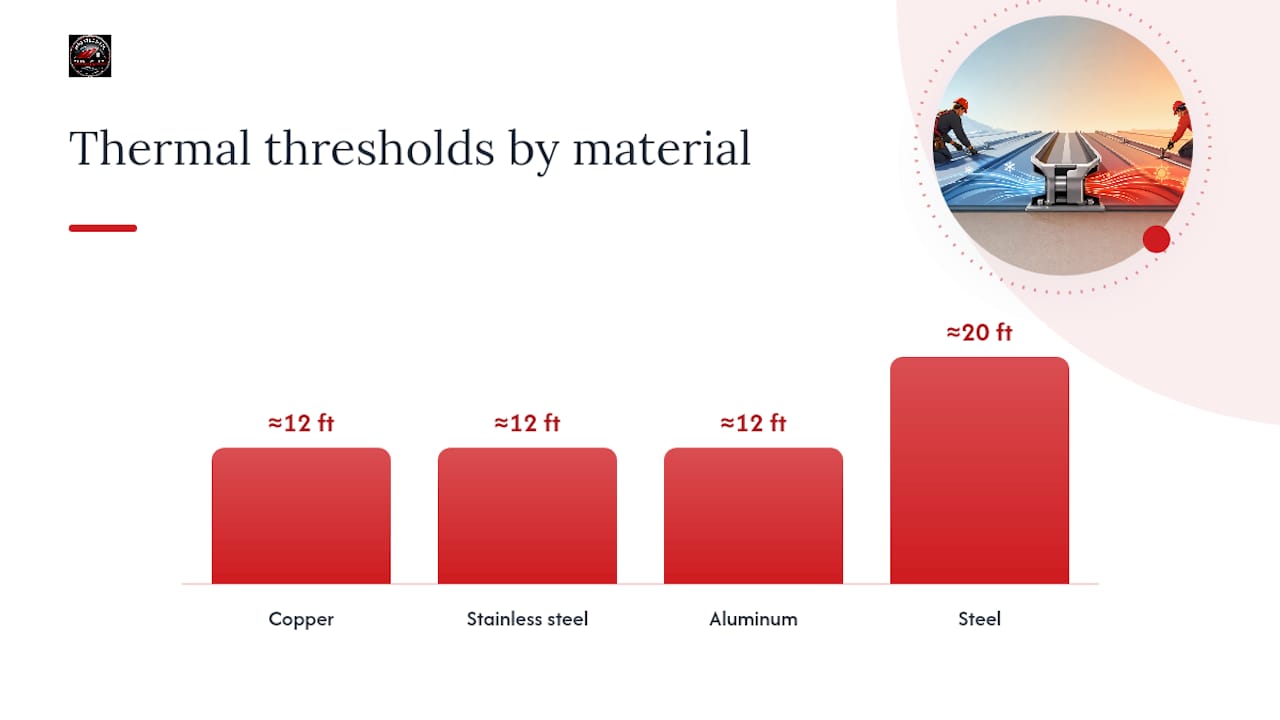
Run-length thresholds aren’t arbitrary. SMACNA’s Architectural Sheet Metal Manual sets recommended minimums for when special thermal accommodation becomes necessary: beyond about 12 feet for copper, stainless steel, or aluminum panels, and beyond about 20 feet for steel. Slope, climate exposure, and finish color can all push those numbers in either direction, so treat them as a starting point, not a hard rule.
Where you place the single fixed point matters as much as the clip type. Eave, ridge, and midspan anchoring each redirect movement differently, and MBCI’s guidance notes manufacturers vary their placement recommendations by roof type and slope.
Pro Tip: Mark the fixed point directly on your panel layout drawings before fabrication starts. A run with two “fixed” ends by accident is one of the most common and most expensive framing errors on a metal roof.
How Do You Calculate Movement Before Ordering Panels?
Confirming clip compatibility is arithmetic, not guesswork, and it takes about five minutes per run once you have the numbers in front of you.
- Measure the design panel length (L) for the actual run, not the roof plane’s overall dimension.
- Estimate ΔT using panel surface temperature, not air temperature. A reasonable planning range is 100°F for daily swings and up to 150 to 200°F for seasonal extremes, per the panel-temperature guidance in The Roofing Brief’s analysis.
- Calculate ΔL using the coefficient for your specific material.
- Compare ΔL to the clip’s published travel limit. If ΔL exceeds it, you have four options: shorten the run, specify a clip with longer travel, add an expansion joint, or relocate the fixed point.
A sample check: a 60 ft steel run at a 150°F swing works out to roughly 7/16 inch of expected movement. If your specified clip is rated for 3/8 inch of travel, that run needs a longer-travel clip or a mid-run expansion joint before it ships.
| Run length | Material | ΔT | Approximate ΔL |
|---|---|---|---|
| 40 ft | Steel | 100°F | 5/16 in. |
| 40 ft | Aluminum | 100°F | 5/8 in. |
| 60 ft | Steel | 150°F | 7/16 in. |
Before ordering panels, gather deck dimensions, expected finish color, slope, and clip manufacturer travel specs. Building Research Systems’ guidance also notes that field movement often runs slightly lower than theoretical calculations because of friction and minor purlin roll. That’s a safety margin, not a substitute for doing the calculation.
How Do You Detail Trim and Penetrations for Movement?
Every trim piece and penetration on the roof is a potential pinch point if it isn’t detailed to move with the panel.
- Ridge caps and rake trim should overlap loosely enough to slide with panel expansion; avoid fastening trim directly through the pan in a way that locks the seam in place.
- Gutters and eave trim need slotted holes or cleats rather than fixed screws where they contact the panel edge, so seasonal movement doesn’t tear the connection loose.
- Curbs and penetrations work best on a floating sub-frame or a curb with a slip joint, rather than a rigid curb welded straight to the panel.
- End laps need enough length and correctly spaced cinch plates to transfer wind and structural loads without buckling the pan when the panel contracts.
When a roof plane changes width or terminates at a parapet, break the panel into a separate weather leg and seal it with counter-flash, per Building Research Systems, so movement at that transition doesn’t tear the flashing.
What Installation Mistakes Cause Thermal Movement Failures?
Most thermal-movement failures trace back to a handful of repeated errors, not exotic engineering problems.
- Fixing both ends of a run instead of one, which forces the panel to fight itself every time the temperature swings.
- Specifying undersized clip travel for the material and run length, especially on aluminum panels where movement runs nearly double steel.
- Placing clamps or accessories directly over halters or fixed points, which can restrict movement the clip was designed to allow, per S-5!'s technical guidance on accessory attachment.
- Slotting screw holes incorrectly or omitting slots entirely at trim connections that need to slide.
Restricted movement shows up in the field as fastener fatigue, seam penetration, oil canning, or worse, and research on halter-based aluminum systems documents installation tolerance and halter alignment as critical failure points. Walk any suspect roof and check for exactly one fixed point per run, full clip travel clearance, and no clamps sitting on halter locations.
Pro Tip: If you spot oil canning developing near a trim line months after install, check for a pinned end lap or a fastener driven through the pan before assuming it’s a cosmetic flatness issue.
What Do Industry Standards Say About Thermal Movement?
For contractors who need panel lengths that fit these thresholds without guesswork, a few practical resources help:
- Custom-length panels cut to the exact run length your clip and fixity plan requires.
- 1-inch mechanical lock and 1.5-inch snap lock standing seam profiles in 24-gauge and 26-gauge steel.
- On-site roll forming for jobs where a single continuous panel avoids an unnecessary lap altogether.
For a deeper look at how run length interacts with clip selection, see how long standing seam panels can run before you finalize a takeoff.
Sequencing and Logistics for Thermal-Movement Compliance
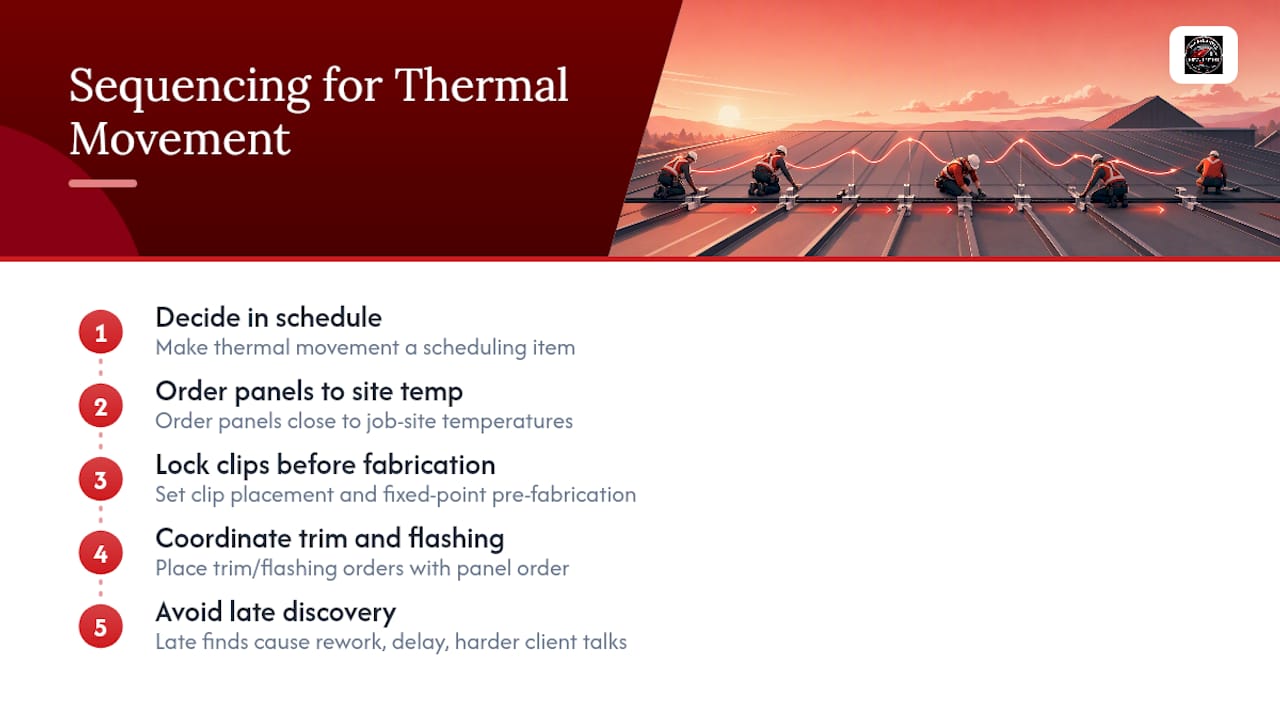
Thermal movement decisions belong in the scheduling conversation, not just the spec sheet. Order panels close to job-site temperatures when the schedule allows, and lock in clip placement and fixed-point location before fabrication, not during installation.
Coordinate trim and flashing orders with your panel order early. Discovering a movement allowance problem after trim has already shipped means rework, delay, and a harder conversation with the client than the one you’d have had at takeoff.
— Matt Catino
Get Custom-Length Panels Built for Your Clip Spec
Custom-length panels cut to the exact run length needed help solve the ordering headache that thermal-movement math creates: once you’ve calculated your run length and picked a clip system with the right travel, you need panels cut to that exact length, not a stock size you have to lap or trim on-site.
Custom-length 1-inch mechanical lock and 1.5-inch snap lock panels in 24-gauge and 26-gauge steel, along with trim and flashing packages built to match your fixity and detailing plan, are available. Our on-site roll forming option eliminates end laps entirely on long runs where field-measured accuracy matters most. If you’re specifying a project in Virginia, Maryland, Washington DC, Pennsylvania, or West Virginia, get a quote through our Roanoke standing seam panel page or reach out to our fabrication team to confirm panel lengths against your clip travel before you place the order.
Sources
For manufacturer-specific data, verify clip travel ratings directly. Consult the SMACNA Architectural Sheet Metal Manual for installation thresholds, and MBCI’s white paper on sliding clips for worked movement figures and clip recommendations.
- Metal roof expansion and contraction: Worked numbers | The Roofing Brief
- Controlling thermal movement of standing seam metal roofs: Sliding clips and beyond | MBCI
- Factors affecting the accommodation of thermal movement in halter-based aluminium standing seam systems | CIBSE
FAQ
What Are the Disadvantages of a Standing Seam Roof?
Standing seam roofs cost more upfront than shingles, and improper thermal-movement detailing can lead to oil canning, fastener fatigue, or seam penetration if clip type and fixity aren’t matched to run length and material.
What Metal Has the Highest Thermal Expansion Rate?
Among common roofing metals, aluminum expands the most, moving roughly 5/8 inch over a 40 ft run at a 100°F swing, compared with about 5/16 inch for steel over the same distance, per worked figures from The Roofing Brief.
What Do Insurance Companies Think of Metal Roofs?
Insurers generally view properly installed metal roofs favorably because of their wind, fire, and impact resistance, and some carriers offer premium discounts, though specific terms vary by insurer and region.
What Is the Average Lifespan of a Standing Seam Metal Roof?
A well-installed standing seam metal roof commonly lasts 40 to 60 years, but that lifespan depends heavily on correct thermal-movement detailing. A roof with pinned panels or undersized clip travel can develop leaks and fatigue failures decades before the material itself would otherwise wear out.