Steel Coil Storage: Racks, Loading Rules and Safe Handling

How to store steel coil safely: rack types, capacity ratings, point-load rules, OSHA basics and when roofing crews can skip coil storage altogether.
Steel coil is stored safely when it sits off the floor in a purpose-built cradle rack, with every coil supported by both the front and back beams, a rack rated well above the heaviest coil, and a dry, stable environment for finished material. Racks are for plants that handle coil every day. A roofing crew that only needs finished standing seam panels can often skip coil storage entirely.
This guide covers both sides. First, how coil racking works, what the rack types can carry and how to load them. Then the part contractors tend to overlook: what to do when coil lands on a jobsite for roll forming, and when cut-and-drop delivery removes the problem.
TL;DR
- A coil rack is a cradle-style storage system built for the shape and weight of coil. Pallet racking is not a substitute.
- Start with the coil (diameter, width, weight, finish), then handling equipment, then pick the rack. Engineer to at least a 2:1 safety factor.
- Support every coil on both the front and back beams. Resting it on the cradle alone creates a point load that can fail a rack.
- Finished or painted coil wants a dry, stable-temperature spot, and wet coil should be dried quickly.
- If you only need roof panels, custom-length cut-and-drop delivery means no coil to store at all.
Table of Contents
- What steel coil storage actually means
- Types of coil storage systems
- How heavy is a steel coil?
- How to choose a coil rack, step by step
- Loading rules that prevent point-load failures
- OSHA and securement basics
- Protecting finished and painted coil
- Do you need to store coil at all?
- Our perspective
- Order panels, skip the coil yard
- FAQ
- Sources
What steel coil storage actually means
A coil rack is a storage structure designed to support, organize and protect coiled inventory such as steel, aluminum or wire. Dexco describes each rack as cradling the coil so it does not deform or collapse under its own weight, with coils held upright or on their sides in dedicated slots so they can be found and pulled without excessive manual handling.
The alternative is the floor. Dexco’s design guide notes that floor storage of sheet coil eats manufacturing floor space, invites material damage and creates a hazard for workers. Racks move the same inventory into vertical space and keep coils off the ground where they are more easily damaged.
That difference matters more than it sounds. Floor-stacked coil forces last-in, first-out access: to reach the bottom coil you move the ones on top. Dexco’s engineering team points out that racking gives true first-in, first-out access, and that secure, elevated cradles prevent roll-away incidents and the creasing and flattening that vertical floor stacking causes.
Types of coil storage systems
There is no single “coil rack.” The right system depends on coil weight, how often you pull coils and how much floor you have. Plexform’s comparison lists these ranges:
| System | Typical capacity | Space efficiency |
|---|---|---|
| Single-tier cradle rack | 500 to 15,000 lbs per position | Moderate |
| Multi-tier cradle rack | 1,000 to 30,000 lbs per tier | High |
| Mandrel vertical rack | 2,000 to 25,000 lbs | Moderate |
| Eye-to-sky flat rack | 1,000 to 20,000 lbs | Low to moderate |
| Coil transfer cart | Up to 40,000 lbs | n/a |
| Coil reel stand | Up to 30,000 lbs | n/a |
Some manufacturers go well past those figures. Dexco states its full-depth cradle systems carry from 2,000 to more than 80,000 pounds per shelf, with shelf beams that adjust in 4-inch increments and predrilled baseplates for anchoring to the floor. Steel King’s portable coil racks handle coil diameters up to 72 inches and capacities up to 20,000 pounds, offer four-way entry, move by forklift or crane and stack up to four high.
Vertical versus horizontal storage
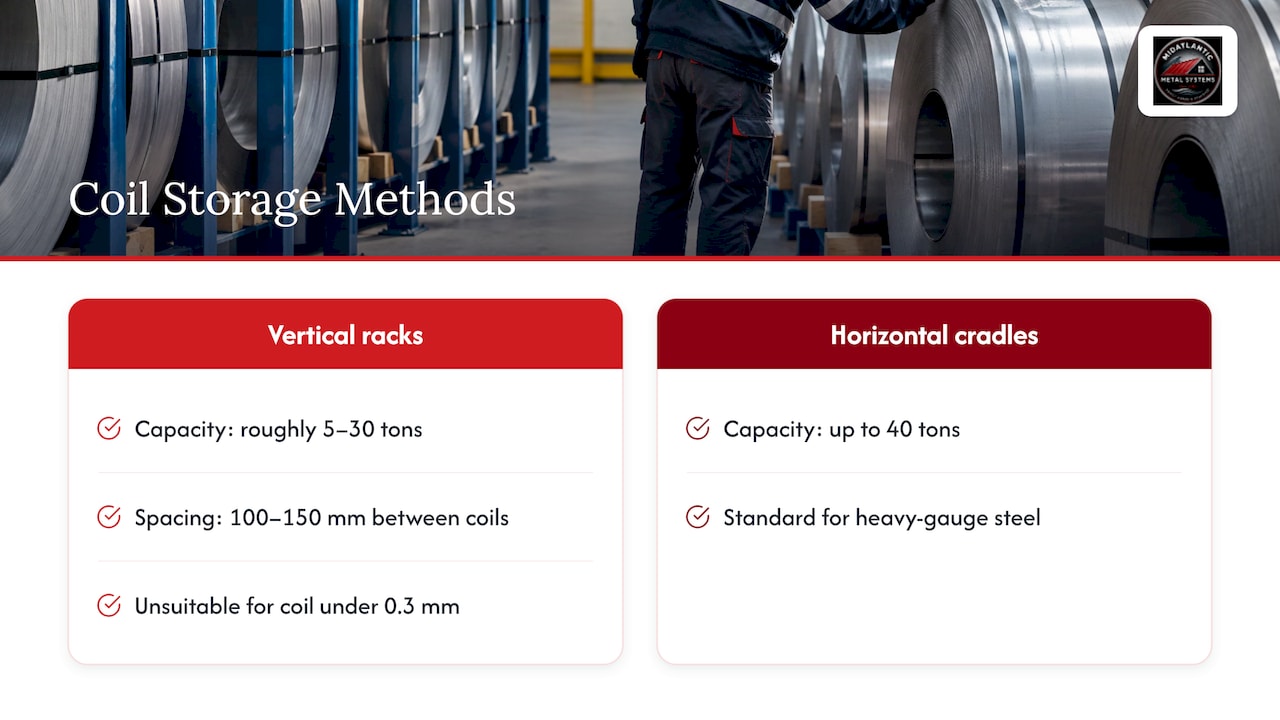
Beli Roll Forming reports that vertical racks, which hold coils of roughly 5 to 30 tons, are the most common method in roll forming plants, while horizontal cradles take coils up to 40 tons and are standard where heavy-gauge steel is handled. Vertical racks let coils sit side by side with only 100 to 150 mm between them, which suits tight floors. The same source cautions that vertical storage does not suit very thin coil, under 0.3 mm, because it can collapse under its own weight.
How much floor space a rack recovers
Plexform reports that facilities moving from floor-stored coil or adapted pallet racking to purpose-built racks recover 20 to 35 percent of their coil staging space. Treat that as a ballpark from one manufacturer, then measure your own floor before you plan.
How heavy is a steel coil?
Heavier than most people expect, and that drives every other decision. FlexBeam reports a single master coil can weigh from 10,000 kg to over 35,000 kg (22,000 to 77,000 lbs). HOJ Innovations puts large coils at 15 to 30 tons and notes that forklifts typically cannot handle anything over 16 tons, so heavier coils need a built-in or custom crane.
Smaller roll forming coils, the kind a roofing operation might use, sit far below those numbers, but the principle holds: a coil is a dense cylinder, and its weight bears on a thin line of contact rather than spreading across a pallet.
That is why ordinary pallet racking is the wrong tool. FlexBeam states that standard roll-formed selective pallet racks are unsuited to heavy coil because of torsional twisting, web crippling and beam shear. MMH Online explains that coil creates concentrated point loads, so rack capacity has to be engineered for the application, accounting for static load, dynamic load as a forklift sets the coil down, beam deflection and long-term performance. For a 10,000-pound coil, it says beam pairs are commonly engineered for 25,000 to 30,000 pounds per level.
How to choose a coil rack, step by step
Plexform advises starting from the coil, not the rack catalog. In practice:
- Document the coil. Outside diameter range, inside diameter if you need mandrel storage, maximum width, maximum weight and finish type.
- Document the handling equipment. Forklift model and fork dimensions, crane capacity and hook type, or coil car geometry.
- Decide the use. In-plant storage only, or also returnable shipping.
- Design to the heaviest coil. Plexform’s guide says to design for the maximum weight and then confirm the cradle geometry still makes positive contact at the minimum. A rack designed for 24-inch OD coils will not safely hold 48-inch OD coils.
- Apply a safety factor. The same guide calls for a minimum 2:1 factor above design load, so a rack holding a 20,000-pound coil should be engineered to 40,000 pounds before yielding.
- Plan aisles and safety. Dexco says load weights, diameters, handling equipment, aisle widths and safety requirements all feed the final design.
If the numbers are close to a limit, go to the rack manufacturer’s engineers, not a spreadsheet. A rack failure with coil on it is not a small repair.
Matching handling equipment to the rack
A rack is only half the system. Coil gets onto a shelf through a boom-equipped forklift, a crane or a coil car, and the rack, the lifting gear and the aisle all have to agree. Dexco’s design guide describes using a forklift with a boom attachment to load and unload, so coils can be pulled and fed into machinery without changing orientation. When you are sizing lifting gear for moving heavy coils between storage and production, coil handling equipment is worth a look alongside the rack decision, because capacity and reach have to match your heaviest coil.
Loading rules that prevent point-load failures
The most common way coil racks fail is not an overload. It is how the coil is placed.
Support the coil on both beams. Rack and Shelf calls this the most important rule of coil racking: every coil must be supported by a front and a back beam. Putting all the weight on the cradle alone is a point load that can cause rack failure and shelf collapse. It recommends the coil extend about 3 inches past the front and back of the cradle so the beams carry the weight.
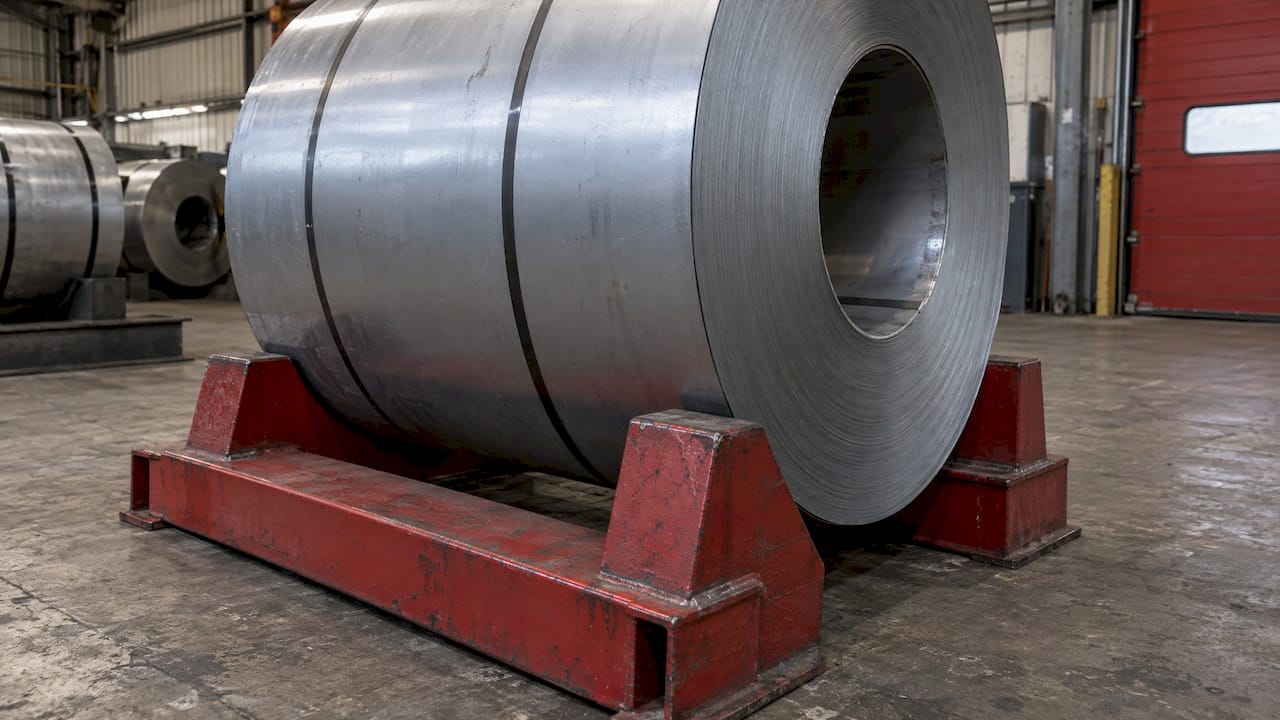
Do not park coils mid-bed. Placing a coil in the middle of the cradle bed instead of across the beams is exactly the point-load mistake above.
Keep coils on flat surfaces. Dexco’s design guide says cradles should be built so the coil always rests on a flat surface, not on the cradle edges, which can crease or flatten it. It adds that cradles and decks should be engineered for the coil’s full load even when the coil is shallower than the shelf.
Respect impact loads. FlexBeam notes coils exert intense line-contact loads and that its designs use dynamic impact factors of typically 1.5 to 2.0 times the working load. Setting a coil down hard is not the same as the coil sitting still.
Mind multi-coil racks. For lighter coils under 5,000 pounds, Plexform’s heavy-duty guide describes racks holding four, six or eight coils per level, stacked two high, with cradles spaced to keep coils separated and posts tall enough to clear the top coil plus a margin.
OSHA and securement basics
Two federal rules apply to stored material in general. OSHA 1910.176(b) requires material stored in tiers to be stacked, blocked, interlocked and limited in height so it is stable and secure against sliding or collapse. On construction sites, OSHA 1926.250(b)(9) says cylindrical materials such as structural steel, poles and pipe, unless racked, must be stacked and blocked to prevent spreading or tilting. Coil on a jobsite is a cylinder, so racking or blocking it is the safe reading of that rule. Ask your safety officer how these apply to your site.
Transport has its own discipline. A published trucking securement manual calls for one coil rack per 10,000 pounds of coil, always rounded up, rubber mats between the deck and racks, beveled hardwood timbers inside the racks, and rubber mats on top of the timbers before loading. It also says to inspect timbers before every use and replace any showing rot, deep cracks, damage or weak points such as knots.
Protecting finished and painted coil
Roofing coil is not raw structural steel. It carries a metallic or painted finish that is the product’s selling point, and moisture is the enemy. The general industry guidance is consistent: store coil indoors or under cover, in a dry place with stable temperatures, because temperature swings can cause condensation, and water can wick between the wraps of a coil and sit there. Wet coil should be dried promptly rather than left to dry on its own, and rubbing, dragging or setting coil edge-down on rough ground damages edges and finish.
A few habits that follow from this:
- Keep coil wrapped until it is needed, and never treat the wrap as a roof.
- Lift with the right gear. Chains and bare forks on a finished coil are how scratches start.
- Keep coil off bare ground and off concrete that sweats.
- Rotate stock first in, first out, which a rack makes easy.
If you are not set up for any of that, you are better off not storing coil at all.
Do you need to store coil at all?
For a manufacturer, yes. For most roofing contractors, the honest answer is no. The cost of a rack, the floor, the lifting gear and the finish risk is worth carrying only when you roll panels all day.
Roofers have two simpler routes.
Cut-and-drop panels. Custom-length panels are manufactured to your takeoff and delivered to the jobsite, so the coil never becomes your storage problem. Our cut-and-drop delivery is built around this, and our guide to cut and drop metal roofing explains how it works. For unloading practice and length limits, see unloading metal panels.
On-site roll forming. When a roof has panels too long for transport or access is tight, a portable roll former brings the process to the site. On-site roll forming means coil is on the job for a short window, so the question becomes where it sits between delivery and forming: dry, level, supported and out of the way of traffic. Our on-site roll forming explainer walks through the process.
| Situation | Coil storage needed? |
|---|---|
| Standard roof, panels under transport limits | No, order cut-and-drop |
| Long panels or tight access | Short-term jobsite coil, handled with the roll forming crew |
| Shop that forms panels daily | Yes, engineered coil racking |
Our perspective
We supply standing seam panels to contractors across Virginia, Maryland, Washington DC, Pennsylvania and West Virginia, and the most common coil question we hear is a logistics question in disguise: how do I avoid handling material twice?
Our view is that the best coil storage for a roofing contractor is the storage you never build. We manufacture panels in 24-gauge and 26-gauge steel using Englert systems, cut to the lengths your takeoff calls for, and deliver them to the job. That means less waste from offcuts, fewer lifts and no finish risk from coil sitting in a yard.
Where a job genuinely needs panels formed in the field, we bring roll forming to the site, and we plan the coil staging with the crew so the material is handled once. Fewer touches, fewer scratches and a schedule that holds.
Matt Catino
Order panels, skip the coil yard
If you are a roofing contractor, builder or general contractor weighing coil against finished panels, talk to us before you buy racks or lifting gear. We make 1-inch mechanical lock and 1.5-inch snap lock standing seam panels in custom lengths, with trim and flashing packages coordinated to the same order, and deliver across our five-state service area. Our contractor supply page shows how we work with crews.
Send us your takeoff and we will help you decide whether cut-and-drop or on-site roll forming fits the roof.
FAQ
What is a coil rack?
A coil rack is a storage structure with cradles shaped to hold rolled metal such as steel or aluminum coil. It supports the coil’s weight so it does not deform, keeps it off the floor and lets crews pull coils without moving others.
How heavy is a steel coil?
It varies widely. Large master coils can run from roughly 22,000 to 77,000 pounds, according to one rack manufacturer, and larger industrial coils run 15 to 30 tons. Smaller roll forming coils weigh much less, but you should confirm the weight of your specific coil before choosing any rack or lift.
Can I store steel coil on pallet racking?
No. Coil creates concentrated point loads that standard roll-formed pallet beams are not designed for. Use racks engineered for coil, with cradles and beams rated to at least twice the design load.
Where should finished roofing coil be stored?
Indoors or under cover, in a dry place with stable temperatures, kept wrapped and off the ground. If a coil gets wet, dry it promptly. If you would rather not manage this, order custom-length panels delivered to the job.
Sources
- What is Coil Racking? (Dexco)
- Dexco Product Design Guide
- Steel Coil Racks & Industrial Coil Storage Rack Systems (Dexco)
- Steel Coil Storage Systems (Plexform)
- How to Choose Steel Coil Storage Racks (Plexform)
- Heavy Duty Coil Racks guide (Plexform)
- Steel Coil Racks (Steel King)
- Roll Forming Coil Storage: 7 Rack Systems (Beli Roll Forming)
- Steel Coil Racking (HOJ Innovations)
- Heavy-Duty Steel Coil Racks (FlexBeam)
- Steel Coil Storage Racks (MMH Online)
- Coil Storage Racks (Rack and Shelf)
- OSHA 1910.176 Handling materials, general
- OSHA 1926.250 General requirements for storage
- Coil Set up and Securement (P&S Securement Manual)
- Hoist F600 Coil Handler