30ft Limits and Cut and Drop: Unloading Metal Panels for Contractors
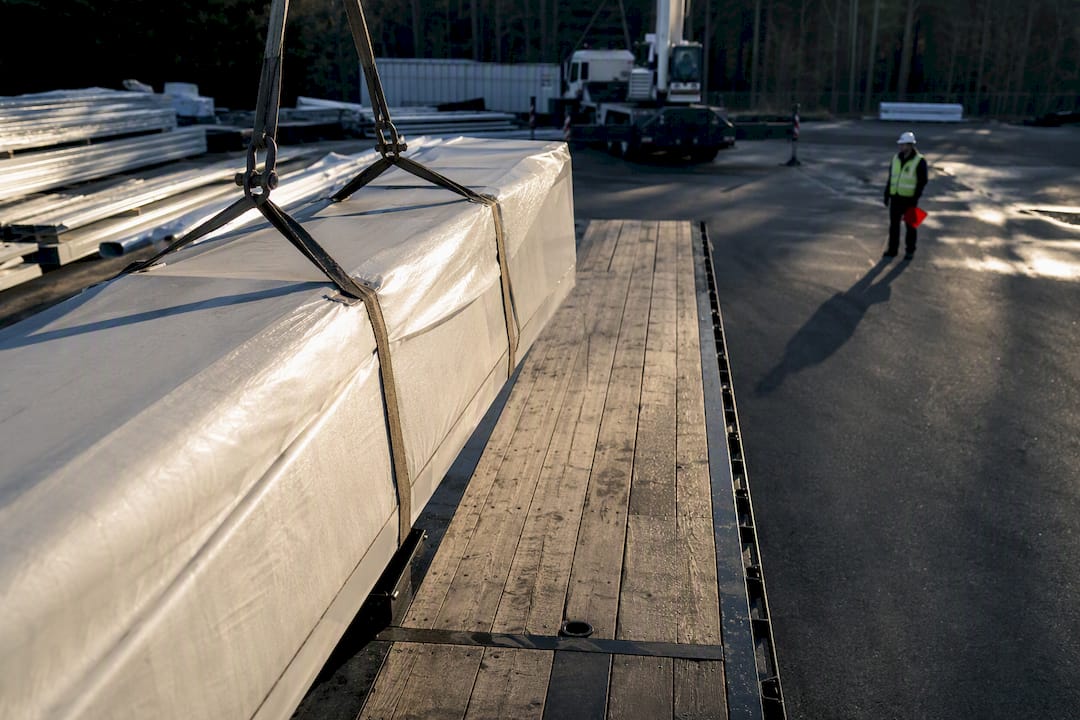
Field tested unloading metal panels without finish damage or injury. Covers the 30 feet handling limit, rigging checks, and cut and drop delivery options.
A single forklift with widely spaced forks handles bundles up to 30 feet; anything longer needs two forklifts spaced evenly or a crane rigged with spreader bars. The single biggest defense against damage is edge protection: wide nylon straps and spreader planks, never wire rope or chains. Skip the snatch lift, keep panels on-edge, and inspect everything before the driver leaves.
TL;DR:
- Longer panels exceeding 30 feet require two forklifts spaced evenly or a crane with spreader bars, as one forklift cannot safely handle them alone.
- Using nylon straps and spreader planks is essential to prevent edge crushing during rigging, with metal-on-metal contact strongly discouraged.
- Proper site preparation includes staged equipment, clear leveling, and assigning roles such as signalers and slingers before unloading begins.
- Mid-Atlantic Metal Panels recommends shorting panel lengths through on-site roll forming or pre-cut delivery to reduce handling risks and rigging complexity.
- Ensuring equipment and load configurations are checked in advance minimizes accidents, with smooth, slow lifts being crucial to prevent panel deformation.
Table of Contents
- Pre-Unloading Checklist For Panel Storage Onsite
- How Do You Choose Between a Forklift and a Crane?
- Lifting and Rigging Best Practices That Protect Panel Edges
- Forklift Techniques That Prevent Bending and Scuffing
- On-Site Storage and Stacking Without Warping or Rusting
- Inspecting Panels on Delivery and Reporting Damage
- Handling Individual Panels Without Denting the Finish
- Safety Roles and PPE During Unloading
- How MidAtlanticMetalPanels Reduces Handling Risk Before It Starts
- Emergency Procedures If Something Goes Wrong
- Who Talks to Whom During a Panel Lift?
- Step-by-Step: From Truck Arrival to Panel Placement
- Checking Your Equipment Before the Load Arrives
- What Contractors Get Wrong About Panel Unloading
- Get Delivery Planning Help From MidAtlanticMetalPanels
- Manufacturer Guides Worth Keeping On File
- Sources
- FAQ
Pre-Unloading Checklist For Panel Storage Onsite
Run this before anyone touches a strap:
- Confirm the delivery matches the order and check the outer packaging and straps for shifting or tears before releasing the driver.
- Clear and level the unloading area, and set a visible danger perimeter that keeps bystanders out of the swing radius.
- Assign a slinger or banksman and one signaler. Nobody else directs the lift.
- Decide now whether you’re using forklift(s) or a crane, and stage spreader bars, nylon straps, and fork sheaths before the truck arrives.
SSoW 14 guidance is blunt about this: the contractor, not the supplier, typically owns the lifting equipment and the qualified operator. Plan accordingly before the truck shows up.
How Do You Choose Between a Forklift and a Crane?
Length and center of gravity make the decision for you. A manufacturer installation guide from CMP sets 30 feet as the standard threshold: under that, one forklift with forks spread wide and centered under the bundle’s balance point is generally sufficient.
Above 30 feet, the rules change:
- Use two forklifts spaced at equal intervals along the bundle, matching lift height and speed exactly.
- Or use a crane rigged with spreader bars and multiple pick points.
- Never let one end hang unsupported while the other gets lifted. That overhang creates a bending moment the panel wasn’t built to absorb.
Pro Tip: If you’re borrowing a second forklift for a same-day job, walk both operators through the lift sequence out loud before the forks touch the bundle. A five-minute briefing prevents the mismatched lift speeds that cause most mid-lift buckling.
Rigging matters as much as equipment choice. Manufacturer handling procedures consistently call for 2-inch or wider nylon straps and spreader planks, never wire rope or chain slings, because metal-on-metal contact crushes seams and finishes in seconds.
Lifting and Rigging Best Practices That Protect Panel Edges
Rigging a bundle correctly takes five steps, in this order:
- Position nylon straps beside the wooden support frames, not directly against bare panel edges.
- Set spreader planks above and below the strap contact points to spread the load and stop crushing.
- For bundles needing three pick points, calculate spreader spacing so no gap exceeds the manufacturer’s maximum overhang distance — exceeding it raises bending stress fast.
- Confirm total spreader and load weight sits within the crane’s rated capacity before the first lift.
- Attach tag lines to control rotation, and lift in one smooth, continuous motion.
Pro Tip: Contractor forum threads on long-panel unloading repeatedly mention improvising a spreader bar out of whatever rigid stock is on hand when a proper one isn’t available. It works in a pinch, but a purpose-built spreader is worth keeping on the truck if you handle 30-footers regularly.
Snatching or jerking a load mid-lift is one of the most common causes of panel damage on record. A sudden tension shift deforms edges before anyone can react, so smooth and slow beats fast every time.
Forklift Techniques That Prevent Bending and Scuffing
Getting the forklift setup right prevents most of the damage that happens between the truck bed and the ground.
- Spread forks to the minimum width listed in the manufacturer’s spacing table, centered directly under the bundle’s balance point.
- Slide fork sheaths over the tines before lifting. They protect the straps from tearing on sharp fork edges.
- Travel slowly across rutted or uneven ground. Rough terrain flexes a long bundle dynamically, which is a different (and worse) stress than static bending.
- Never drag a bundle across the ground to reposition it, even a few feet.
- If you’re combining a crane and a forklift on a hybrid unload, lower the panels under crane control or let the truck pull forward slowly rather than dropping the load suddenly onto the forks.
On-Site Storage and Stacking Without Warping or Rusting
Getting panels off the truck safely is only half the job. Bad storage undoes good rigging within days.
Store bundles on level, firm ground over plastic ground cover, raised on clean, dry supports and sloped slightly so water runs off rather than pooling under the stack. Keep panels away from wet lumber or chemically treated wood, since both can stain or react with the coating. If you’re covering panels outdoors, use a ventilated tarp rather than a tight plastic wrap. Trapped moisture under an unventilated cover is how blistering and coating damage show up two weeks later, long after the delivery truck is gone.
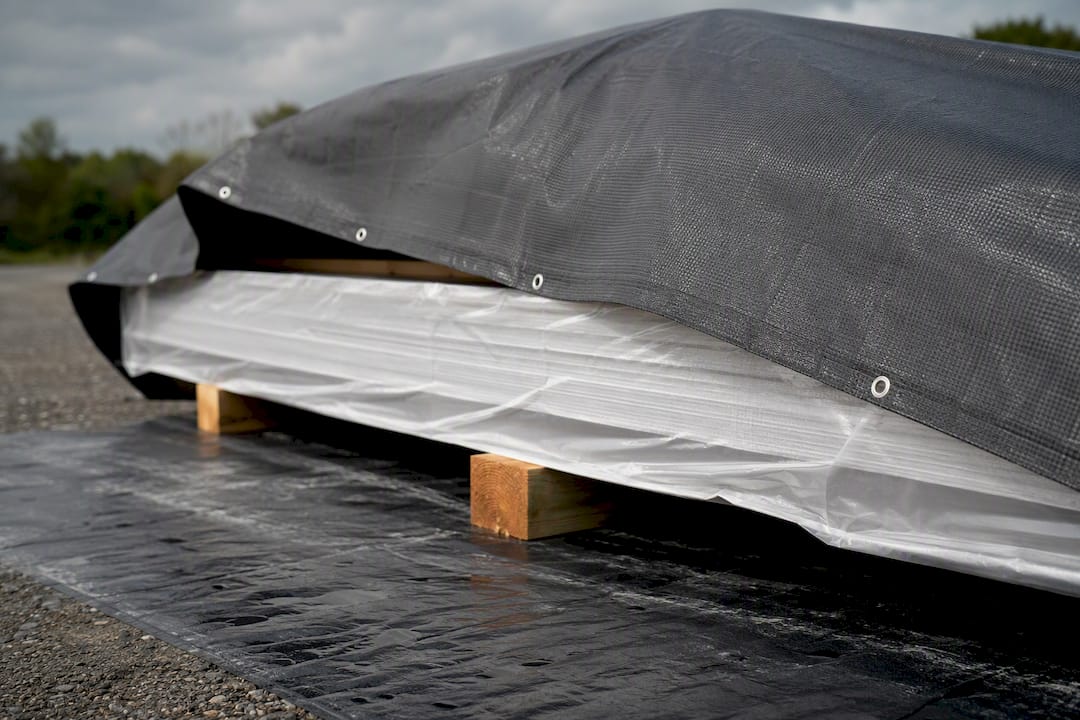
Pro Tip: Check the panel manufacturer’s spec sheet for the protective film removal window. Waiting too long to peel it off in direct sun can bake the adhesive onto the finish, and that residue doesn’t come off easily.
Inspecting Panels on Delivery and Reporting Damage
Do this before the driver leaves, not after:
- Walk the full length of the load looking for shifted stacks, torn banding, or wet spots on the packaging.
- Check exposed ends and corners for dents, scuffs, or bent seams.
- Photograph anything questionable with a wide context shot and a close-up, then note it on the delivery paperwork on the spot.
- Call the supplier immediately if you find damage. Waiting until installation day weakens any claim.
- If a bundle is wet inside, separate the panels right away, dry them fully, and restack with spacers for airflow. Keep a damaged sample if the supplier requests one.
Handling Individual Panels Without Denting the Finish
Once a bundle is broken down, single-panel handling has its own risks. Always carry panels on-edge, never flat, and lift by the seam whenever the profile allows it. Flat carrying flexes the metal and can leave a permanent bow that no amount of careful installation fixes later.
- Use at least two handlers for any panel longer than about 10 feet.
- Wear clean gloves when handling painted panels. Bare hands and dirty gloves both leave marks that show up once the sun hits the roof.
- Never drag a panel across a surface, even a smooth one. Grit under the panel scratches the finish in one pass.
- On windy days, tie panels down with guide ropes or stop moving them altogether until conditions calm down. A gust catching a 3-foot-wide panel like a sail is how fingers get pinched and panels get bent.
Safety Roles and PPE During Unloading
Every unloading operation needs clear roles: a qualified equipment operator, a dedicated slinger or banksman, and one signaler giving directions. Everyone else stays outside the marked danger zone, no exceptions.
Required PPE includes hard hats, cut-resistant gloves, eye protection, and high-visibility clothing at minimum, with fall protection added whenever work happens at height. Untrained personnel should never climb onto a trailer bed to release straps. Use a telescopic cutter from the ground, or have the driver handle strap removal under the site supervisor’s direction.
How MidAtlanticMetalPanels Reduces Handling Risk Before It Starts
The safest unload is the one that never requires a long, awkward lift in the first place. Cut-and-drop delivery and on-site roll forming both shorten panel lengths to near-install size, which cuts the number of multi-point lifts a crew has to run.
Supplier packaging choices matter too. Pre-slung bundles and organized delivery scheduling reduce the amount of improvised rigging happening curbside. If you’re planning a delivery across Virginia, Maryland, Washington DC, Pennsylvania, or West Virginia, coordinating the drop sequence with your supplier ahead of time solves half your unloading problems before the truck even leaves the yard.
Emergency Procedures If Something Goes Wrong
Every crew needs a plan before the first lift, not after something slips. Stop the lift immediately if a strap shifts, a spreader bar creaks, or the load starts swinging unexpectedly. The signaler’s job in that moment is simple: call it loud, and everyone backs away from the load path.
If a panel or bundle drops or a strap fails, clear the area first and account for every person on-site before anyone approaches the load. Do not attempt to right a shifted bundle or free a pinned strap while the crane or forklift is still under tension. Lower the boom, release load pressure, and reassess from a safe distance.
Keep a basic first-aid kit on-site and know the location of the nearest emergency care facility before work starts, especially on remote job sites without quick cell coverage. Cuts from sheet metal edges and pinch injuries from shifting loads are the two most common incidents during unloading, and both call for prompt attention rather than a “walk it off” approach.
Report every near-miss, not just actual injuries. A strap that slipped but didn’t fail is useful information for the next crew handling the same load type. Document what happened, what equipment was involved, and what changed afterward. If the incident involved a rented crane or a subcontracted operator, notify that company directly and in writing, since verbal reports get lost fast on a busy site.
Finally, designate one person, usually the site supervisor, as the point of contact for emergency services if a call ever needs to be made. Confusion about who’s calling costs time nobody has in an actual emergency.
Who Talks to Whom During a Panel Lift?
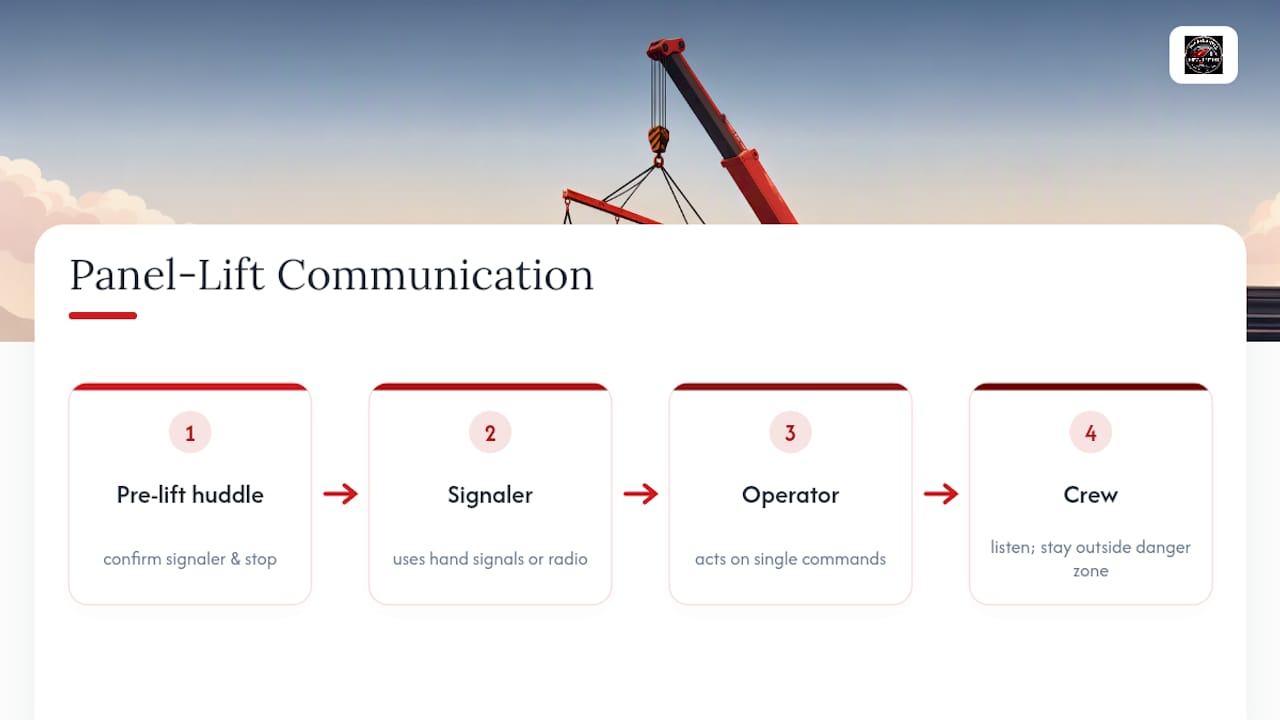
A lift with unclear communication is a lift waiting to go wrong. The structure that works on every job site is simple: one signaler, one set of hand signals or radio commands, and everyone else listening rather than talking.
Standard crane hand signals cover the basics: raise, lower, swing, stop, and emergency stop. Every operator and rigger on-site should know these cold, not just the crew that uses them daily. On sites where the operator can’t see the signaler directly, radios replace hand signals, but the same discipline applies. Only one voice gives commands at a time.
Before the first lift of the day, hold a two-minute huddle. Confirm who’s signaling, what the emergency stop command sounds like, and where the danger zone boundary sits. This costs almost nothing and eliminates the “I thought you meant something else” confusion that causes hesitation mid-lift.
Radio discipline matters as much as hand signals. Keep transmissions short: identify who’s speaking, state the action, confirm it was received. “Forklift one, lift slow” and “Copy, lifting slow” beats a running conversation that clutters the channel right when someone needs to shout “stop.”
Written signage helps too. Post the danger zone boundary and the designated signaler’s name or role at the site entrance so subcontractors and delivery drivers know the rules before they walk in. On multi-crew sites, a laminated card with hand signal diagrams zip-tied to the crane or forklift saves an argument when someone forgets the difference between “swing” and “stop.”
Step-by-Step: From Truck Arrival to Panel Placement
Here’s the full sequence, start to finish:
- Confirm and inspect. Match the delivery ticket to the order, then walk the load checking packaging, straps, and visible condition before the driver disconnects.
- Stage the site. Clear the unloading path, level the ground where the bundle will land, and mark the danger perimeter.
- Assign roles. Name the operator, the slinger or banksman, and the signaler out loud before anyone touches equipment.
- Rig the load. Position nylon straps and spreader planks according to bundle length, using two lift points under 30 feet and three or more spreader-supported points beyond that.
- Lift smoothly. Raise the bundle in one continuous motion, using tag lines to control swing and rotation.
- Transport carefully. Move slowly across the site, avoiding ruts, drop-offs, and sudden direction changes that flex the bundle.
- Set down on supports. Lower onto raised, dry supports rather than bare ground, keeping the bundle level.
- Final inspection. Check for any damage that occurred during the move itself before releasing the crew.
Skipping steps to save ten minutes is how a $40,000 panel order turns into a warranty dispute.
Checking Your Equipment Before the Load Arrives
A forklift or crane that looks fine from the cab can still have a problem that turns a routine lift into an incident. Before the delivery truck arrives, walk the equipment the same way you’d walk a job site.
For forklifts, check fork condition for cracks or excessive wear at the heel, confirm the carriage and mast move freely through their full range, and verify tire condition and pressure, especially if the site has rough or graded terrain. Test the lift and tilt controls empty before the bundle is anywhere nearby.
For cranes, inspect all rigging hardware, including hooks, shackles, and spreader bars, for deformation or cracking. Nylon straps need a close look too: cuts, fraying, or UV damage weaken a strap well before it looks obviously unsafe. Retire any strap with visible wear rather than pushing one more lift out of it.
Confirm the load chart matches today’s configuration, boom angle, and spreader weight, not last month’s job. Equipment that was rated correctly for a different lift last week isn’t automatically rated correctly for this one. A five-minute walk-around catches most of the failures that would otherwise show up mid-lift, when there’s a lot less room to react.
What Contractors Get Wrong About Panel Unloading
Most crews treat unloading as the boring part of the job, the five minutes before the real work starts. That mindset is backward. The lift and the first twenty feet of transport across the site cause more finish damage than an entire day of installation work, because nobody’s watching for it the way they watch a cut or a seam.
The conventional advice out there focuses almost entirely on equipment, forklift versus crane, strap type, spreader bars. That’s necessary but incomplete. The bigger failure point is coordination: unclear roles, no pre-lift huddle, and a driver who pulls away before anyone’s confirmed the load is clear. Manufacturer handling limits on fork spacing and overhang exist because engineers modeled the actual bending stress on a 30-foot bundle. Ignoring those numbers because “it looked fine last time” is how a coating that should last thirty years starts showing hairline stress marks in year two.
The other overlooked lever is upstream: fewer, shorter lifts beat better technique on long lifts. Supplier-side options like cut-and-drop and on-site roll forming take the riskiest variable off the table entirely by shrinking the bundle before it ever reaches your crew. That’s not a replacement for good rigging discipline. It’s a way to need it less often.
— Matt Catino
Get Delivery Planning Help From MidAtlanticMetalPanels
Certain supplier options help skip the riskiest part of unloading altogether: the long, unwieldy bundle that needs two forklifts or a crane just to hit the ground safely. Because panels are custom-cut to length before they leave the shop, and on-site roll forming can produce near-install lengths right at the job site, your crew handles shorter, lighter pieces instead of wrestling 40-foot bundles across a muddy lot.
That means fewer rigging setups, fewer people needed for each lift, and less exposure to the damage risks covered above. If you’re running a job anywhere across Virginia, Maryland, Washington DC, Pennsylvania, or West Virginia, reach out to plan your delivery and cut-and-drop order before your next pour date. Getting the panel lengths right at the order stage saves your crew a lift they’d otherwise have to manage by hand.
Manufacturer Guides Worth Keeping On File
The CMP handling and installation guide and ATAS transit and storage procedures both include the fork spacing tables and overhang limits referenced throughout this guide. Keep a copy on the truck for quick reference on unfamiliar bundle sizes.
Sources
- CMP Multi-Rib & R Panel Installation Guide (handling and forklift guidance)
- SSoW 14 — Safe unloading of panels using a crane (method and roles)
FAQ
How Do You Safely Unload Long Metal Roof Panels From a Truck?
Use a single forklift with wide-spaced forks for bundles up to a typical length limit, and two forklifts spaced evenly or a crane with spreader bars for longer bundles, always protecting edges with nylon straps and spreader planks.
Can You Bend Metal Roof Panels Without Damaging Them?
Panels should never be flexed or bowed to force a bend. Any curved or custom profile needs to come from the manufacturer or a proper roll former; field-bending a standing seam panel typically causes permanent creasing or oil-canning.
What Tool Cuts Metal Roof Panels?
Contractors typically use a nibbler, shear, or fine-tooth circular saw blade designed for metal, rather than an abrasive grinder wheel, which can throw hot slag that burns through protective coatings and voids finish warranties.
Can a Metal Roof Be Removed and Reused?
A metal roof can sometimes be removed and reinstalled if panels come off without bending, but standing seam panels with mechanically locked seams are difficult to remove without deforming the seam, which usually makes reuse impractical.
What’s the Biggest Cause of Damage During Unloading?
Snatching or jerking the load during a lift causes sudden tension shifts that deform panel edges, which is why smooth, continuous lifting and tag-line control matter more than lift speed.