Contractors: Stop Natatorium Metal Roof Corrosion Without Full Reroof

Contractors' facilities-first playbook to stop natatorium metal roof corrosion: secure vapor-barrier continuity, fix ponding and condensate routing, and...
Most natatorium metal roof corrosion traces back to a coupled failure: a discontinuous vapor barrier lets chemically laden, humid air into the roof assembly, while ponding on low-slope areas keeps metal wet longer than it should be. Before anyone replaces a single panel, check vapor-barrier continuity and confirm the dehumidification system is running at spec. Skip that step, and you’ll be back on the roof within two years, paying for the same failure twice.
TL;DR:
- Most corrosion results from vapor-barrier discontinuities combined with high indoor humidity and ponding on low-slope roof sections.
- Corrosion patterns typically cluster at the lowest slope areas where water tends to pond and drainage is ineffective, not randomly across the roof surface.
- Mechanical system issues, such as improperly balanced dehumidification and vapor barrier gaps at curbs or penetrations, are the main causes rather than pool chemistry alone.
- Regular inspections every quarter, with detailed checks annually and after severe weather, can identify early signs before structural damage occurs.
- Proper detailing of material compatibility, vapor-barrier continuity, and drainage is essential to prevent corrosion and reduce long-term repair costs.
Table of Contents
- What Causes Natatorium Metal Roof Corrosion? A Field Checklist
- Prevention Strategies: Fixing the Building System, Not Just the Roof
- Material Compatibility: Avoiding Dissimilar-Metal Corrosion
- How Often Should You Inspect a Natatorium Roof for Corrosion?
- Repair or Reroof? Matching the Fix to the Root Cause
- How MidAtlantic Metal Systems Supports Natatorium Roofing Projects
- The Overlooked Problem: Treating Symptoms Instead of Systems
- Get Specification Support for Your Natatorium Reroofing Project
- Sources
- FAQ
What Causes Natatorium Metal Roof Corrosion? A Field Checklist
Corrosion rarely shows up randomly across a natatorium roof. It concentrates in predictable spots, and mapping that pattern is the fastest way to separate a mechanical-system problem from a straightforward leak. A 2012 case study on natatorium enclosure failures found panel corrosion clustered at the roof’s lowest slope, where flat or near-flat sections (down to half an inch of fall per foot) trapped water that architectural panels were never designed to shed. The investigators pushed back on the assumption that pool chemistry alone was to blame and recommended ruling out ponding and exterior leak paths first.
Work through this sequence before calling in a full envelope consultant:
- Map the corrosion. Photograph and log every affected area against the roof plan, noting proximity to drains, seams, curbs, skylights, and penetrations.
- Check the slope. Measure actual pitch in suspect zones and confirm drains are sized and positioned to clear standing water, not just puddle around it.
- Inspect vapor-barrier terminations. Look closely at curbs, rising walls, and penetrations. A termination gap as small as a quarter inch can let humid, chlorinated air migrate into the assembly, a failure mode documented in a 2017 reroofing investigation that traced severe panel degradation to exactly this defect.
- Pull HVAC and dehumidifier logs. Compare setpoints against actual run time and check whether source-capture exhaust near the pool surface is functioning.
- Look for outside electrolytes. Rooftop condensate lines, copper plumbing runoff, treated lumber, and rubber pads or blocking can all accelerate corrosion independent of anything happening inside the poolroom.
Pro Tip: Visual inspection alone can miss the real cause. The Gale Associates case study found vapor-barrier installation defects that were invisible from the roof surface and only turned up under destructive testing, so if corrosion is widespread, budget for a probe cut, not just a walk-through.
Prevention Strategies: Fixing the Building System, Not Just the Roof
Natatorium corrosion is fundamentally a heat, air, and moisture problem, and ASHRAE frames prevention as an integrated systems issue that ties pool-water chemistry, envelope design, air distribution, source-capture exhaust, and dehumidification together rather than treating any one of them in isolation. That means the fix rarely lives entirely on the roof.
Start with the building envelope. The vapor and air barrier needs to run continuously up curbs and walls, terminate tight against every penetration, and get sealed at every transition. A barrier that stops short at a single skylight curb is enough to let months of humid air condense inside the assembly.
From there, coordinate the mechanical side:
- Run dedicated dehumidification sized for the pool’s actual evaporation load, not a rough estimate.
- Confirm source-capture exhaust is pulling moisture-laden air away from the water surface before it disperses.
- Balance space pressurization so humid air isn’t being pushed toward roof penetrations and wall cavities.
- Correct slope and drainage on low-slope sections, or specify a watertight membrane where architectural panels can’t reliably shed water on their own.
- Route rooftop condensate and any mechanical discharge directly to drains, never across coated steel panels.
Condensation loads in cooler climates can be substantial enough to soak insulation and wood decking over a season, and once that moisture is trapped, drying it out passively can take much longer than the leak took to develop, according to case histories on enclosure deterioration. That’s the argument for fixing the vapor barrier and HVAC balance before a reroof, not after.
Pro Tip: If your dehumidifier setpoint hasn’t been reviewed since the pool opened, that’s worth checking today. A setpoint calibrated for the original bather load and water temperature can drift out of spec for years without anyone noticing until panels start showing rust.
Material Compatibility: Avoiding Dissimilar-Metal Corrosion
Galvanic corrosion between incompatible metals is one of the most avoidable causes of premature roof failure, and it’s almost always a detailing problem rather than a material-quality problem, as explained in detail in Galvanic Corrosion Enclosures: Sourcing Outdoor Enclosures in China. The Metal Construction Association’s guidance on dissimilar metals lays out the core controls: separate incompatible metals with a barrier membrane, avoid area-ratio mismatches that concentrate corrosion on the smaller metal, and never let runoff from one metal wash across another.
In practice, that shows up in a few recurring details:
- Copper plumbing vent stacks or gutters draining directly onto coated steel panels, which carries dissolved copper ions onto the panel surface every time it rains.
- Rooftop condensate lines discharging across finished metal instead of into a drain.
- Wood blocking or rubber pads left in contact with panels, which trap moisture against the surface indefinitely.
- Fasteners or flashings made from a metal that isn’t compatible with the panel substrate.
Where separation isn’t physically possible, stainless steel flashings or barrier membranes at the contact point solve most of these cases. Our dissimilar-metal corrosion guide covers the area-ratio math contractors use to size these transitions correctly.
Interior-face resistance and exterior weathering performance are two different specifications, and treating them as one is a common mistake. A South Carolina natatorium project addressed this directly, pairing chlorine-resistant interior coatings with a separate coastal-grade exterior finish rather than assuming one coating system could handle both environments. Finally, every transition detail should extend the vapor retarder onto curbs and up walls, with flashing designed to avoid pockets where liquid can sit rather than drain.
How Often Should You Inspect a Natatorium Roof for Corrosion?
A quarterly visual check catches most developing problems before they become structural. Pair that with one detailed annual inspection and an immediate walk-through after any extreme weather event or major HVAC change, since a failed dehumidifier can do real damage in a matter of weeks in a chlorinated, high-humidity environment.
During each check, track:
- Visible corrosion progression at the transitions and low-slope zones identified during your initial mapping.
- Interior condensation on windows, walls, and structural members. Condensation, mold growth, and a persistent chlorine odor are all flagged as correlated risk indicators worth logging every time you see them.
- HVAC and dehumidifier performance logs against original design setpoints.
- Evidence of rooftop condensate or metal runoff crossing panel surfaces.
Moisture mapping, infrared scanning, or a targeted destructive test (a small probe cut at a suspect seam or curb) is worth the cost when corrosion is spreading faster than visual inspection alone can explain. One natatorium reconstruction project traced accelerated corrosion on structural members to years of inadequate exhaust and uninsulated sections, a failure that had progressed far enough by the time it was caught that it required structural replacement0887-3828(1988)2:3(170)) rather than a roof-level repair. Document every finding with dated photos and a marked-up roof plan, and escalate to a building-envelope consultant once corrosion reaches structural members or spreads beyond a single localized zone.
Repair or Reroof? Matching the Fix to the Root Cause
Not every corroded panel needs a full reroof, but replacing panels without fixing what caused the corrosion guarantees you’ll be doing this again. The scope of the fix should match the scope of the failure, not the other way around.
- Temporary containment: Stop active leaks, correct HVAC or dehumidifier settings immediately, and reroute any condensate discharge away from panel surfaces while you plan the permanent fix.
- Localized panel replacement: Appropriate only when corrosion is confined to a small area and you’ve already confirmed and corrected the root cause, whether that’s a vapor-barrier gap, a drainage defect, or misrouted condensate.
- Full-assembly reroofing: Necessary when vapor-barrier discontinuities run throughout the assembly, ponding is persistent across low-slope sections, or corrosion has spread across multiple zones. Low-slope areas may need a watertight membrane rather than another panel system that depends on positive drainage.
- Warranty protection: Specify coastal or chemical-resistant finishes where exposure demands it, and document every installation detail, since incomplete records are a common reason manufacturers deny corrosion-related warranty claims. Our coastal metal roofing specification guide covers the finish and fastener choices that hold up under warranty review.
How MidAtlantic Metal Systems Supports Natatorium Roofing Projects
MidAtlantic Metal Systems supplies cut-and-drop standing seam panels, on-site roll forming, and matched trim and flashing packages built to reduce the field improvisation that causes vapor-barrier breaches in the first place. Every panel-length modification made on a job site is a chance for a crew to shortcut a termination detail or leave a curb undersealed.
Contractor-focused supply narrows that risk by delivering panels cut to the exact run length the drawings call for, so there’s less pressure to trim, splice, or patch flashing under deadline. On a building type as unforgiving as a natatorium, that early coordination between the roofing supplier, the installing contractor, and a building-envelope consultant during specification is worth more than any post-installation fix.
The Overlooked Problem: Treating Symptoms Instead of Systems
Most corrosion advice treats the roof as an isolated component: pick a better coating, upgrade the gauge, add a protective finish. That misses what the case studies keep showing. The 2017 Gale Associates investigation didn’t find a bad panel. It found a vapor barrier that stopped short of a curb by a fraction of an inch, and that gap did more damage than any coating choice could have prevented.
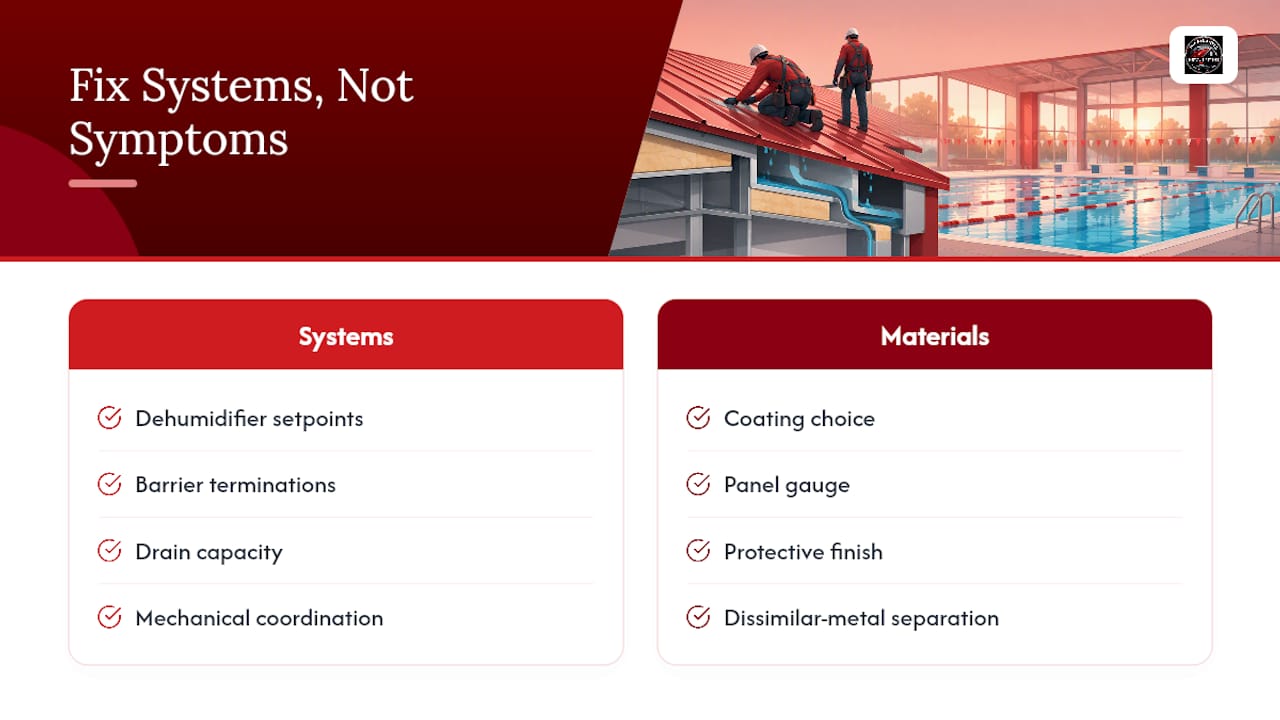
The conventional advice oversells material selection and undersells mechanical coordination. A chlorine-resistant coating on a panel sitting under a discontinuous vapor barrier is still going to fail, just more slowly. Facility teams should prioritize the boring, unglamorous checks first: dehumidifier setpoints, barrier terminations, drain capacity. Those three things resolve more corrosion cases than any panel upgrade on its own.
Where material choice genuinely matters is at the details: dissimilar-metal separation, condensate routing, and transition flashing. Get the mechanical system and the details right, and the panel spec becomes a durability decision, not a rescue mission.
— Matt Catino
Get Specification Support for Your Natatorium Reroofing Project
Correcting a vapor-barrier gap or a dissimilar-metal detail after the panels are already installed costs far more than getting the specification right the first time. MidAtlantic Metal Systems works directly with roofing contractors on natatorium and pool-building projects across Virginia, Maryland, Washington DC, Pennsylvania, and West Virginia, supplying 1-inch mechanical lock and 1.5-inch snap lock standing seam panels cut to exact job-site lengths.
Custom trim and flashing packages matched to your panel profile close the gap where most vapor-barrier failures start, at curbs, penetrations, and transitions. Cut-and-drop delivery means your crew isn’t field-trimming panels on a deadline, and on tight or unusual roof geometries, on-site roll forming lets you produce exact-length panels right at the job site. If you’re specifying materials for a reroof or new natatorium build, request a contractor-supply quote or specification support through our contractor supply page before finalizing your panel order.
Sources
- Natatorium Building Enclosure Deterioration Due to Moisture Migration (MDPI, 2012)
- Dissimilar metal corrosion in roofing installations (Metal Construction Association)
FAQ
What causes most natatorium metal roof corrosion?
The dominant cause is a coupled failure between vapor-barrier discontinuity and high indoor humidity, often combined with ponding on low-slope roof areas. A 2012 case study found corrosion concentrated at the flattest sections of the roof rather than spread evenly, pointing to drainage and envelope issues over pool chemistry alone.
Can dissimilar metals cause roof corrosion in a natatorium?
Yes. Copper runoff, incompatible fasteners, and rooftop condensate crossing coated steel panels are common accelerants. The Metal Construction Association recommends separation barriers and routing condensate directly to drains rather than across panel surfaces.
How often should a natatorium roof be inspected for corrosion?
Quarterly visual checks combined with one detailed annual inspection catch most developing issues before they become structural. Add an immediate inspection after extreme weather or any change to the HVAC or dehumidification system.
Does MidAtlantic Metal Systems supply materials for natatorium roofing projects?
Yes. MidAtlantic Metal Systems supplies 1-inch mechanical lock and 1.5-inch snap lock standing seam panels, custom trim and flashing, and cut-and-drop delivery for contractors working on natatorium and pool-building roofs across Virginia, Maryland, Washington DC, Pennsylvania, and West Virginia. Pricing is available on request through the site.
Is a full reroof always necessary once corrosion appears?
No. Localized panel replacement works when corrosion is confined to a small area and the root cause, whether that’s a vapor-barrier gap, drainage defect, or misrouted condensate, has already been corrected. A full-assembly reroof becomes necessary when barrier discontinuities or ponding are widespread across the roof.