Protective Film on Metal Panels: When to Peel It and Why
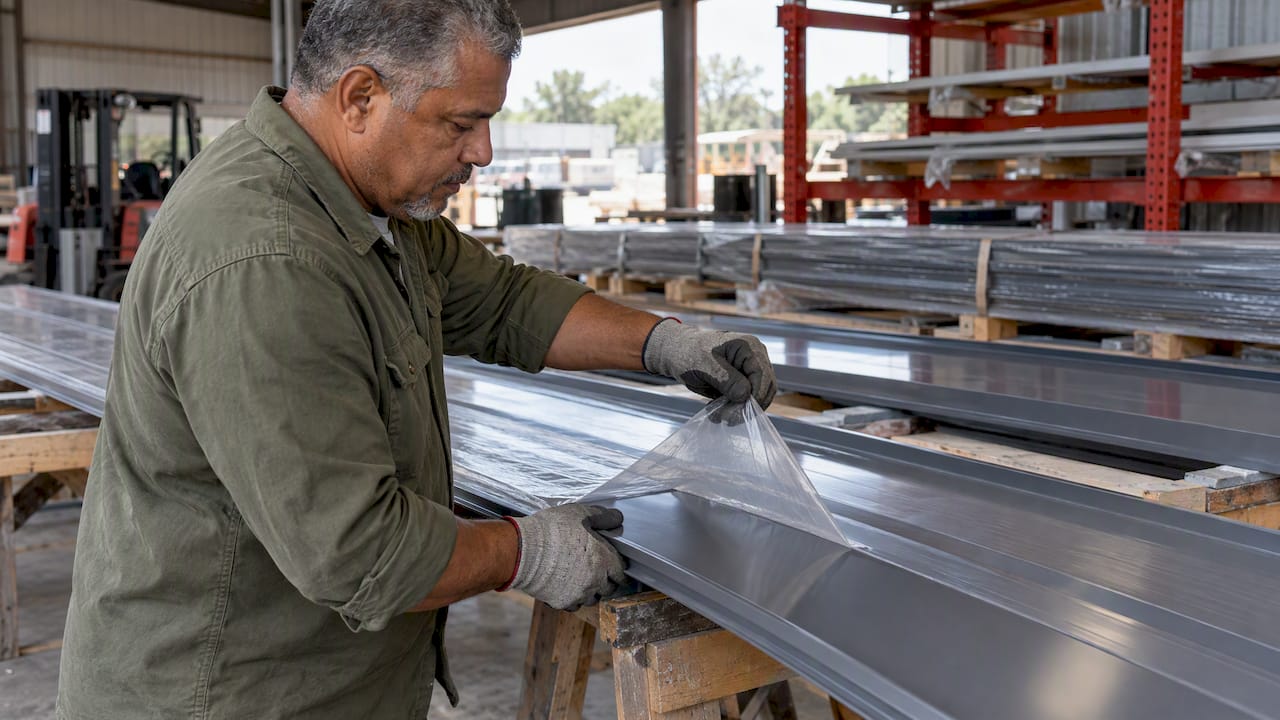
Protective film on metal roofing panels is a handling aid, not long-term armor. Learn storage limits, sun and heat risks, and when to peel it on the jobsite.
The protective film on a metal panel is there to get the panel from the forming line to the roof without scratches. It is not there to protect the roof for the long haul. Keep it in the shade, keep it dry, strip it soon after installation, and never leave it baking in the sun. Most film problems on a jobsite come from ignoring one of those four things.
This guide is written for roofing contractors, builders and GCs who receive standing seam panels and have to decide where to stage them, how long film can stay on, and what to do when it will not peel.
TL;DR
- Strippable film is a transport and handling aid, not a barrier against corrosion, humidity or harsh chemicals.
- Heat, sun and trapped moisture make the adhesive bond harder over time. The film you could peel easily in week one can be a cleanup job in week six.
- Treat roughly 30 days of jobsite storage as the outer limit. Past that, move panels indoors, out of direct sunlight.
- If panels sit outside, elevate them, tilt them for drainage and leave airflow. A tight tarp on a hot day works against you.
- Plan delivery around your install date so film is on the panel for days, not months.
Table of Contents
- What the film actually is
- Why film goes wrong outside
- The 30-day rule and what to do about it
- Staging panels on site
- Inspect at delivery, before film becomes a claim
- Film on standing seam panels in transit
- Removing film without damaging the finish
- Our perspective: shorter time on the jobsite beats better storage
- Plan the delivery around your install date
- Common mistakes to avoid
- FAQ
- Sources
What the film actually is
Strippable film is a thin, removable layer applied to the finished face of the metal. The New Zealand metal roofing industry’s code of practice describes it as a clear pressure-sensitive polyethylene film that helps protect the surface from damage and scratching during forming, transport and handling. Architectural metals suppliers describe a strippable vinyl layer applied to full-width coil or sheet during processing.
Specifications ask for it too. A university facilities master spec for sheet metal flashing and trim calls for a strippable, temporary protective film applied before shipping to protect finishes on exposed surfaces.
The key word in all of these is temporary. The film exists because prefinished steel is handled many times: coil to roll former, roll former to bundle, bundle to truck, truck to ground, ground to roof. Every one of those steps can drag a hard edge across a painted face.
What it does not do
Industry guidance is blunt on this point. Film offers no protection against corrosion, humidity or harsh chemicals. It will not save a bundle that has been sitting in standing water, and it will not stop a cleaning chemical from marking a finish. Treating it as a weather wrap is the most common misunderstanding, and it is the one that leads to ruined panels.
Why film goes wrong outside
The adhesive is pressure sensitive, and pressure sensitive adhesives respond to conditions. Three things change the bond on a jobsite.
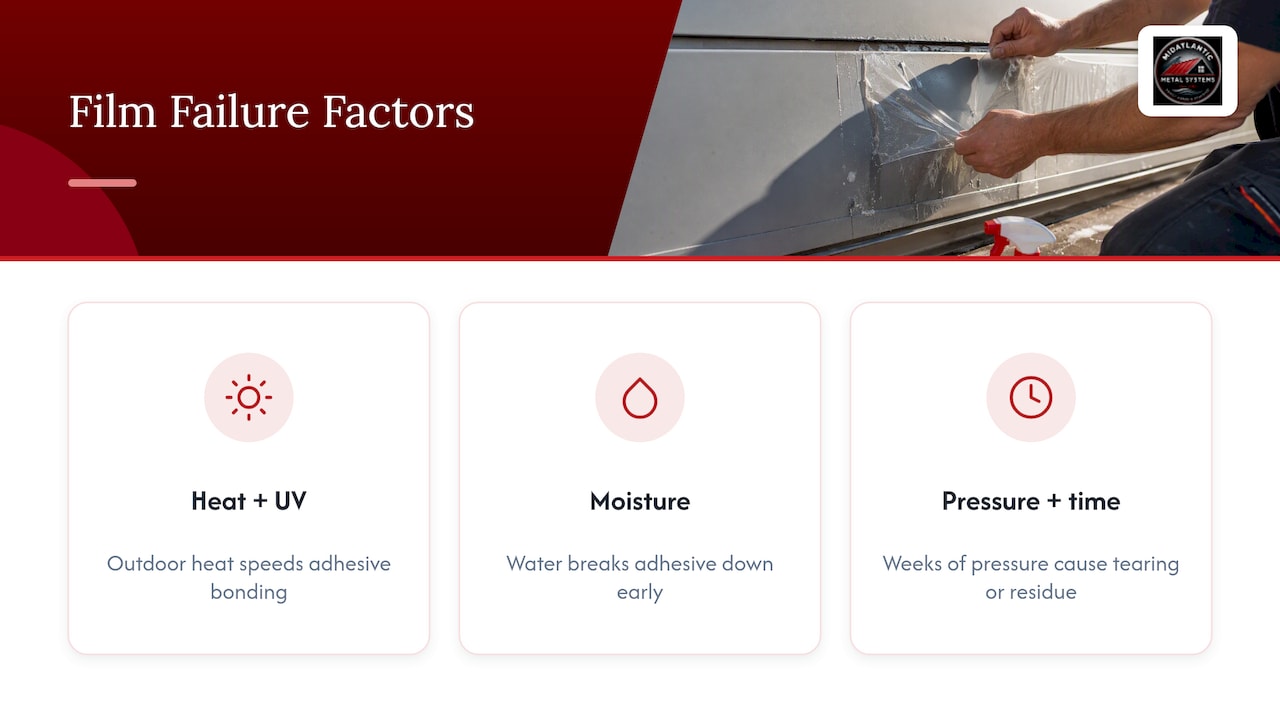
Heat and UV. Sun on a dark prefinished panel raises the surface temperature well above the air temperature. The same research notes that when panels are stored outdoors under wraps for long periods, a greenhouse effect can rapidly degrade the film adhesive. Even under tarps, outside heat can speed up adhesive bonding.
Moisture. Water that gets between wraps, between bundles or under a poorly vented tarp breaks the adhesive down early. Elevating the bundle and tilting it so water drains, with air moving around it, is the guidance for jobsite storage.
Pressure and time. Stacked weight keeps the film pressed to the metal for weeks. Combined with heat, that is how a film that peeled cleanly becomes one that tears into strips or leaves residue.
A metal supplier’s handling guide puts it simply: metal finished with a protective PVC film needs special attention so the material is not damaged or rendered unusable. That phrase, rendered unusable, is the real cost here. A panel with baked-on film is a panel you may be fighting to clean or replacing.
The 30-day rule and what to do about it
For panels stored on a jobsite, the commonly cited limit is about 30 days. Beyond that, the guidance is to move panels indoors into a climate-controlled space, away from direct sunlight.
That is a ceiling, not a target. In a hot stretch, a bundle left in full sun can have a problem long before day 30. Use the table below as a practical way to think about it.
| Situation | Risk to the film | What to do |
|---|---|---|
| Panels land the week you start the roof | Low | Stage in shade, strip as each panel is set or soon after |
| Panels sit 2 to 4 weeks, shaded, ventilated | Moderate | Elevate, tilt for drainage, check a corner of one panel weekly |
| Panels sit past 30 days outside | High | Move indoors, away from sun, or schedule a film strip test now |
| Dark panels in direct summer sun | High, even short term | Shade the bundle, avoid sealed tarps, strip early |
| Bundle wet from rain or trapped condensation | High | Open it up, dry it, restack with spacers and airflow |
A simple weekly check
Peel a small corner of film from the least visible spot on one panel in the bundle. If it lifts cleanly, you are fine for now. If it resists, tears or leaves tacky residue, strip that bundle sooner rather than later and tell whoever is scheduling the install.
Staging panels on site
Good staging does most of the work. The sequence that holds up in the field:
- Pick the spot before the truck arrives. Level, firm ground, away from where equipment will track mud or water. Our guide to unloading metal panels covers truck access and the length limits that decide whether you need a crane or a forklift.
- Get the bundle off the ground. Use blocking so water can drain and air can move under it.
- Tilt it slightly. A gentle slope lets water run off instead of pooling.
- Cover loosely if you must. Cover for rain, but leave the ends and sides open for airflow. Do not seal the bundle like a package.
- Keep it out of direct sun where you can. Shade from a building or a canopy beats a tarp on its own.
- Lift with the right gear. A spreader bar and nylon slings protect edges and finish, and our notes on crane lifts for metal panels go through how to cut down on lifts and protect the face.
Inspect at delivery, before film becomes a claim
The best time to catch a film problem is the moment the driver is still on site. Check that wraps are intact, that no bundle is wet, that edges are not crushed and that the film is attached across the face. Note anything on the delivery ticket and take photos.
We built a ready-to-copy receiving checklist for exactly this. Use it on every drop, because damage reported at receiving is far easier to resolve than damage discovered three weeks later.
Film on standing seam panels in transit
On standing seam, film is sometimes used in a narrower way. A technical bulletin from an architectural metals supplier describes 2 to 3 inch strips applied next to the male leg of a standing seam panel when panels are formed in a facility and crated. The strip protects the painted surface of the panel underneath when panels are nested together, since vibration in transit could otherwise mark them.
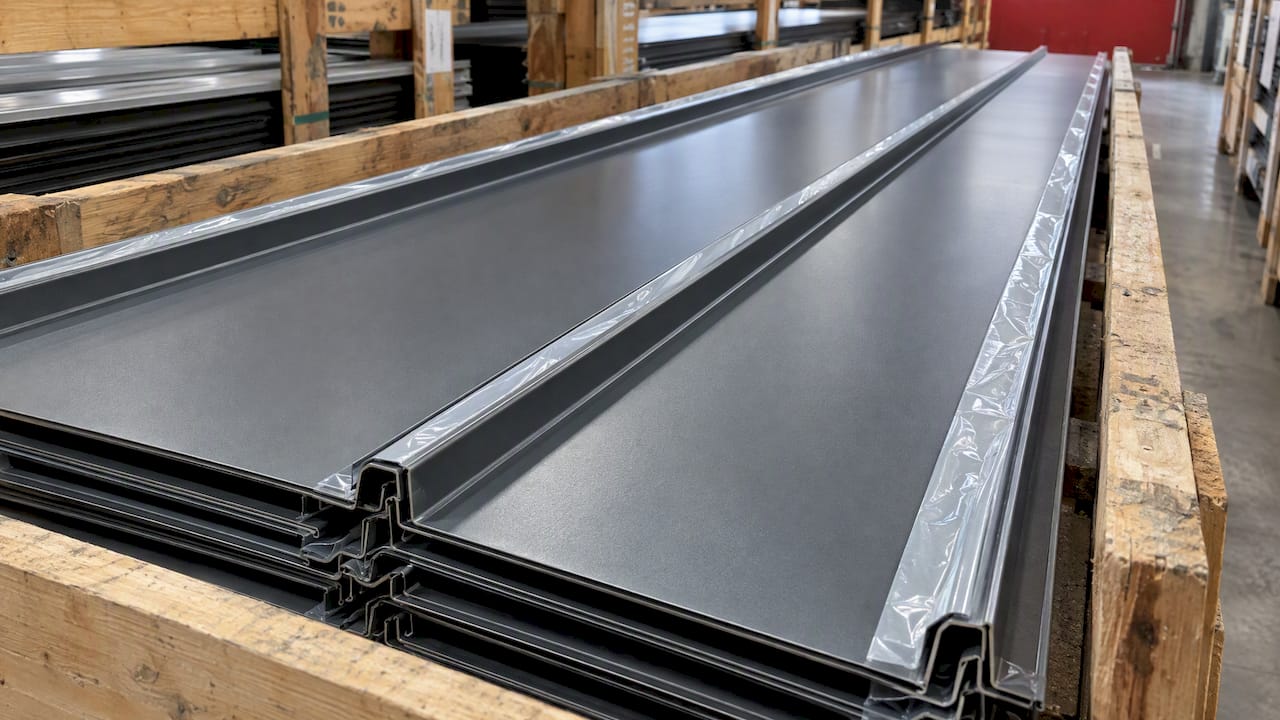
The same bulletin also describes film covering the entire face of full-width coil or 10 foot sheets used to make flashing and trim. So what you see on a delivery can vary: full-face film on trim stock, strips along the seams on nested panels, or other arrangements depending on the product and the manufacturer. Ask what you are getting, and ask how long it is rated to stay on.
Removing film without damaging the finish
When it is time to strip, a few habits keep the finish clean.
- Strip by hand, slowly, at a low angle. Pulling back along the panel surface, not straight up, reduces the chance of tearing.
- Work in manageable sections on warm days, since film that has been heated can stretch and break.
- Remove film from the seam area before seaming. Film caught in a seam or under a clip is a headache to chase later.
- Do not use unapproved solvents on residue. Check with the paint manufacturer before using any cleaner so you do not put the finish warranty at risk.
- Bag the film as you go. Loose film blows around a site and can scratch or stick to freshly set panels.
If you are cutting panels on the roof, strip the film back from the cut line first. Film dragged across a cut edge can fold under and trap metal shavings against the paint, which is a scratch waiting to happen.
Our perspective: shorter time on the jobsite beats better storage
We supply custom-length standing seam panels to contractors across Virginia, Maryland, Washington DC, Pennsylvania and West Virginia, and the pattern we see is simple. Film trouble is almost always a scheduling problem dressed up as a materials problem. Panels arrive early because someone wanted material on site, then the weather turns, the roof start slips, and the bundle sits.
That is the thinking behind cut-and-drop. When panels are cut to the lengths your takeoff calls for and delivered to the jobsite when you are ready to hang them, there is less to store, less to cull and less time for film to bond. Custom lengths also mean fewer field cuts and less scrap, so there is less handling of finished faces to begin with.
Our advice to crews is practical:
- Tell us your real install start, not the earliest possible one, so the delivery can be matched to it.
- If the roof is going to slip, say so early. It is much cheaper to move a delivery than to replace panels.
- Stage in shade, elevated and vented, and check a corner of film weekly.
- For tough access or tight sites, consider forming at the job. Panels formed on site go from machine to roof with very little staging at all.
Film is a good tool when it is used for what it is for. It is a bad warehouse.
— Matt Catino
Plan the delivery around your install date
If your schedule is tight, or the site has no good place to stage bundles, the cheapest fix is to change how the material arrives. Our cut-and-drop delivery brings custom-length panels directly to the jobsite, and our on-site roll forming puts the machine at the project so panels are formed when you need them. Our 1-inch mechanical lock and 1.5-inch snap lock standing seam panels come in 24-gauge and 26-gauge steel. Trim and flashing packages are coordinated with the panel order through our trim and flashing offering, so the whole job arrives on one schedule.
Send us your takeoff and your target start date, and we will work out a delivery plan that keeps film time short.
Common mistakes to avoid
- Wrapping a bundle tight in plastic and leaving it in the sun. This is the classic greenhouse setup.
- Storing panels flat on the ground. Moisture collects and has nowhere to go.
- Assuming film will protect panels for the season. It will not, and it is not designed to.
- Stripping film too early on the roof when other trades are still working above. Film is cheap protection while others are on the surface, so strip as you go, not all at once.
- Skipping the weekly peel test. Thirty seconds on a corner tells you whether you are heading for trouble.
- Using the wrong cleaner on residue. Check approval first.
FAQ
How long can protective film stay on metal panels?
For jobsite storage, about 30 days is the commonly cited maximum. Hot, sunny or wet conditions can shorten that, so check a corner of the film regularly and strip sooner if it starts to resist. Past 30 days, move panels indoors and out of direct sunlight.
Does the film protect panels from rust or weather?
No. It guards against scratches and scuffs during forming, shipping and handling, and does not protect against corrosion, humidity or harsh chemicals. Keep bundles dry and ventilated regardless of the film.
Why will the film not peel off cleanly?
Usually because heat, UV, moisture or long contact under pressure strengthened the adhesive bond. Sun exposure under tight tarps is the typical cause. Try removing it slowly at a low angle, and check with the paint manufacturer before using any cleaner on residue.
Should I leave the film on during installation?
It can help protect the surface while panels are handled and set, but remove it from seam areas before seaming and strip it from the rest soon after the panels are in place. Do not leave it on for the long term.
Can I store panels under a tarp?
Only loosely, with the bundle elevated, tilted for drainage and open at the sides for airflow. A tarp pulled tight in the sun traps heat and moisture, which is what damages the adhesive.
Sources
- Vinyl Strippable Film, architectural metals technical sheet
- Strippable vinyl film technical bulletin
- Metal Handling & Storage Guide
- NZ Metal Roofing Manufacturers, Code of Practice: Strippable Films
- 07 62 00 Sheet Metal Flashing and Trim master spec