How to Repair Scratched Metal Panels on a Roof Job

When to touch up, when to replace, and how to log scratched metal panels on a punch list, with field steps for standing seam roofing contractors.
Most scratches on painted metal panels should be left alone or touched up in a small, controlled way. Only the ones that cut through to bare metal, or that show from normal viewing distance, justify a repair or a new panel. The deciding questions are how deep the scratch is, how visible it is, and who has to accept the finish. This guide is written for roofing contractors, builders and general contractors who find marks on panels before closeout.
TL;DR
- Judge the scratch first: if it only dulls the paint and can’t be seen from 6 to 9 feet in normal light, the usual guidance is to leave it.
- If a fingernail catches or you see a gray or silver line, the coating is breached and the metal needs protection.
- Field-applied air-dry touch-up paint will not weather like a baked factory finish, so use it sparingly and get acceptance in writing.
- Replacing a panel is often the better long-term fix on prominent slopes, and custom-length panels make a single replacement practical.
- Prevention beats repair: edge guards, careful lifting and clean-up cut the punch list before it starts.
Table of Contents
- Start by grading the damage
- Know what touch-up paint can and can’t do
- How to touch up a coating breach
- When to replace the panel instead
- Add scratches to the punch list
- Prevent the scratches in the first place
- Our perspective: the fix starts at the order
- Replacing a panel without losing the schedule
- Need panels or replacements for a Mid-Atlantic job?
- Frequently asked questions
- Sources
Start by grading the damage
A scratch is not one problem. A hairline scuff in the paint film, a scrape through the paint to the primer, and a gouge into the substrate each call for a different response. Sort them before you open a can of paint.
A technical bulletin on panel repairs from a metal panel manufacturer makes the point that how and whether to repair depends on how severe the damage is. It also gives a practical viewing test: superficial scratches that can’t be seen from about 6 to 9 feet under normal lighting generally should not be repaired. The reason is that touch-up paint fades and weathers at a different rate than an oven-baked factory finish, so the repair can end up more noticeable than the original blemish.
Use three tiers on site.
| Tier | What you see | What you feel | Usual response |
|---|---|---|---|
| Cosmetic | Light scuff or mark in the paint film, invisible at 6 to 9 feet | Smooth, nothing catches | Clean and leave |
| Coating breach | Visible line, may show primer or a gray or silver streak of bare metal | Fingernail catches | Prime and touch up, or replace if prominent |
| Substrate damage | Gouge, crease, dent, or distorted rib or seam | Obvious deformation | Replace the panel |
The fingernail test is a trade rule of thumb rather than a standard, but it lines up with the guidance on deep scratches that a catch or a gray line means the protective layers are through. Treat that as the point where a scratch stops being an appearance issue and becomes a corrosion question.
View it the way the owner will
Walk the roof, then walk the ground. Look from the driveway, the street and any second-floor window that faces the roof. Check at different times of day if you can, because low sun rakes across a flat pan and exaggerates marks that vanish at noon. Dark colors show scratches more readily than light ones, and high-gloss finishes show more than matte.
Take dated photos with something for scale, and note the panel location by slope, rib count or eave-to-ridge position. That record protects you whichever way the repair goes.
Know what touch-up paint can and can’t do
Field-applied touch-up paint is air-dried. The factory finish is baked on. They are different coatings, and no amount of careful brushwork closes that gap. The Metal Construction Association’s application guidelines describe field air-dry systems as intended for small areas where factory paint is scratched or marred during construction. The MCA states that it does not condone or endorse their use. It acknowledges they are sometimes necessary, leaves final acceptance to the project owner or engineer, and notes that replacement is often the better long-term solution.
Two practical conclusions follow.
- Touch-up is a compromise, not a restoration. Say so to the owner or builder before you do it, not after they notice it.
- Acceptance is a decision, not an assumption. If the owner or the architect’s representative wants the repair approved, get that approval in the closeout paperwork.
Check the panel warranty too. Some paint warranties limit or void coverage for field repairs, and some specify an approved touch-up product. Read the document that came with the coil or the panel order before you pick a product. Use only paint formulated for air-dry metal roofing applications, matched to the panel’s color and gloss from the supplier’s data, not a hardware-store enamel.
How to touch up a coating breach
Use this only for small, isolated marks where leaving the metal exposed is the worse option. Work in dry weather, within the paint’s stated temperature range.
- Clean the area. Wash with mild soap and water, rinse, and let it dry completely. Remove metal shavings and swarf from the area, since loose steel debris left on a roof can rust and stain the finish.
- Find the true edges of the damage. Lift loose or flaking paint gently. Do not sand a wide halo around the scratch. Abrading more finish than necessary enlarges the repair area.
- Prime if bare metal shows. A scratch that exposes the base metal, such as a Galvalume or galvanized substrate, should get an approved primer first. One panel-repair guide says to use a zinc-rich or approved primer before color so corrosion doesn’t start under the paint. Check the touch-up manufacturer’s instructions for what they allow on your substrate.
- Apply color in thin coats. Use a fine artist’s brush or applicator pen, working only inside the scratch. Let each coat dry as directed. Several thin coats beat one heavy one, because a thick bead stands proud and reflects light differently.
- Stop. Don’t blend or feather beyond the damage. Expanding the touched-up area makes a patch that reads from the ground.
- Photograph before and after, and note the product, color code and date.
A pen or small brush is the right tool. Spray touch-up over a panel face tends to leave a visible halo of mismatched gloss.
When to replace the panel instead
Replace when any of these is true:
- The scratch is long, runs the full pan, or sits on a main elevation.
- The substrate is gouged, creased or dented, or a seam is distorted.
- The color is dark or the finish is high-gloss and the mark reads from the ground.
- The owner, architect or engineer has not accepted field touch-up.
- The panel is still under a finish warranty that excludes field repair.
The MCA’s position that replacement is often the better long-term solution is the reason many experienced crews pull a damaged panel on a visible slope rather than argue about a repair at final walkthrough. The cost of one panel is usually small next to a callback, a withheld payment, or a dispute about finish.
Replacing one standing seam panel isn’t always simple, since adjacent panels interlock. Plan the sequence before you start. On a snap lock system, you often have to release panels back to the damaged one. A mechanically seamed panel must be unseamed and reseamed. That’s why it helps to catch the damage early, before the neighboring work is finished.
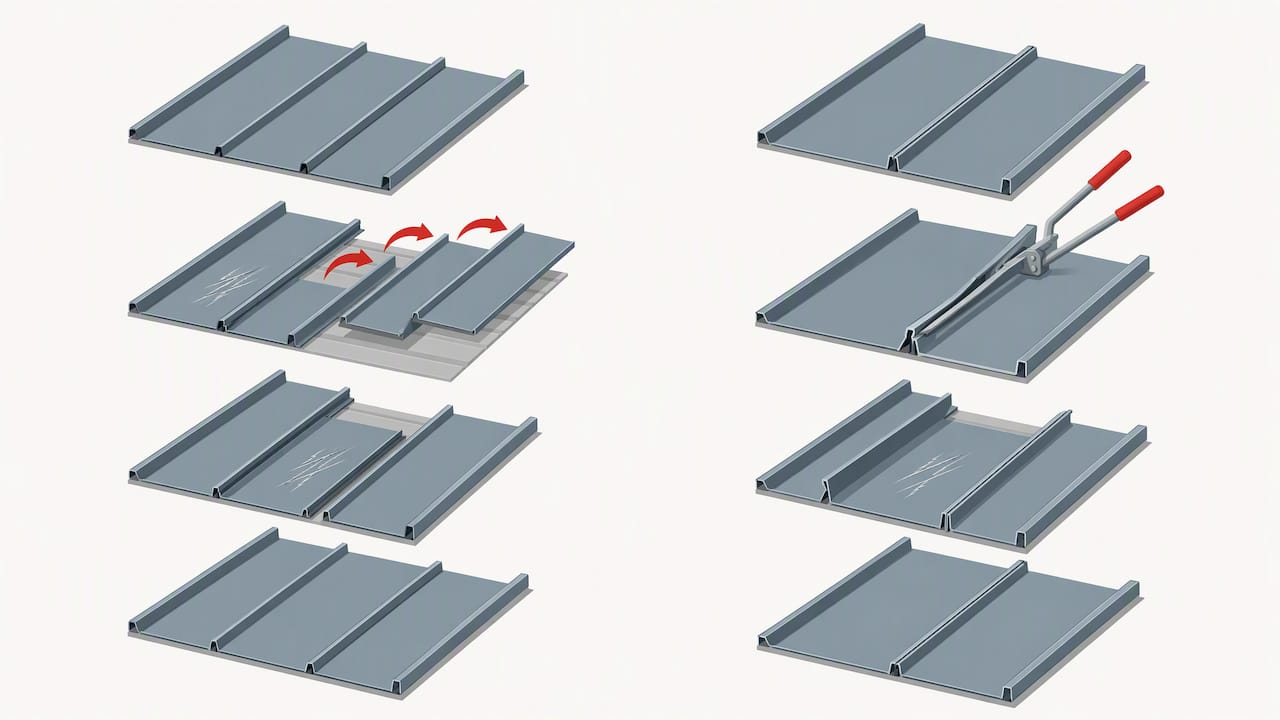
Color matching a replacement
A new panel next to weathered ones can look different, especially on older roofs. If the roof has been in service, read about causes of color variation in metal roof panels before you promise an invisible fix. On a brand-new job, ordering replacements from the same coil lot as the original panels, where possible, gives the best chance of a match. Pull the color name and finish from the original order before you call.
Add scratches to the punch list
Scratched panels are a standard closeout item, along with missing screws, bent flashing, oil-canned panels and cleanup. A Metal Construction News piece on metal roofing punch lists lists items such as whether metal shavings were cleaned daily to prevent premature rusting, which is the same debris issue that causes scratch-adjacent staining.
A useful punch list entry is specific. Write the location (slope, panel number counted from a fixed edge, elevation), the condition (coating breach at 14 inches, 6 inches from the eave), the required correction (prime and touch up, or replace the panel) and who signs off. A vague line such as “fix scratches” invites a second walk.
A simple sequence works on most jobs:
- Do a pre-installation check of delivered panels and note any shipping marks the day they arrive, before they go up.
- Do a mid-job check on a completed slope while the crew is still on site.
- Do a final inspection from the roof and from the ground, with the owner’s representative if possible.
- Record each item, assign it, and photograph it complete.
Get the owner’s or builder’s acceptance of any touch-up in writing at that stage. If a scratched panel might be part of a larger damage event, such as a storm, the way cosmetic versus functional damage is assessed on metal surfaces can matter for claims. A guide on hail damage on metal surfaces explains how that distinction is approached.
Prevent the scratches in the first place
The technical bulletin cited above stresses that the best repair strategy is to avoid the damage. Most scratches happen between the truck and the roof, not after.
- Protect edges during lifting. Use edge guards and proper lifting equipment so straps and slings don’t bite into long panels. Our article on crane lifts for metal panels covers how to protect finishes and reduce the number of lifts.
- Unload with a plan. Panel length, stacking and where the pack sits when the truck leaves all decide how much handling the panels take. See our notes on unloading metal panels.
- Keep the roof clean. Sweep or blow off screws, drill shavings and swarf at the end of every shift. Metal debris rusts and stains.
- Mind foot traffic. Soft-soled shoes, no dragging tools or ladders across panels, and a plan for where materials are staged.
- Keep dissimilar metals apart. Contact with certain metals causes staining and corrosion that look like damage. Read about preventing dissimilar metals corrosion.
- Cut away from finished panels. Do any field cutting off the roof, or on a protected surface, so hot particles don’t embed in the paint.
Our perspective: the fix starts at the order
We supply standing seam panels to contractors, and the scratches we hear about most come from handling, not from the roof’s life after installation. Our view is that the cheapest scratch is the one that never shows up on a punch list.
That is part of why we sell custom-length panels. When panels are cut to the run, crews handle fewer pieces, do less field cutting, and leave less cut-off waste and fewer metal shavings on the finished surface. Delivered to the job site in the lengths you asked for, panels go from the truck to the slope with less shuffling. We also coordinate trim and flashing packages with the panels, so the finish and color on the small pieces match the field panels rather than being a late substitute.
Our practical advice for contractors:
- Inspect on delivery, and note any damage before the panels are signed for and installed.
- Decide your replacement policy early. On a visible, dark or gloss finish, we’d lean toward replacing a badly scratched panel rather than painting it.
- Keep a record of the color and finish for every order, so a replacement can be ordered quickly.
- Don’t promise an owner a perfect touch-up. Promise a documented, accepted one.
— Matt Catino
Replacing a panel without losing the schedule
A single damaged panel shouldn’t stall a job for weeks. If you have to replace one, give the supplier the panel profile, gauge, color and exact length, and the panel’s position on the roof. Our panels come in 1-inch mechanical lock and 1.5-inch snap lock profiles in 24-gauge and 26-gauge steel, made with Englert metal systems. Naming the profile and gauge avoids a mismatch that wastes a delivery.
If the problem is a trim piece or a flashing, the same applies. Matching a scratched ridge cap or rake trim means matching the color and the gauge of the original. Our trim and flashing packages are made to go with the panels. For colors, our standing seam metal roof colors page is a quick reference for what you’re matching.
On a job where handling is the main risk, such as long runs, tight access or a roof with limited staging, it may make sense to bring the forming to the job. Our on-site roll forming service produces panels at the site, so there are fewer transport and lifting steps between forming and installation.
Need panels or replacements for a Mid-Atlantic job?
We work with roofing contractors, builders and general contractors in Virginia, Maryland, Washington DC, Pennsylvania and West Virginia. Our cut-and-drop delivery service brings custom-length standing seam panels to your site, and our contractor metal roofing supply page explains how to set up an order, including replacements for a panel that took a hit. See the full range on our standing seam metal roofing page.
Frequently asked questions
Can scratched metal be restored?
Minor scuffs in the paint can often be cleaned and left alone. A scratch that has breached the coating can be primed and touched up, but the repair won’t match the factory finish over time. If the damage reaches the substrate or sits on a prominent slope, a replacement panel is the more reliable restoration.
How do you touch up scratches on a metal roof?
Clean and dry the area, prime any exposed bare metal with an approved primer, then apply matching air-dry paint in thin coats with a fine brush or pen. Stay inside the scratch and don’t feather outward. Check the panel warranty and get the owner’s acceptance before you start.
Should I repair a scratch I can barely see?
Usually not. Guidance from a panel manufacturer says scratches not visible from roughly 6 to 9 feet in normal lighting generally shouldn’t be repaired, because the touch-up can end up more visible than the scratch. Clean the area, log it with a photo, and move on.
How do I know a scratch is deep enough to matter?
Run a fingernail across it. If it catches, or you see a gray or silver line where primer or bare metal shows, the coating is breached. That exposed metal needs protection or a replacement panel.
Who decides whether a field repair is acceptable?
The project owner or engineer. The MCA’s guidelines leave acceptance of field-applied touch-up to them, so ask for their sign-off in writing at closeout.
Sources
- Panel Repairs, Technical Bulletin Vol. 13.1
- Application Guidelines for Field-Applied Touch-Up Paint Systems on Metal Panels, Metal Construction Association
- Metal Roofing Punch Lists, Metal Construction News