OSHA 1910 vs 1926: Which Standard Applies on a Roof

OSHA 1910 covers general industry and 1926 covers construction. Learn which one governs roofing crews, fall protection, and hazards no standard names.
OSHA 1910 is the general industry rulebook. OSHA 1926 is the construction rulebook. If your crew is building, altering or repairing a structure, including a metal reroof, Part 1926 is the one that governs the work, and Part 1910 matters mainly where 1926 points to it or says nothing. The line between them follows the activity your employees are doing, not the name on your truck.
This guide is for roofing contractors, builders and general contractors who order and install standing seam panels. It explains how the two parts relate, what that means for fall protection on a roof, and how building codes (IBC and IRC) fit in, since they are a separate system that people often confuse with OSHA.
TL;DR
- Part 1910 covers general industry. Part 1926 covers construction, and it governs when the work is construction, alteration or repair.
- Roofing contractors follow 29 CFR 1926, including Subpart M for fall protection. Low-slope roofs (4:12 or less) fall under §1926.501(b)(10), steep roofs under §1926.501(b)(11).
- Fall protection generally starts at 6 feet above a lower level.
- A hazard with no specific 1926 standard can still be enforced under the General Duty Clause, Section 5(a)(1) of the OSH Act.
- OSHA is a worker-safety system. IBC and IRC are building codes enforced by your local building department. They are not interchangeable.
Table of Contents
- What each part actually covers
- How OSHA decides what counts as construction
- Citing 1910 on a construction site
- What happens when no 1926 standard fits
- Roofing under 1926: fall protection is the main event
- Where our perspective comes in
- Order materials that match your site plan
- Do not confuse OSHA with the building code
- A practical checklist for a standing seam job
- FAQ
- Sources
What each part actually covers
29 CFR Part 1910 holds the occupational safety and health standards for general industry: factories, warehouses, shops, and the permanent operations of a building. Part 1926 sets out safety and health standards for construction, and OSHA reprinted the applicable general industry standards inside it so a construction employer has one place to look.
That reprinting was not recent. OSHA incorporated the applicable 1910 standards into Part 1926 on June 30, 1993, so employees doing construction work are governed by the construction regulations. If you have an old habit of hunting through 1910 for ladder, hand tool or PPE rules on a job site, you will usually find a 1926 counterpart.
| OSHA 1910 | OSHA 1926 | |
|---|---|---|
| Name | General industry | Construction |
| Typical workplace | Plants, warehouses, fixed facilities | Job sites: new work, alterations, repairs |
| Fall protection | Subpart D, walking-working surfaces | Subpart M |
| Head protection | §1910.135 | §1926.100 |
| Who it applies to | Employers whose employees do general industry work | Employers whose employees do construction work |
The key word is employees’ activity. A 1991 OSHA interpretation explains that general industry standards apply unless a specific standard for the ongoing activity preempts them, such as Part 1926 for construction or Part 1928 for agriculture. In practice, once the work is construction, Part 1926 takes over for that activity.
How OSHA decides what counts as construction
OSHA defines construction work in 29 CFR 1910.12(b) as construction, alteration, and/or repair, including painting and decorating. A 1996 interpretation confirms the definition reaches work on existing facilities as well as new construction. That matters for reroofing. Tearing off an old roof and installing new standing seam panels on an occupied building is repair or alteration, so it is construction.
The same interpretation stresses that the test looks at the activity itself rather than the type of company doing it. Three practical consequences follow:
- A facility’s own maintenance crew replacing a roof panel is doing repair work. Do not assume 1910 applies just because the employer runs a plant.
- A roofing company is not “general industry” in the yard and “construction” on the roof by label. Each employee’s activity at a given moment decides it. Shop and warehouse tasks can sit under 1910, while installation on the roof sits under 1926.
- A supplier delivering to the site is a different situation again. The standards attach to the employer of the employees exposed to the hazard.
If your operation straddles fabrication and installation, ask your safety consultant or your OSHA area office which activities fall where. The answer can differ task by task.
Citing 1910 on a construction site
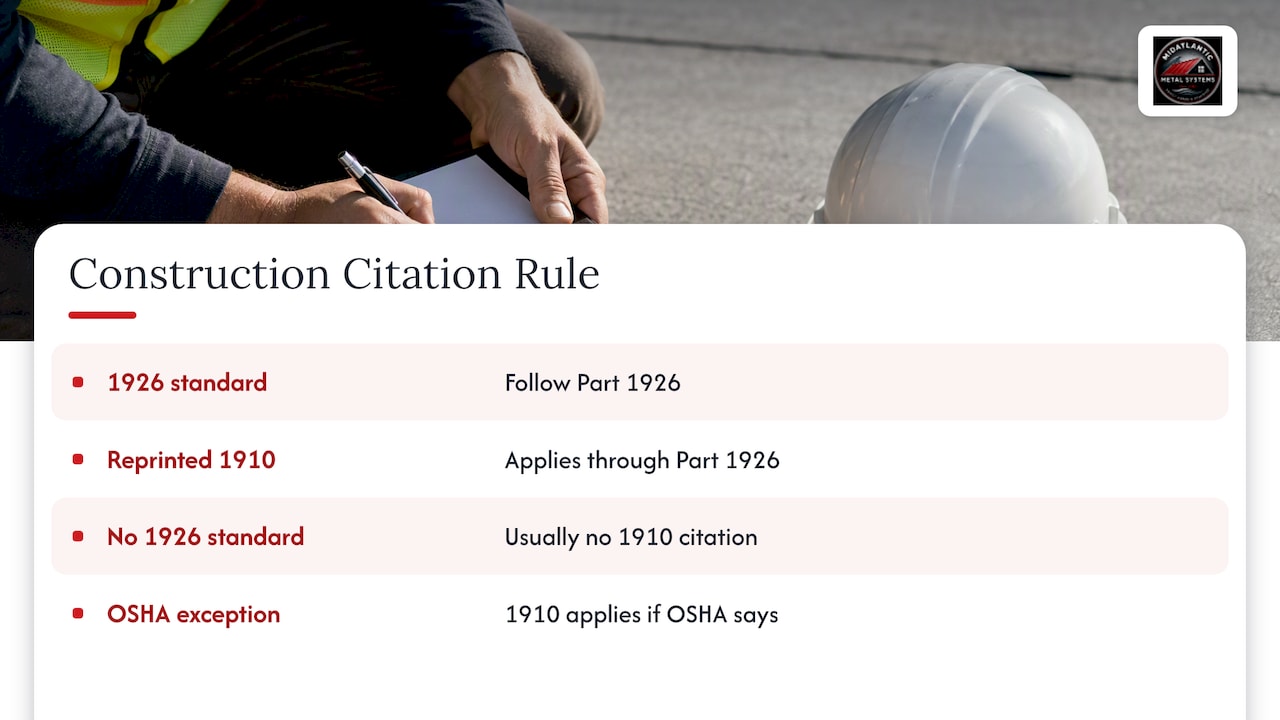
One top-ranking OSHA letter addresses this directly: hazards found in construction work that are not covered by a specific 1926 standard are not normally cited under 1910. The exception is where OSHA has said a 1910 standard applies to construction. So 1910 is not a free-for-all on your job site, but it is not irrelevant either. Where Part 1926 reprints a 1910 rule, you are following that rule through Part 1926.
What happens when no 1926 standard fits
Some hazards have no neat standard: a new tool, an unusual rigging setup, a heat or lightning exposure on an exposed roof deck. OSHA’s answer is Section 5(a)(1) of the OSH Act. Employers must provide a workplace free of recognized hazards that may cause death or serious injury, even when no OSHA standard addresses the situation.
For a roofing foreman that means “there is no rule against it” is not a defense. If a hazard is recognized in your industry and likely to cause serious harm, you are expected to deal with it. Write the control into your job hazard analysis.
Roofing under 1926: fall protection is the main event
Roofing contractors must comply with 29 CFR 1926, Subpart C and other applicable standards, and fall protection in Subpart M drives most day-to-day decisions. The split depends on pitch:
- Low-slope roofs, 4:12 or less: §1926.501(b)(10).
- Steep roofs, above 4:12: §1926.501(b)(11).
OSHA’s guide to fall protection says roofers working 6 feet or more above lower levels generally need fall protection. On low-slope roofs, §1926.501(b)(10) allows systems such as guardrails, personal fall arrest, or a combination of warning lines and monitoring. On roofs 50 feet or less in width, monitoring alone is permitted.
How do you know whether a roof is 50 feet wide or less? OSHA publishes non-mandatory guidance for that in Subpart M Appendix A on determining roof widths, meant to minimize areas protected only by a safety monitoring system.
Residential work and infeasibility
Residential construction can use other alternatives under §1926.501(b), or a site-specific fall protection plan when conventional systems are infeasible or create a greater hazard. Do not read that as a loophole. A 2002 OSHA interpretation limits these alternative procedures to wood-frame residential construction where the slope is 8:12 or less and the eave-to-ground fall distance is 25 feet or less. A steep metal roof on a custom home with a tall walkout elevation may fall outside that window, so confirm before you rely on it.
Other trades on your roof
Standing seam jobs often bring HVAC, solar or gutter crews onto the same surface. Their rules differ from yours. OSHA has said that HVAC installers cannot rely on a roofer’s 6-foot warning line. They may use a 15-foot line only under specified conditions, or conventional fall protection. A separate 2000 interpretation set out a de minimis policy for warning lines 15 feet or more from an edge for non-roofer trades, again with conditions. If you are the general contractor, brief every sub on what applies to them before they step onto the deck.
Hard hats on a roof
Head protection is a good example of 1910 and 1926 running in parallel. §1910.135 and §1926.100 do not require head protection when there is no risk of head injury, according to a 2014 OSHA interpretation, though employers may adopt a universal hard hat policy. Many contractors do, because overhead work from other trades is hard to rule out.
Where our perspective comes in
We supply architectural standing seam panels to contractors across Virginia, Maryland, Washington DC, Pennsylvania and West Virginia, and we see how material decisions touch safety on the roof. We are not OSHA consultants, and nothing here replaces your safety program. But here is how we think about it.
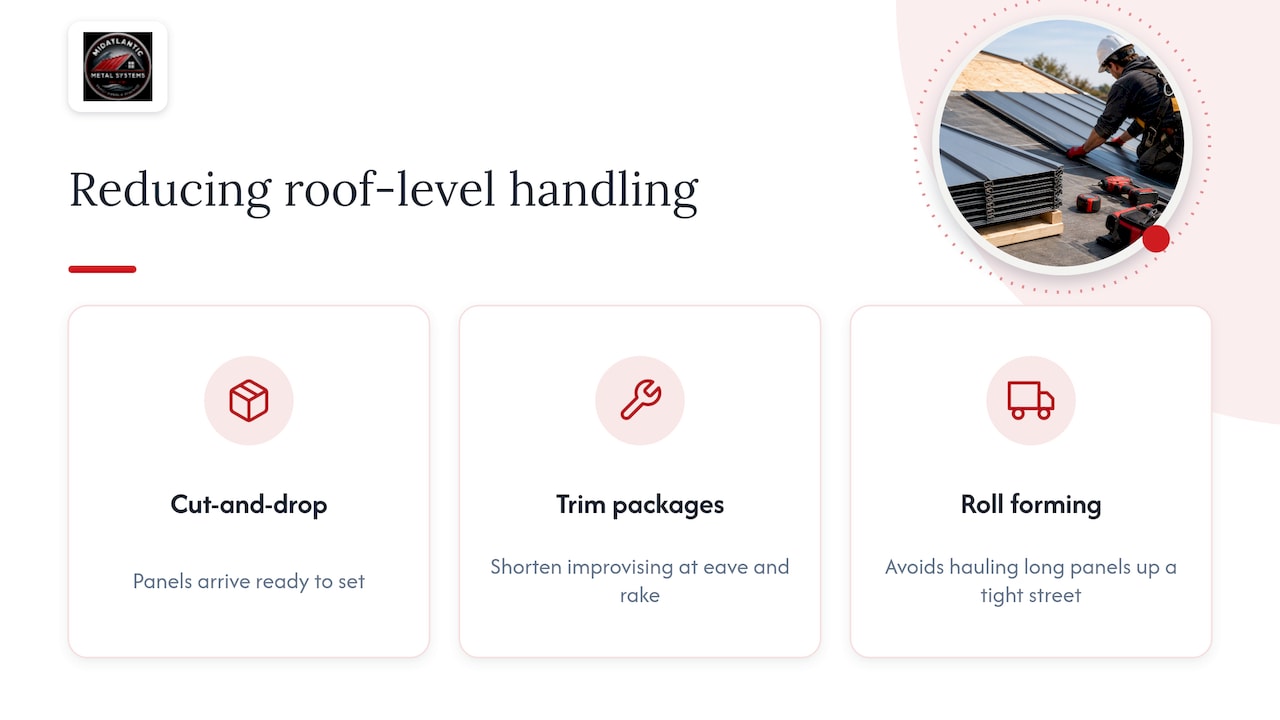
Cut-and-drop delivery changes what your crew handles. Panels cut to the exact length on your takeoff arrive ready to set, so there is less field cutting, less scrap to carry off a roof, and fewer trips with sheet metal across an edge. Coordinated trim and flashing packages shorten the time workers spend improvising details at the eave and rake, which is where exposure tends to be highest. For long runs or hard-to-access sites, on-site roll forming can keep long panels from being hauled up a tight street or over a fence.
The common thread: reduce handling at height. Plan your fall protection around the actual slope, roof width and crew mix, and order your material so the work on the roof is as short as possible.
— Matt Catino
Order materials that match your site plan
If you are scheduling a standing seam job, the fewer surprises on delivery day, the easier it is to run a safe crew. We make 1-inch mechanical lock and 1.5-inch snap lock standing seam panels from Englert systems in 24-gauge and 26-gauge steel, cut to your lengths and delivered to the job site through our cut-and-drop service. Trim and flashing can come as a matching package, and contractor supply support covers takeoffs for roofing and construction professionals.
Send us your takeoff and the delivery site, and we will coordinate panels and accessories so the material arrives when your crew is ready for it.
Do not confuse OSHA with the building code
The other query that follows this topic is IBC vs IRC. These are not OSHA standards at all. OSHA regulates worker safety. The International Building Code and International Residential Code regulate how the finished building is designed and built, and your local building department enforces them.
| OSHA 1926 | IBC / IRC | |
|---|---|---|
| Purpose | Protect workers during construction | Set minimum requirements for the completed building |
| Enforced by | OSHA (or an OSHA-approved state plan) | Local authority having jurisdiction |
| Roofing content | Fall protection, PPE, hazard controls | Roof assembly, wind, fire, slope and underlayment requirements |
The IBC applies to buildings and structures generally. Under the ICC’s interpretations, detached one- and two-family dwellings and townhouses not more than three stories above grade plane, with a separate means of egress, are to comply with the IRC. A house typically follows the IRC. A commercial building, apartment block or larger structure follows the IBC.
For roofs, minimum roof assembly requirements sit in IBC Chapter 15, IRC Chapter 9, and IEBC Chapter 7, the last covering existing buildings. For a metal roof, the IBC side is where slope limits, underlayment and tested assemblies come up. We cover that in detail in our IBC metal roofing checks for contractors.
Which edition applies on your job
The model code is only a starting point. States and localities adopt specific editions and add amendments. The IBHS roof guide advises contacting the authority having jurisdiction, commonly the local building department, to learn local requirements and modifications. The same guide notes that most U.S. jurisdictions that adopt building codes have moved toward some edition of the ICC’s IBC or IRC.
An adopted code also does not pull in every other I-Code automatically. When the IBC is adopted, only the specifically referenced sections of other I-Codes are enforceable unless the other code is adopted on its own.
Before you pull a permit, check with the building department and confirm the adopted edition, the local amendments, and any wind or energy provisions. Our state guides cover the local angle for our region:
- Maryland metal roof code
- Virginia wind zones and tested roof assemblies
- Washington, D.C. roofing code
- West Virginia roof code
- Pennsylvania roof energy code
The same habit of checking the exact local rule applies to code changes elsewhere. A contractor working across jurisdictions might look at how local building code updates are explained for contractors in another city, and ask the same question at home: what did our jurisdiction adopt, and what is different?
A practical checklist for a standing seam job
- Classify the work. Reroof, new build or repair? All are construction, so plan under Part 1926.
- Measure slope and width. Pitch above or below 4:12 decides between §1926.501(b)(11) and (b)(10). Width decides whether monitoring alone is even a candidate.
- Check the 6-foot trigger and every edge. Include skylight openings, hatches and the eave line where panels are staged.
- Brief other trades. Their warning line distances and conditions are not yours.
- Document a hazard analysis for anything unusual, since the General Duty Clause covers hazards no rule names.
- Confirm the code and permit path with the local building department: IBC or IRC, which edition, which amendments.
- Order panels, trim and flashing together so details are not field-improvised at height.
- Keep your equipment records current. Harnesses, lanyards and ladders need inspection. For one view on structuring that work, see this overview of OSHA equipment inspection requirements.
FAQ
Does OSHA 1910 apply to construction sites at all?
Not as the primary rulebook. Where work is construction, alteration or repair, Part 1926 governs, and OSHA reprinted the applicable general industry standards inside it in 1993. Some 1910 rules still matter where 1926 incorporates them or where OSHA has said a 1910 standard applies. When in doubt, ask your OSHA area office.
What is the OSHA fall protection height for roofers?
Generally 6 feet or more above a lower level. Low-slope roofs (4:12 or less) fall under §1926.501(b)(10) and steep roofs under §1926.501(b)(11). Residential work and infeasibility situations have specific alternatives, so read the standard and the interpretation that fits your project.
What if my hazard is not in 1926?
You can still be cited. Section 5(a)(1) of the OSH Act, the General Duty Clause, requires a workplace free of recognized hazards likely to cause death or serious injury. Treat the hazard as covered and write the control into your plan.
Is the IBC the same as OSHA 1926?
No. OSHA 1926 protects workers while they build. The IBC and IRC set minimum standards for the finished building. Houses generally follow the IRC and larger buildings the IBC, and your local building department confirms the adopted edition.
Sources
- eCFR: 29 CFR Part 1926, Safety and Health Regulations for Construction
- OSHA interpretation: Contractors and the criteria for applying the Construction Standards (1996)
- OSHA interpretation: Application of the OSHA standards 1910 and 1926 (1991)
- OSHA: Protecting Roofing Workers
- OSHA: Fall Protection in Construction
- OSHA: 1926 Subpart M Appendix A, Determining Roof Widths
- OSHA interpretation: Fall protection requirements for roofing work in residential construction (2002)
- OSHA interpretation: Fall protection for employees other than roofers (2002)
- OSHA interpretation: Acceptable use of warning lines (2000)
- OSHA interpretation: Use of hard hats on roofs in hot weather (2014)
- ICC: 2015 Code Interpretations
- IBHS: Roof Guide, Codes and Standards
- OSHA equipment inspection requirements overview
- Building code updates for contractors